
















Cheat or Repeat
What Is Cheat or Repeat?
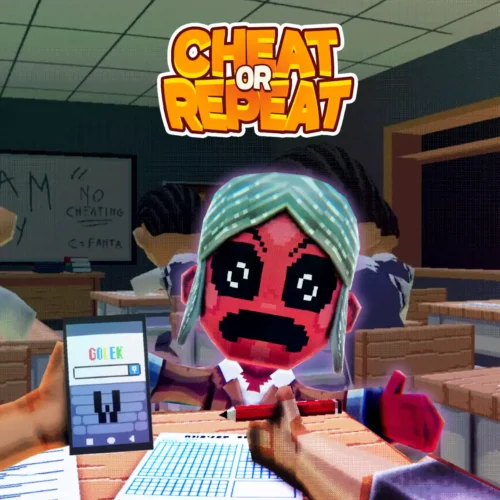
Cheat or Repeat is a free indie horror stealth game set entirely inside an exam room. You are a student who did not study. The test is in front of you. The only way through is to secretly use your phone to find the answers — while a teacher patrols the classroom and watches for exactly that.
Get caught once and the exam ends immediately. No warnings, no second chances. The title is exactly what it says: cheat successfully and pass, or repeat the year.
The horror here is not jump scares. It is the sustained, claustrophobic pressure of doing something you should not be doing while someone watches for it — a feeling that turns a simple pixel-art classroom into one of the most tense browser games available. No download, no account required.
How It Works
You sit at a desk with an exam paper in front of you. Ten multiple-choice questions. Ten minutes. Roughly one minute per question on average — enough time if everything goes smoothly, not enough if you hesitate.
The correct answers are not on the paper. They are on your phone. Press the spacebar to pull out the phone, type the displayed letters to fill the search bar, and the answer appears. Return to the exam, select the right option, and move to the next question. Do this ten times without the teacher noticing and you pass.
The problem is the teacher. They patrol the room continuously. Looking at your phone while they face you ends the run instantly. Reading the room — knowing where the teacher is, which direction they are walking, and whether you have enough time to check your phone and put it away safely — is the entire game.
Controls
| Input | Action |
|---|---|
| Spacebar | Pull out phone / put phone away |
| Type letters | Fill the phone search bar to look up the answer |
| Mouse | Look around the room and select exam answers |
The controls are minimal. The skill is entirely in the decision of when to use them — specifically when to press spacebar and when to press it again to put the phone away.
The Three Teachers
The game runs across multiple exam days and each day introduces a different teacher, progressively harder to avoid.
The Audio System — Why Silence Is the Most Dangerous Sound
Footsteps are your primary warning signal. When you can hear the teacher walking, you know they are moving and roughly how close they are. Louder footsteps mean closer proximity.
Silence is the signal most new players misread. When the footsteps stop, the instinct is to relax — the movement has paused. The reality is the opposite. Silence often means the teacher has stopped moving because they are watching you. Silence while your phone is out is the highest-risk state in the game.
Do not wait to confirm whether the teacher is watching before hiding your phone. If the footsteps cut out and you are holding your phone, the safe move is always to put it away first and look around second. The cost of an unnecessary phone hide is a second or two of delay. The cost of waiting to confirm is the end of the run.
Visual Warnings You Should Not Ignore
Cheat or Repeat uses visual distortions as a secondary warning system. Screen glitches, flickering, and unusual visual effects are not random aesthetic choices — they are signals that the teacher’s attention is on you or that a suspicious action is building your exposure meter.
Most players dismiss these effects as style on the first few attempts. They are not. Treating every visual anomaly as an instruction to reduce exposure — put the phone away, look at the paper, stop any suspicious action — prevents the slow accumulation of suspicion that ends runs the player did not expect to lose.
The Right Way to Think About Risk
Most players who die repeatedly ask themselves: “Can I check my phone right now?” This is the wrong question. By the time the answer seems obvious, the risk has usually already arrived.
The better question is: “Can I put my phone away safely if the teacher turns toward me?” If the answer is no — if the teacher is too close, too unpredictable, or if the sound cues have gone quiet — then starting the phone check is already too late.
Short, controlled phone checks with a clear exit plan produce consistently longer runs than long, efficient ones that leave no recovery window.
Learning Teacher Patrol Patterns
Teachers in Cheat or Repeat do not move completely randomly. Each one has a patrol route that, while not perfectly fixed, follows tendencies that repeat across runs. A teacher who regularly passes the left side of the room and then pauses near the window before turning back will do roughly that again — not always, but often enough to predict.
The first attempt on any new day should be treated as a scouting run. Watch the patrol. Identify the longest window where the teacher’s back is turned. Plan your phone check around that window. Runs that begin with observation produce better outcomes than runs that begin with immediate action.
Similar Games You Will Like
Frequently Asked Questions
Cheat or Repeat achieves something genuinely difficult — it creates real psychological tension out of a classroom exam without a single jump scare or scripted horror moment. The pressure comes entirely from the mechanic: you are always doing something you should not be doing, and the teacher is always looking for exactly that.