







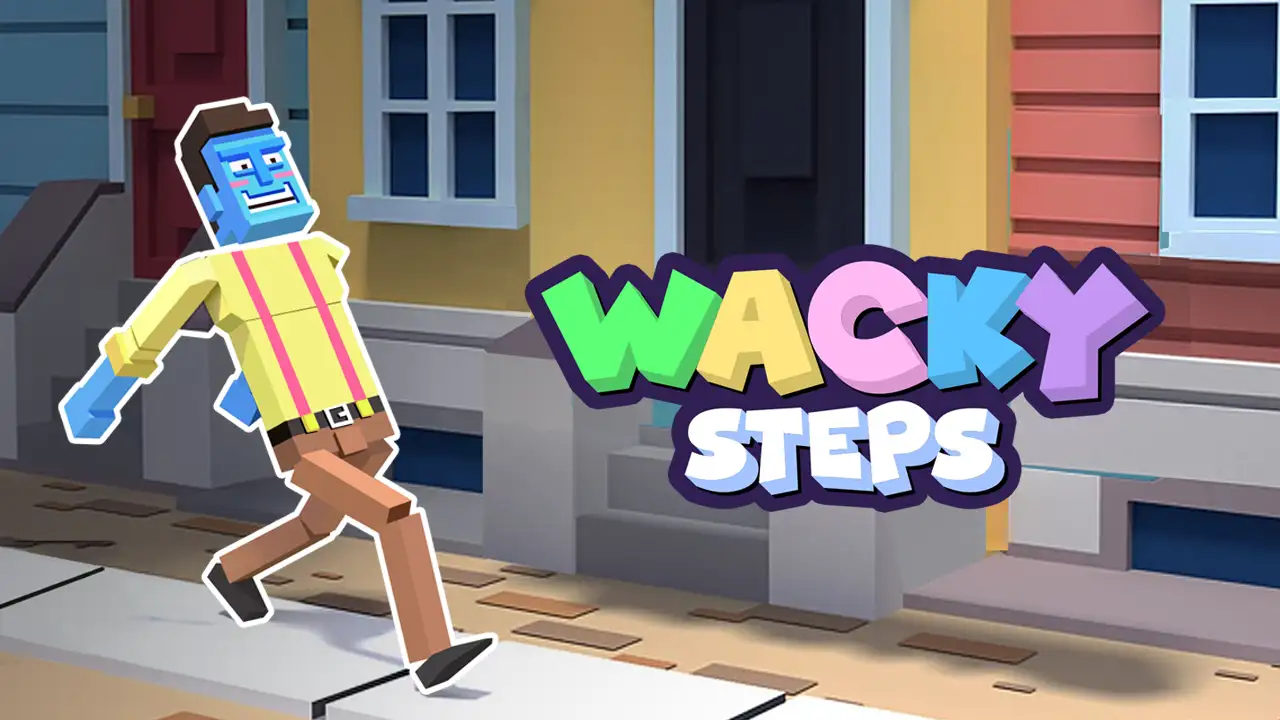
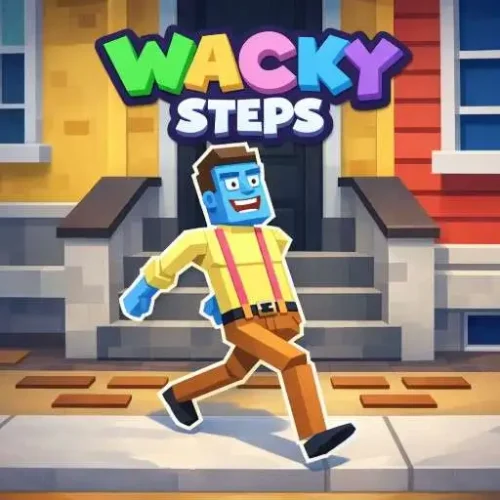







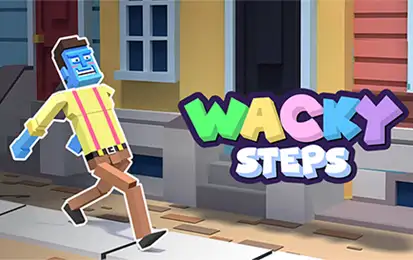
You walk. That’s it. But your ragdoll character is perpetually off-balance, the sidewalk has cracks that end your run instantly, and every step’s length depends on how long you hold the click. The goal is simple — walk as far as possible — and somehow that’s enough to make this addictive.
Wacky Steps is a 3D physics-based walking game built in HTML5, released around late March to early April 2026. It’s free to play in browser on desktop, tablet, and mobile with no download. The game is explicitly inspired by the mobile game Steppy Pants — Miniplay’s description recounts the developer noticing themselves instinctively avoiding sidewalk cracks and building a game around that habit.
| Feature | Details |
|---|---|
| Released | Late March – early April 2026 |
| Inspired by | Steppy Pants (mobile game) |
| Technology | HTML5, 3D ragdoll physics |
| Core mechanic | Click/tap and hold — hold length determines step length |
| Fail condition | Stepping on a crack, or losing balance and falling |
| Progression | Coins from runs unlock characters, outfits, and environments |
| End condition | None — endless, escalating difficulty |
| Platform | Browser (desktop, tablet, mobile) — free, no download |
Contents
Controls
| Action | Input |
|---|---|
| Take a step | Click (desktop) or Tap (mobile) |
| Short step | Quick click/tap |
| Long stride | Hold click/tap longer |
That’s the entire control scheme — one input, variable duration. Steps alternate automatically left-right-left-right with each click; you don’t choose which foot moves. The skill is entirely in hold duration: a quick tap produces a short, stable step, while holding longer produces a long stride that can clear bigger gaps but is far more likely to throw your character off balance.
The Step Mechanic
The official description frames this clearly: “Short tap = small, safe step. Long hold = risky long stride.” Your character’s ragdoll body means even a “safe” short step carries some wobble — there’s no perfectly stable state, only degrees of risk. The game is built around instability as its core feeling, not as an occasional hazard.
This creates a genuinely different rhythm from most endless runners, which are built around speed. Wacky Steps inverts that: going fast (long strides) increases your fall risk on every single step, while going slow (short steps) is safer but covers less ground per click and may not clear wider gaps or hazards. The tension between distance-per-step and stability-per-step is the entire game.
Hazards
The primary hazard is cracks in the sidewalk — stepping directly into one ends the run immediately. As you progress, additional hazard types appear: explosive tiles and moving obstacles, confirmed by Wacky Flip’s description. The game also features multiple environmental themes across different game modes, each presumably introducing different hazard layouts even though the core step mechanic stays the same.
Difficulty is endless and escalating — there is no finish line. The longer a run goes, the denser and more varied the hazards become, meaning the skill ceiling isn’t really about learning a fixed pattern but about maintaining consistent step-timing decisions under increasing visual clutter.
Coins and Unlocks
Coins are collected during runs and spent on new characters, outfits, and environments — confirmed by Hot Games. These are confirmed as the primary unlock categories. The official 1Games.IO listing also promises “Tons of costumes and characters to unlock,” consistent with the coin-based unlock system described elsewhere.
Tips
▸ Default to short steps — only go long when you have to
This is the game’s own stated rule, and it’s correct: “Short steps are your default. Don’t go for long strides unless you really need to. Overstriding is the #1 reason you fall.” The temptation to hold longer for faster progress is exactly the instinct that ends runs early. Reserve long strides specifically for moments where a gap or hazard requires the extra reach.
▸ Play by rhythm, not by reaction
The official guidance frames this as staying calm and timing steps to the road’s rhythm rather than panic-clicking. A steady, predictable click cadence produces more consistent step lengths than rapid, anxious clicking — which tends to produce erratic hold durations and unpredictable step results.
▸ Look one hazard ahead, not at your current step
The official tip: “Don’t just watch the step you’re taking now. Scan for cracks, cars, or obstacles ahead.” By the time a hazard is directly in front of your character, it’s often too late to adjust the current step’s timing. Planning the next 1-2 steps while executing the current one gives the reaction time needed for hazards that require a longer stride to clear.
▸ When in doubt, take the failure for the laugh and restart fast
Wacky Flip’s description notes that falls happen “in a funny way, which makes each attempt less frustrating.” The game is designed around quick restarts — there’s no meaningful penalty structure beyond the run ending, so treating each fall as a fast restart rather than a setback matches the game’s intended pace.