
















Flipping Master
What Is Flipping Master?
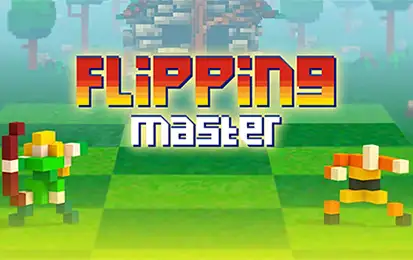
Flipping Master is a free pixel art arcade survival game set in a vibrant jungle. Your hero moves across a tile-based environment in one specific way: diagonal hops, either left or right. Every jump covers three consecutive tiles in that direction. Your health bar drains continuously from the moment the round starts. The only way to restore it is to land directly on enemies. Touch a spike or a trap and the run ends instantly.
Three interlocking mechanics — diagonal-only movement, constant health drain, and enemies as the health source — produce a game that forces you to stay aggressive and precise simultaneously. You cannot play it safe by standing still. You cannot move randomly and survive either. Every hop needs a reason: an enemy to land on, a coin to collect, a path through the obstacles that keeps the health bar from emptying before the next enemy appears.
Each round begins instantly. Scores are based on distance travelled, enemies defeated, and combo chains. No download, no account. Plays free in any browser on desktop, tablet, and mobile.
The Diagonal Movement System
Most arcade games let you move in four directions. Flipping Master uses two. Pressing A sends your hero on a diagonal hop to the lower-left. Pressing D sends them diagonally to the lower-right. Each hop spans three consecutive tiles in that direction. That is the entire movement vocabulary.
What sounds like a limitation becomes the game’s defining challenge. Because you can only go diagonally left or right, the path through any given screen is not “move where you want.” It is “figure out the sequence of diagonal hops that reaches the enemies without hitting the spikes, given that you can only go in these two directions.” The planning element is genuine. A path that looks navigable forward often is not — until you trace the specific diagonal sequence that makes it work.
Controls
| Input | Action |
|---|---|
| A | Hop diagonally left — covers three tiles in that direction |
| D | Hop diagonally right — covers three tiles in that direction |
| Touch left / right (mobile) | Same as A and D — tap the left or right side of the screen |
Two keys. Three tiles per hop. The challenge is entirely in the sequence and timing of those two inputs rather than in managing a complex control scheme.
The Three Mechanics That Define Every Run
The Ultimate Meter
Eliminating enemies builds a super meter alongside your score. When the meter reaches its threshold, an ultimate ability becomes available. The game specifically recommends using it as an escape tool — saving it for moments when the path ahead is dense with traps and no clear bop-route to health, rather than using it as pure damage output when things are already going well.
This is one of those design notes that is easy to dismiss and frustrating to rediscover after doing the opposite. An ultimate ability used during a comfortable stretch provides minimal benefit because the run was already going fine. An ultimate used in a screen where the spike layout seems impossible to navigate through diagonally is potentially a run-saving decision. Save the meter. Use it when you genuinely cannot see a way through.
The health drain creates pressure that feels like it demands constant fast movement. Experienced players resist this. Controlled, deliberate hop timing — looking one or two tiles ahead before committing to a direction rather than just alternating A and D reflexively — produces more accurate landings, fewer accidental spike touches, and more enemy bops per screen. The game rewards players who have the discipline to move with intention rather than speed. Panic movement shortens runs. Deliberate movement extends them.
Coins vs Enemies — The Risk Calculation
Coins appear throughout the jungle alongside enemies and traps. Collecting them adds to your score and feeds long-term progression toward treasure chest unlocks and rewards. The temptation is to grab every coin visible.
The correct prioritisation, as the game itself notes, is enemies over coins. Here is why that matters mechanically: a coin collected provides score. An enemy bop provides score and health restoration. When the health bar is under pressure — which is always, because it drains constantly — the enemy bop is worth more than the coin pickup in almost every calculation. A coin that sits beside a trap on a diagonal that also routes away from enemies is a coin to skip. The run survives longer without it than with it.
Combo Chains — How Score Accumulates
Scoring in Flipping Master runs on three inputs simultaneously: the distance your hero travels, the number of enemies defeated, and the combo chain maintained. Chains build when enemy bops happen in quick succession without breaking contact — consecutive eliminations without a non-enemy landing in between multiply the score value of each subsequent bop.
A combo chain that reaches high multipliers is the difference between a modest score and a leaderboard-relevant one. Building chains requires reading the enemy layout ahead and planning diagonal sequences that bounce from one enemy to the next without the chain-breaking interruption of an empty tile or a coin. The combination of health management and combo optimisation is where the game’s depth lives for players who push past the early runs.
The Pixel Art Jungle Setting
The vibrant pixelated jungle backdrop runs across all Flipping Master’s environments. The visual style is bright and readable — a deliberate design choice given that the gameplay depends entirely on parsing the tile layout quickly. Enemies, spikes, coins, and empty tiles need to be visually distinct at a glance, and the pixel art style achieves this cleanly. Characters are expressive and movement feels snappy despite the constrained movement vocabulary.
Tips for Longer Runs
- Always look where your diagonal will land before pressing. Three tiles is a significant hop. Pressing A or D without confirming the landing tile is clear of traps is how most early runs end. A half-second of visual confirmation before each hop costs almost no time and prevents a large proportion of spike deaths.
- Prioritise enemies over coins, always. Health is the resource the game is built around. Enemies restore it; coins do not. When choosing between a coin route and an enemy route, the enemy wins unless the health bar is full and the coin is directly on the enemy’s diagonal path anyway.
- Save the ultimate meter for impossible screens. If you can see a clear enemy bop path through the current screen, you do not need the ultimate. Save it for the screen where every diagonal seems to land on a spike and the health bar is nearly empty. That is the correct moment.
- Plan enemy chains two or three bops ahead. Combo chains build through consecutive enemy bops. Reading the next two enemies after the current one — and planning the diagonal sequence that links all three — produces significantly higher scores than landing one bop at a time reactively.
- Move deliberately, not quickly. The health drain creates the illusion that speed is the answer. Deliberate, planned hops produce more enemy bops per screen than fast reflexive ones because they land more accurately. The enemy bops restore more health than the drain costs for that brief extra moment of thinking. Pace is the skill.
Similar Games You Will Like
Frequently Asked Questions
Flipping Master earns its arcade credentials by taking three simple mechanics — diagonal-only movement, constant health drain, enemies as health — and combining them into something that demands genuine strategic thinking rather than pure reflex. The diagonal constraint forces path planning. The health drain forces aggression. The enemy-as-health system makes aggression the same as survival.