






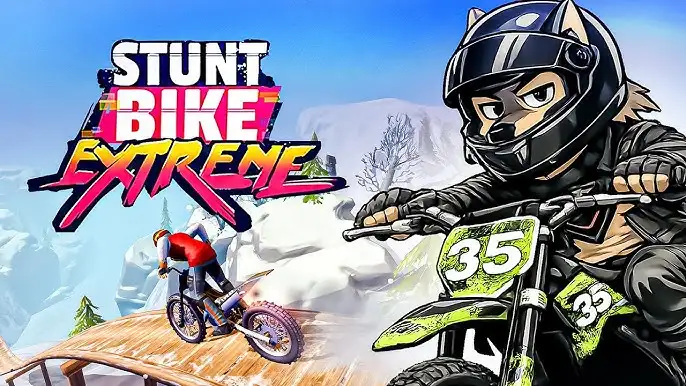







You ride a motocross bike through obstacle courses, lean to keep balance, and perform flips off ramps to earn EXP — all while beating the clock for a better star rating.
Stunt Bike Extreme is developed by Hyperkani, released in August 2024. It runs free in browser via WebGL on PC, tablet, and mobile, with separate apps on iOS, Android, and Steam. The same developer made Stunt Car Extreme and Stunt Car Challenge 3. The browser version has received ratings from over 250,000 players with a 4.2/5 overall score.
Contents
Controls
| Action | Keyboard | Mobile |
|---|---|---|
| Accelerate | Up Arrow | Pedal icon (on-screen) |
| Brake / reverse | Down Arrow | Pedal icon |
| Lean / flip left | Left Arrow | Flip icon (bottom left) |
| Lean / flip right | Right Arrow | Flip icon |
| Reset | R | — |
| Menu | Esc | — |
Left and right arrows serve two purposes depending on whether you’re grounded or airborne. On the ground they lean the bike, which shifts weight for ramp approaches and recovery from bad landings. In the air they rotate the bike for flips. You don’t switch modes — the same keys do both, which means input that feels natural on flat ground can over-rotate a jump if applied at full speed off a ramp.
Levels and Environments
The game has over 270 levels plus bonus tracks beyond that count. The Steam version has been reviewed as having 400+ levels — the browser and mobile versions may vary. Each level is rated by 1 to 3 stars: one star for finishing the course, two for finishing quickly, three for a fast and clean run.
Confirmed environments include jungles, warehouses, junkyards, mountains, factories, floating platforms, deserts, and rooftops. Each environment has different obstacles, terrain angles, and ramp types that change what approach works. Hidden collectibles are placed throughout levels — collecting them often requires deliberate detours that add risk.
Stunts and Scoring
Flips earn EXP and chaining multiple different tricks on a single jump multiplies the score. The flip counter resets on landing, so back-to-back tricks during one airborne stretch give more return than single flips spread across multiple jumps. Coins and diamonds are earned by completing levels and used to upgrade the bike.
Star ratings are time-based. A finish at any speed earns one star — the second and third stars require progressively faster completions. A run focused on three-star times is often in tension with trick chaining, since detours for combo jumps add seconds to the clock.
Customization
The shop has two sides — bike and rider. For the bike, up to 100 paint options are available. Bike skins also unlock automatically as you level up, not through purchase — confirmed by Drifted’s review. For the rider, the shop contains helmets, outfits, and leg options across multiple pages. The rider shop items are purchased separately from bike skins.
Cosmetic choices don’t affect physics or performance. Bike upgrades that do affect performance — speed, handling — are funded by coins and diamonds from level completion.
Tips
▸ Use engine braking on difficult ramps, not full speed
This is Miniplay’s confirmed tip directly from the game’s own description: on harder extra tracks, braking just before a ramp sends the bike onto the downhill slope at a controlled angle rather than launching it wildly. Landing on the downhill face of the next slope preserves momentum for the following jump; overshooting into a crash wastes it entirely.
▸ Land on downhill slopes, not flat ground
A landing on flat ground or an uphill face absorbs all your speed and often sends the bike forward-flipping into a crash. Aiming for the downhill face of the next obstacle — the side closest to you — carries speed forward naturally. This applies even at low speeds; the angle of the landing surface matters more than landing softly.
▸ Chain flips on the same jump, don’t split them
Multiple tricks during one single airborne period multiply the EXP reward. Two tricks across two separate small jumps give less than two tricks on one large jump. When a ramp gives good height, commit to multiple rotations rather than landing early and repeating on the next opportunity.
▸ Use R to reset immediately after a stuck position
Getting the bike wedged against geometry — pinned between a wall and the ground, or nose-down on an obstacle — is a dead end that wastes time. Pressing R resets to the last checkpoint immediately. The time lost to the reset is almost always less than the time spent trying to reverse out of a stuck position.
▸ Lean forward on acceleration, back on landings
Holding forward while accelerating up a slope keeps the front wheel from lifting into a wheelie that slows you down. Switching to lean back on approach to a landing raises the front wheel and lets the rear absorb the impact first, which reduces crash risk on steep descents and keeps the bike upright through the landing.