







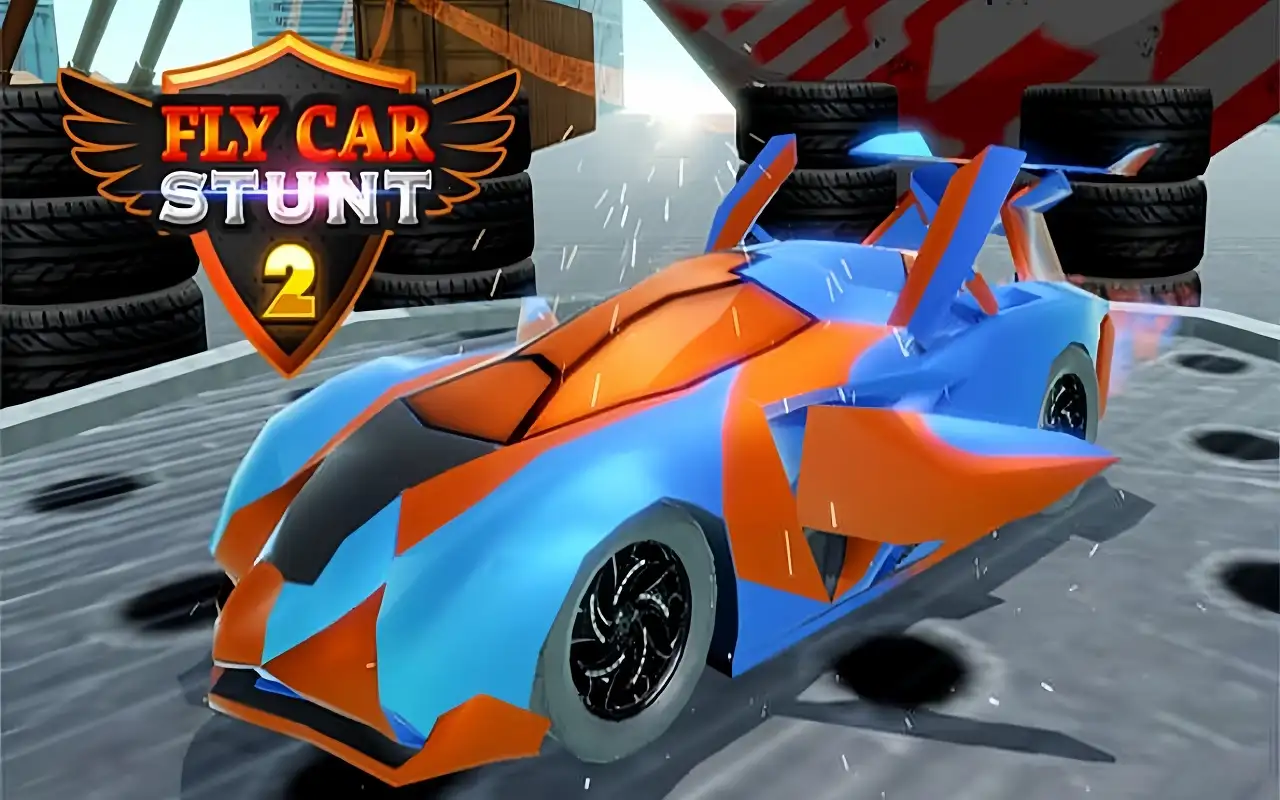





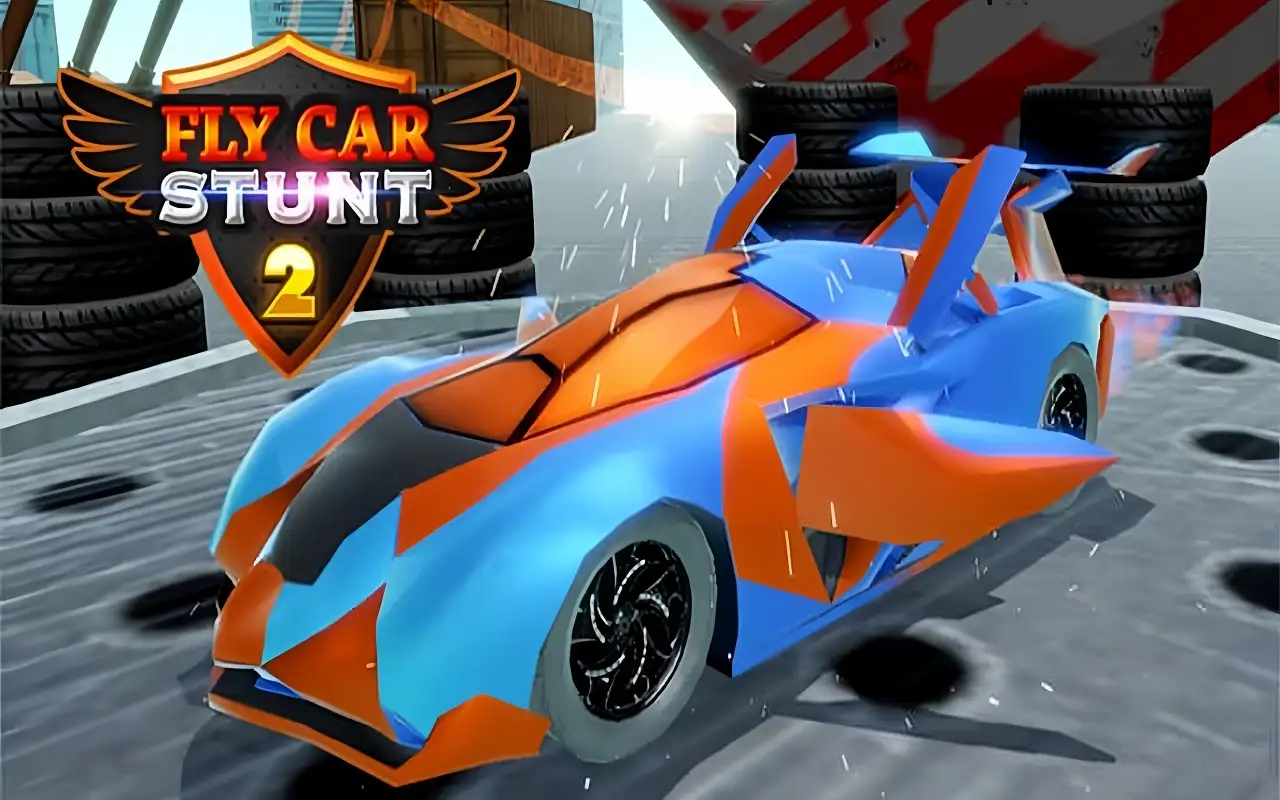
Fly Car Stunt 2 takes the traditional racing formula and throws it high above the clouds. Instead of driving on normal roads, players race futuristic wing-equipped vehicles across suspended sky tracks filled with deadly obstacles, giant gaps, moving hazards, and precision jumps. Developed as a sequel to the original Fly Car Stunt, this installment introduces improved flying physics, redesigned levels, better vehicle handling, and more challenging aerial sections.
While the game looks like a simple stunt racer at first glance, experienced players quickly discover that success depends on balancing speed, flight control, nitro management, and obstacle awareness. Whether you’re racing solo or competing against a friend in split-screen mode, Fly Car Stunt 2 offers one of the most unique browser racing experiences available.
What Is Fly Car Stunt 2?
Fly Car Stunt 2 is a 3D racing and flying game where players control futuristic vehicles capable of gliding through the air using deployable wings.
Unlike traditional racing games where staying on the road is the primary challenge, Fly Car Stunt 2 constantly forces players to transition between driving and flying. Large gaps separate sections of the track, meaning players must launch into the air and carefully guide their vehicle back toward the platform.
The game features:
- 12 unique levels
- Single-player mode
- Two-player split-screen mode
- Flying car mechanics
- Nitro boosts
- Dynamic obstacles
- Checkpoint progression
Each level becomes progressively more difficult, introducing tighter jumps, deadlier hazards, and more demanding flying sections.
About The Flying Physics
The biggest difference between Fly Car Stunt 2 and most racing games is that your car spends a large portion of each race airborne.
The wings are not simply visual effects.
They directly affect movement and survival.
When your car leaves the track:
- Wings deploy automatically.
- Air movement becomes critical.
- Vehicle angle affects distance.
- Nitro influences flight time.
Many beginners assume jumps are automatic.
In reality, controlling the car while flying often matters more than driving.
A poorly aligned landing can cost far more time than a slow takeoff.
Game Modes
Single Player
Single-player mode focuses on completing all 12 levels while mastering the game’s flying mechanics.
Each level introduces new obstacles and larger jumps, forcing players to gradually improve their control.
Two Player Mode
The game’s most popular feature is local multiplayer.
Two players race simultaneously on the same track while competing to reach the finish line first.
Unlike many racing games where opponents can recover easily after mistakes, a single missed landing in Fly Car Stunt 2 can completely change the outcome of a race.
Because of this, multiplayer matches remain competitive until the final checkpoint.
Controls
Player 1
- W, A, S, D = Drive
- T = Nitro
- Y = Change Camera
Player 2
- Arrow Keys = Drive
- P = Nitro
- C = Change Camera
General
- R = Restart Level
The Most Important Mechanic: Nitro Management
Most new players treat nitro like a speed boost.
Experienced players use nitro as a flight tool.
Nitro extends airtime and helps maintain altitude during long jumps.
Using nitro correctly allows players to:
- Reach distant platforms
- Recover from bad launches
- Correct poor trajectories
- Skip dangerous sections
The biggest mistake beginners make is activating nitro immediately after leaving a ramp.
Advanced players often wait until they begin losing altitude before activating it.
This creates longer, more efficient flights.
How To Control Your Car In The Air
Many guides tell players to “fly carefully.”
That advice is too vague.
The real goal is maintaining a stable flight angle.
When airborne:
- Nose too high = speed loss
- Nose too low = early crash
- Balanced angle = maximum distance
Small adjustments work better than aggressive steering.
Many crashes happen because players overcorrect during flight.
The best approach is treating the car like a glider rather than an airplane.
Understanding Checkpoints
One of the most important systems in Fly Car Stunt 2 is the checkpoint system.
Whenever players reach a checkpoint platform, progress is saved.
If you fall:
- You respawn at the previous checkpoint.
- Time is lost.
- Momentum resets.
Because of this, reaching checkpoints safely is often more important than taking unnecessary risks.
Many advanced players adopt a conservative approach before checkpoints and a more aggressive strategy afterward.
Things The Game Doesn’t Tell You
Landing Angle Matters More Than Jump Distance
A perfect jump can still fail if the landing angle is wrong.
Nitro Is Stronger During Recovery
Nitro often provides more value when correcting mistakes than when accelerating normally.
Camera Changes Can Improve Precision
Different camera views help during difficult aerial sections.
Flying Is Usually Safer Near The Center
Center alignment reduces the risk of clipping track edges.
Checkpoints Create Risk Windows
Once a checkpoint is secured, players can attempt more aggressive shortcuts.
Common Mistakes Beginners Make
Using Nitro Too Early
This often causes players to lose speed before reaching distant platforms.
Steering Too Much While Flying
Overcorrection is one of the most common causes of crashes.
Ignoring Landing Setup
Many players focus entirely on takeoff.
Rushing Obstacle Sections
Speed alone rarely solves obstacle-heavy areas.
Watching The Car Instead Of The Track
Strong players focus on upcoming platforms rather than their current position.
Understanding Obstacles
Fly Car Stunt 2 includes several hazards designed to punish careless driving.
Common obstacles include:
- Swinging sledgehammers
- Rotating saw blades
- Giant axes
- Electrical traps
- Spike hazards
- Narrow platforms
Each obstacle requires different timing.
Many levels are less about speed and more about choosing the safest route through hazard sequences.
Advanced Fly Car Stunt 2 Tips
Save Nitro For Large Gaps
Using nitro on straight sections often wastes its potential.
Keep The Vehicle Level
Balanced flight creates more consistent landings.
Learn Respawn Locations
Knowing checkpoint positions improves risk management.
Use Practice Runs
Many difficult jumps become easy after understanding the required launch angle.
Focus On Smoothness
Clean runs consistently outperform reckless speed-focused runs.
Two-Player Strategy Guide
Most multiplayer races are not won through pure speed.
They are won through consistency.
When racing against another player:
- Avoid risky shortcuts early.
- Prioritize checkpoint progression.
- Force opponents to take risks.
- Stay calm after mistakes.
Many multiplayer victories happen because one player survives while the other crashes repeatedly.
A clean run is often enough to secure a win.
Why Fly Car Stunt 2 Is More Challenging Than It Looks
The game constantly combines three separate skill sets:
- Racing
- Flying
- Platforming
Most racing games only require speed.
Most flying games only require navigation.
Fly Car Stunt 2 demands both simultaneously.
This combination creates a unique learning curve that keeps players returning even after completing all levels.
Similar Games You Might Enjoy
Frequently Asked Questions
How many levels are in Fly Car Stunt 2?
Fly Car Stunt 2 contains 12 levels that gradually increase in difficulty.
Can you play Fly Car Stunt 2 with friends?
Yes. The game supports local two-player split-screen racing.
What does nitro do?
Nitro increases speed and helps extend flight time during jumps.
Why do I keep falling off the track?
Most falls occur because of poor flight angles, excessive steering, or incorrect nitro timing.
Is Fly Car Stunt 2 harder than the original?
Many players consider the sequel more challenging due to improved physics, more complex tracks, and tougher obstacle layouts.
Final Thoughts
Fly Car Stunt 2 successfully combines futuristic racing, flying mechanics, and platforming challenges into a single experience. While beginners can enjoy the excitement of launching cars through the air, experienced players discover a much deeper game built around flight control, checkpoint strategy, nitro management, and obstacle mastery.
2 Player GamesRacing & DrivingUnblocked Games