









Blocky Rider
What Is Blocky Rider?
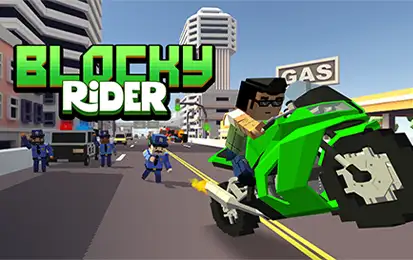
Blocky Rider is a free 3D voxel motorcycle game originally developed as Blocky Moto Racing by isTom Games, a Hungarian studio also known for Highway Traffic and Nyan Cat: Lost in Space. The browser version brings their polished mobile experience directly to your browser without any download or installation.
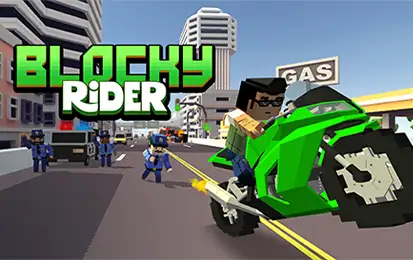
The game puts you on a motorcycle in a blocky city filled with cars, buses, trams, and trucks that change lanes without warning, brake suddenly, and chain-crash into each other in ways that become your problem. Three completely different game modes give it replay depth that goes beyond a straightforward traffic runner — because in one of those modes, you are actively trying to crash into everything rather than avoid it.
No upgrades, no power-ups, no stat bars to level. Everything in Blocky Rider comes down to skill alone, which is simultaneously the most honest and most demanding design choice the game makes.
Three Modes That Play Like Different Games
Most traffic games have one objective wrapped in slight variations. Blocky Rider has three modes that ask genuinely different things from the player — enough that your best skill set in one does not automatically translate to the others.
Controls
| Input | Action |
|---|---|
| W or ↑ | Accelerate |
| S or ↓ | Brake / reverse |
| A or ← | Steer left / lean left |
| D or → | Steer right / lean right |
| C | Switch camera perspective |
| On-screen arrows (mobile) | All movement — same inputs, touch-based |
The C key camera switch is worth using deliberately rather than just leaving on the default. Different camera angles give you more or less visibility of the road ahead — in dense traffic, a slightly pulled-back perspective gives earlier warning of lane changes than the tight follow camera. Find the angle that shows you the most road ahead and stick to it.
The Three Bikes and What Changes Between Them
Coins collected during runs unlock three bike types. Each handles the road differently enough that switching between them takes adjustment, and each suits a different mode better than the others.
The Cross (dirt bike) is narrower and more responsive to lean inputs, making it more agile between cars in tight traffic but slightly less stable at very high speeds. The Superbike has more forward momentum and sits lower through corners, making it the preferred choice for Race Mode at advanced distances where stability matters more than agility. The Police bike activates a siren effect that is primarily cosmetic but does produce a noticeably different ride feel — heavier weight distribution makes it particularly effective in Demolition Mode where absorbing impact without losing control determines your score.
What Makes the Traffic Actually Difficult
Blocky Rider’s traffic is not scripted. Vehicles change lanes based on reactions to each other, which means the highway does not follow a predictable pattern you can memorize — it produces chain reactions that require genuine real-time reading.
The most common cause of Race Mode deaths is not a single vehicle moving into your lane. It is one vehicle braking hard, causing the vehicle behind it to swerve, which puts that second vehicle into a space you were already committed to occupying. By the time the chain reaches you, there is no warning and sometimes no gap. The players who survive longest are not the ones who react fastest — they are the ones who maintain enough buffer distance that reactions are still possible when the chain starts.
The buffer zone between your bike and the car ahead directly determines how much time you have when something unexpected happens. Riders who sit close to traffic because the immediate road looks clear consistently run out of options when a chain crash starts two cars ahead. Staying further back feels slower but produces significantly longer runs.
Stunts and Scoring Bonuses
Beyond raw distance in Race Mode, two stunt mechanics add to your score. Holding a wheelie for sustained distance builds a combo that multiplies points earned during that stretch. The handbrake technique — using the brake to slide the rear wheel — builds a separate scoring bonus when maintained across distance. Both require balancing the stunt with enough control to avoid crashing, which is the obvious trade-off: the stunts that score the most are the ones that expose you to risk the most.
Speed cameras positioned along the Race Mode highway also give point bonuses when you pass through them. They are fixed positions — learning where they sit on the road and building your run line through them rather than around them adds up across a long session.
How to Approach Demolition Mode Strategically
Most players treat Demolition Mode as a ramming game and score poorly. The better approach is treating it as a chain-reaction engineering problem. A single large truck hit scores decent points. A truck hit that destabilizes it into two adjacent cars, which then spin into oncoming traffic, scores several times more.
Why City Mode Is Worth More Than Players Give It
City Mode has no score, no leaderboard entry, no coins, and no competitive stakes. That makes most players ignore it after the first look. This is a mistake for anyone who wants to go further in Race Mode.
The city environment contains ramps, trampolines, and airport sections that are the same geometry as sections appearing in Race and Demolition. Crashing on a ramp in Race Mode because you did not know where it sent you is avoidable. Learning the layout in City Mode — specifically where ramps launch and where trampolines propel you — takes minutes and removes a class of unexpected death from your Race Mode runs entirely. It is the closest thing the game has to a practice track.
Similar Games You Will Like
Frequently Asked Questions
Blocky Rider’s decision to offer three genuinely different modes in a single browser game is what elevates it above most traffic runners. Race Mode gives you a clean survival challenge with honest difficulty that compounds as the traffic density grows.