



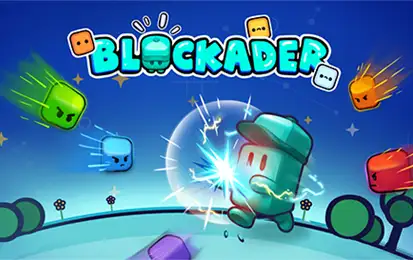







Blockader is a fast 2D roguelite arena shooter where a small space rodent faces increasingly dangerous enemy waves on a colorful lunar battlefield. Your weapon handles the basic shooting automatically, leaving you free to concentrate on the most important part of survival: movement, positioning, and choosing upgrades that work together.
Every cleared wave gives you another chance to reshape the run. You can increase raw projectile damage, fire faster, expand your magazine, build around critical hits, spread poison or curses, trigger chain lightning, launch extra arrows, summon autonomous allies, improve survivability, or chase rare upgrades with dramatic strengths and weaknesses. A good build can turn the opening weapon into a screen-filling combat setup before the hardest waves arrive.
Who Developed Blockader?
Blockader is developed by AZGames. The browser version was released on September 23, 2026 and is available on supported desktop, tablet, and mobile browsers.
Its combination of automatic shooting, wave survival, randomized cards, six character skill trees, permanent Gear, build synergies, special upgrades, and long-term collection systems gives Blockader considerably more depth than its simple block-style presentation first suggests.
How to Play Blockader
Move around the circular arena while enemies approach from multiple directions. Your character automatically targets and fires at nearby threats, so there is no need to manually aim every shot. Instead, keep enough space between yourself and the swarm while letting your weapon clear enemies.
Each wave has a required enemy quota. Defeat enough attackers to complete the wave and you will enter an upgrade phase where several random cards are offered. Pick the upgrade that best supports your current build, or spend a reroll when the available choices do not fit your strategy.
The main run is structured around 30 waves. Enemy pressure increases as you progress, with tougher enemy compositions and ranged attackers making positioning much more important later in the run.
Blockader Controls
| Action | Desktop |
|---|---|
| Move | WASD |
| Select Upgrade Card | 1 – 4 |
| Reroll Upgrade Choices | Space |
| Show / Hide Stats | Tab |
| Pause | Esc |
The controls can also be rebound through the game’s Input settings. Because firing is automatic, movement is the main skill during combat. Your job is to keep the character alive while the current build handles its offensive effects.
Clear Enemy Quotas and Advance Through 30 Waves
Blockader does not use a traditional map of numbered stages. A run progresses through waves inside the same arena, with each wave requiring enough kills to fill its progress meter.
Early waves are useful for establishing the foundation of your build. Later waves increase enemy durability and movement pressure, making weak upgrade combinations much harder to carry. The game also expands the enemy mix as the run develops rather than simply spawning more copies of the same opponent.
Surviving all the way through the run requires both damage and control. Huge offensive numbers are useful, but they do not help if you become trapped between enemies or fail to notice an incoming ranged shot.
Enemies Become More Dangerous as the Run Develops
Blockader contains multiple color-coded enemy archetypes, including White, Yellow, Green, Teal, Blue, Purple, Orange, and Red enemies, plus a separate Sniper type.
Different enemy groups can vary in health, movement speed, size, and reward value. Snipers create an additional problem because they can attack from range rather than relying only on contact damage.
This changes how you move around the arena. When only close-range enemies are nearby, circling the outer space can be enough. Once ranged threats appear, you also need to watch incoming projectiles and avoid getting forced into them by the surrounding swarm.
Choose a New Build With Every Run
The upgrade-card system is the heart of Blockader. Each wave gives you another opportunity to strengthen one part of your build, and many upgrade families can be pushed through several increasingly powerful tiers.
Major upgrade paths include:
- Impact: increases projectile damage.
- Rush: raises fire rate.
- Ammo: expands magazine capacity and can improve reload speed.
- Critical: improves critical-hit chance and critical damage.
- Lightning: adds chain-lightning attacks against nearby enemies.
- Poison: applies damage-over-time effects.
- Curse: makes affected enemies more vulnerable to damage.
- Arrow: gives attacks a chance to launch additional projectiles.
- Star Ally: adds orbiting allies that fire automatically.
- Health: increases hearts and can provide healing.
- Movement: increases movement speed and can improve dodge chance.
There are also piercing, Gear, healing, economy, and hybrid upgrades. Because offered cards are randomized, you cannot rely on receiving exactly the same setup in every attempt.
Combine Upgrade Families for Stronger Synergies
The most interesting Blockader builds come from combining systems rather than endlessly increasing one stat.
Lightning works well when you are firing enough shots to trigger it frequently. Poison becomes more effective when both its activation chance and damage improve. Extra arrows create more projectiles, while piercing lets individual shots travel through additional enemies. Critical-focused builds benefit from both critical chance and critical damage rather than stacking only one side of the equation.
Hybrid upgrades can strengthen two families at once. Combinations exist between effects such as Lightning and Poison, Lightning and Curse, Lightning and Arrow, Poison and Arrow, Curse and Arrow, or offensive effects combined with Star Allies.
That makes the upgrade screen a strategic decision rather than a simple choice of whichever card displays the largest number.
Unique Upgrades Can Completely Change a Build
Most progression comes from regular upgrade ladders, but Blockader also includes special upgrades with much more dramatic effects. These can create powerful advantages while sometimes demanding a serious trade-off.
Glass Heart, for example, greatly increases projectile damage but leaves you with only one heart. Glitch Armor adds a major dodge bonus while reducing fire rate. Overload dramatically increases fire rate at the cost of magazine capacity, while Speed Transmutation sacrifices movement speed for much faster firing.
Other unusual upgrades include Silver Bullet, which empowers every eighth shot, Perforation for additional piercing, Plume for another projectile per shot, Magic Heal for healing after wave clears, and Unalterable Critical, which makes every shot critical while preventing further critical-damage growth.
These upgrades are powerful because they can change which future cards are valuable. A strong roguelite build is often about adapting to what you already have instead of following the same plan every run.
Rerolls Help Rescue a Bad Upgrade Screen
You do not always have to accept the first group of cards. Space rerolls the current selection when you have rerolls available.
Permanent progression can increase your reroll supply, add extra card options, improve the chance of receiving rare upgrades, and even create opportunities for free rerolls. These bonuses become particularly useful once you understand which upgrade families work together.
A good rule is to save rerolls for moments when every offered card conflicts with your existing build. Spending them simply because a card is not perfect can leave you without a reroll when you genuinely need one later.
Stars Create Permanent Progress Between Runs
Not everything disappears when a run ends. The Stars you collect support permanent progression, giving failed attempts value even when you do not reach the final waves.
Permanent Gear is divided into three groups: Offense, Defense, and Utility. Gear improvements cover areas such as projectile damage, critical performance, fire rate, health, enemy-speed control, agility, additional upgrade options, rerolls, and upgrade luck.
These improvements strengthen future attempts before the first upgrade card even appears, so steady meta progression can make previously difficult waves much more manageable.
Six Playable Characters and Separate Skill Trees
Blockader includes six playable characters:
- Lucky
- Byte
- Spark
- Orbit
- Sludge
- Spike
Lucky is the default starting character, while additional characters can be unlocked through progression. More importantly, each character has its own dedicated skill tree instead of sharing one universal set of upgrades.
Each tree contains 14 standard skill nodes with prerequisites and branching progression. This means unlocking another character is not just a visual change; it opens another long-term development path and another reason to experiment with different builds.
Star Allies Add Automatic Support Fire
The Star Ally upgrade family introduces autonomous companions that orbit your character and attack enemies by themselves.
The first Star Ally creates an orbiting attacker, and the system can add further allies as the run advances. Additional Star Ally upgrades raise the damage dealt by each companion, while hybrid cards can combine ally damage with Lightning, Poison, Curse, or Arrow-based effects.
This makes Star Allies particularly useful for builds that want extra damage without depending entirely on the player’s main projectile stream.
Ammo and Reloading Matter
Although firing is automatic, your weapon does not simply fire forever without interruption. Blockader uses a magazine and reload system, so ammo capacity and reload speed affect how consistently you can deal damage.
A large magazine reduces downtime, while faster reloads help restore your offense after the weapon runs empty. High fire-rate builds especially benefit from keeping Ammo upgrades in mind because firing faster also means consuming the magazine more quickly.
This interaction is why upgrades such as Overload can be risky: enormous fire-rate bonuses are less useful if the weapon constantly runs dry.
Track Your Build With the Stats Panel
Press Tab to display the stats panel during a run. Blockader tracks a broad set of combat values including projectile damage, fire rate, ammo, critical chance, critical damage, movement speed, dodge chance, reload speed, upgrade options, rare-card chance, Poison, Curse, Lightning, Arrow, and Star Ally stats.
Checking this screen can help when two upgrade choices appear equally useful. Instead of guessing which area is weak, you can see what your current build has already invested in.
Build a Collection of Discovered Upgrades
Blockader also keeps an upgrade collection outside individual combat runs. Cards you have encountered become part of the collection, while undiscovered upgrades remain hidden until you find them.
This creates another progression goal beyond simply reaching wave 30. Experimenting with different families, characters, and rerolls can reveal combinations that may never appear when you repeatedly force the same build.
Best Blockader Tips
- Keep moving. Auto-fire handles your attacks, so positioning should receive most of your attention.
- Leave yourself an escape route. Avoid getting pinned against the edge by several enemy groups.
- Respect Snipers. Ranged enemies can punish predictable movement even when nearby enemies are under control.
- Build around synergies. Several upgrades from one or two compatible families are usually more useful than unrelated bonuses.
- Do not ignore Ammo. Very high fire rate can create long reload gaps without enough magazine and reload support.
- Save rerolls for bad choices. A decent card now may be better than having no reroll when an important wave offers nothing useful.
- Use defensive upgrades when needed. Extra hearts, movement speed, dodge chance, and healing can keep a powerful offensive build alive.
- Spend Stars between attempts. Permanent Gear and character skill-tree progress make future runs stronger.
Other Similar Games
Blockader FAQ
What is Blockader?
Blockader is a 2D roguelite arena shooter where you move around a circular lunar battlefield, automatically attack approaching enemies, clear waves, and choose randomized upgrades to develop a stronger build.
How do you control Blockader?
Use WASD to move. Press 1–4 to select upgrade cards, Space to reroll the current upgrade choices, Tab to open or close the stats panel, and Esc to pause.
Does Blockader shoot automatically?
Yes. Your main weapon automatically targets and attacks enemies, allowing you to concentrate on movement, dodging, and positioning.
How many waves are in Blockader?
The main run is structured around 30 waves, with enemy health, speed, composition, and overall pressure increasing as you progress.
How many characters does Blockader have?
There are six playable characters: Lucky, Byte, Spark, Orbit, Sludge, and Spike. Lucky is the default character.
Do the characters have skill trees?
Yes. Each of the six characters has a separate skill tree containing 14 standard nodes with prerequisites and permanent progression.
What upgrades are available?
Upgrade families include Impact, Rush, Critical, Ammo, Poison, Curse, Lightning, Star Ally, Arrow, Health, Movement, Bits/Stars-related rewards, piercing, healing, and several hybrid or unique effects.
What are Stars used for?
Stars support permanent progression between runs, including Gear improvements and other meta-progression systems that strengthen future attempts.
What is Gear in Blockader?
Gear provides permanent upgrades divided into Offense, Defense, and Utility categories. Improvements can affect damage, critical hits, fire rate, health, movement, rerolls, card options, and upgrade luck.
Does Blockader have ranged enemies?
Yes. Along with several color-coded enemy types, the game includes Snipers that can attack from range and force you to dodge enemy projectiles.
ActionShooting