



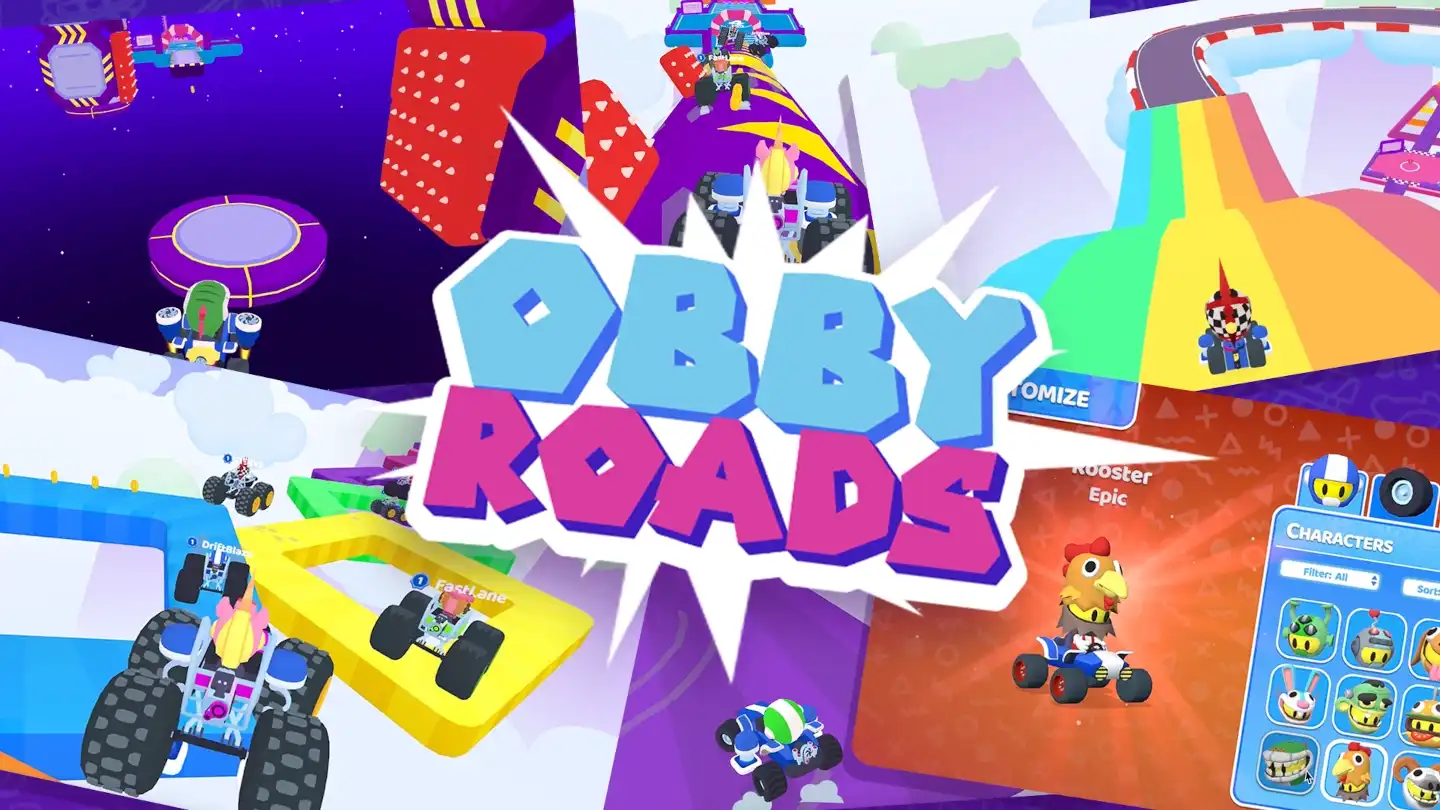





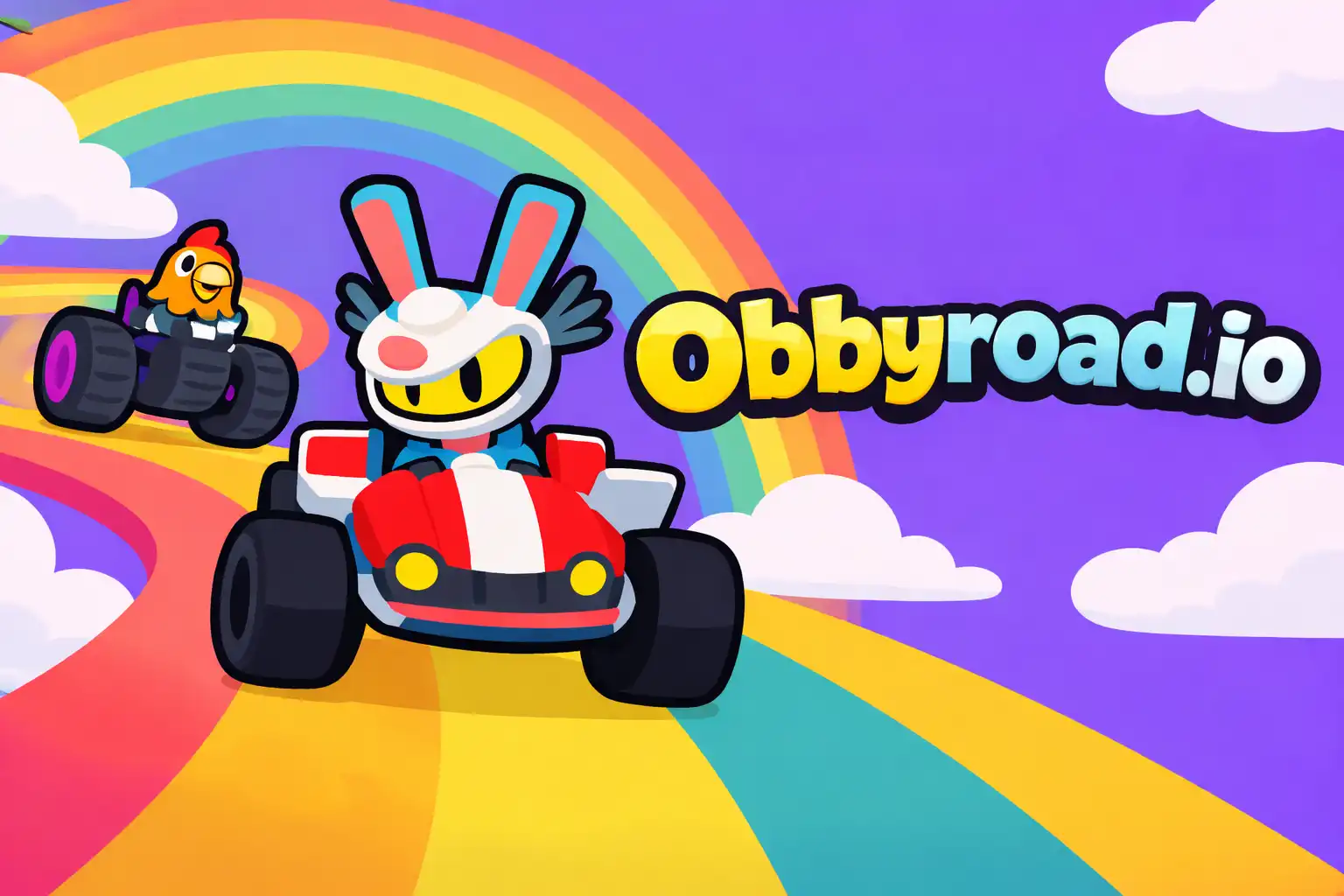
You drive a car across floating obstacle tracks suspended in the sky. One wrong turn and you plummet into the void. The goal is not raw speed — it’s keeping the car on a narrow, moving, spinning path from start to finish.
Obbyroads.io is developed by Tall Team, the creators of Smash Karts. Released on October 19, 2025, it takes the smooth handling from Smash Karts and builds a precision obstacle-driving game around it. Free to play in browser — requires WebGL 2 (Chrome, Firefox, or Edge recommended). Playable on desktop and mobile.
| Feature | Details |
|---|---|
| Developer | Tall Team (creators of Smash Karts) |
| Released | October 19, 2025 |
| Technology | WebGL 2 — Chrome, Firefox, or Edge required |
| Controls | Arrow Keys or WASD |
| Vehicles | Monster trucks, toy cars, race cars, sports cars — each with distinct handling |
| Modes | Obby, Race, Campaign, Challenges |
| Multiplayer | Ghost system (recorded runs) — live multiplayer planned |
| Weekly content | Fresh courses and leaderboard competitions every week |
| Platform | Browser (desktop and mobile) — free, no download |
Contents
Controls
| Action | Input |
|---|---|
| Accelerate / move forward | Up Arrow or W |
| Brake / reverse | Down Arrow or S |
| Steer left | Left Arrow or A |
| Steer right | Right Arrow or D |
The control scheme is simple. What separates players isn’t which keys they press but how much they press them. On narrow floating sections, holding the steering key full-lock sends the car off the edge. Light taps and partial inputs are what keep control on tight corners. The game carries over the polished physics from Smash Karts — the car responds smoothly, but that smoothness means small corrections are possible where a full steer would be fatal.
Tracks and Obstacles
Every track in Obbyroads.io is suspended in the sky with no ground beneath it. Falling off any edge ends the run. The obstacle types confirmed across multiple sources:
- Narrow platforms — sections where the track width drops to car-width or less, demanding precise lateral positioning
- Spinning traps — rotating obstacles placed on or across the track that must be timed to pass through
- Moving platforms — sections of the track that shift position, requiring timing the approach to match where the platform will be when you arrive
- Ramps and gaps — jumps across open air; speed into the ramp is critical — too slow and you fall short, too fast and you overshoot the landing
- Tight turns — sharp corners on floating paths where braking early and setting the turn line matters more than reaction speed
Some tracks contain shortcuts — alternative routes that cut time but require riskier driving. Confirmed by multiple sources: the shortcut path rewards successful execution but a single mistake drops you off the edge. On standard runs, the clean line is almost always safer than the shortcut.
Game Modes
| Mode | What it is |
|---|---|
| Obby | Floating tracks focused on jumps, narrow paths, and spinning traps. Precision over speed — the classic obstacle-driving format. |
| Race | Circuits with ramps, loops, and obstacles. More momentum-based than Obby — maintaining speed through obstacles rather than slowing for them. |
| Campaign | Themed worlds with progressively harder challenges. Each world introduces unique hazards and shifting platforms before escalating difficulty. |
| Challenges | The hardest mode — combines mechanics from all other modes. Competes on global leaderboards. Intended for players who have already mastered the other three modes. |
Vehicles
Confirmed vehicle types from the official site description and TwoPlayerGames: monster trucks, toy cars, and race cars. Gameflare and other sources add sports cars and heavy-duty trucks. Each vehicle has distinct handling — this is not purely cosmetic. A monster truck handles differently from a race car on narrow platforms: more mass and higher center of gravity change how it responds to steering input and how it lands after a jump.
Players start as a basic driver and unlock new vehicles through progression — ranked play and coin collection. The right vehicle for a track depends on its obstacle type: lighter, more agile vehicles suit narrow precision sections; heavier vehicles may have an edge on ramp-based tracks where momentum carries through gaps. Trying different vehicles on the same track to find which handles best for its specific obstacles is worth the experimentation.
Weekly Courses and Leaderboards
The official site’s tagline confirms: “Fresh courses & leaderboards weekly!” New tracks appear each week with different themes and obstacle combinations. Weekly challenges come with exclusive rewards tied to leaderboard ranking — the better your position, the better the reward. Leaderboards update in real time.
The multiplayer system is currently ghost-based — you see semi-transparent replicas of other players’ recorded runs alongside your own, not live players. Competing against ghosts gives you a real pace reference without the collision chaos that live multiplayer would introduce on narrow floating tracks. Real-time multiplayer is confirmed as planned for a future update.
Tips
▸ Brake before the corner, not in it
The car’s momentum carries through turns even after you release the gas. Slow down in the straight section before a tight corner, then steer through it without braking. Braking mid-corner while on a narrow platform often causes the car to rotate off the edge rather than stay on the line.
▸ Treat shortcuts as practice runs, not default routes
Shortcuts exist on some tracks but sit at track edges. Until you know a shortcut’s exact entry angle and the landing position on the other side, attempting it in a scored run is a poor trade. Learn the shortcut in practice runs first — only commit to it in leaderboard attempts once the line is muscle memory.
▸ Line up ramp approaches early, not at the last moment
Ramps send the car airborne and the landing zone is fixed. If you approach a ramp at an angle, the car flies at that angle and misses the landing platform. Straighten the car toward the ramp center at least two car-lengths before the edge, not as you reach it. Late corrections off a ramp lead to off-axis landings that spin the car over the edge.
▸ Match your vehicle to the track type
Lighter vehicles (toy cars, race cars) respond more quickly to steering corrections — better for precision sections. Heavier vehicles (monster trucks, trucks) carry more momentum through gaps — better on ramp-heavy tracks. Switching vehicle before a specific track rather than sticking with one vehicle for everything pays off in later, harder courses.
▸ Watch the ghost replays for pace reference
The ghost system shows other players’ recorded runs alongside yours. A ghost that pulls ahead on a specific section tells you where your timing or speed is off. Use the ghost’s line and braking points as a guide rather than pure competition — the fastest lines through obstacles are often not obvious without seeing someone else execute them first.