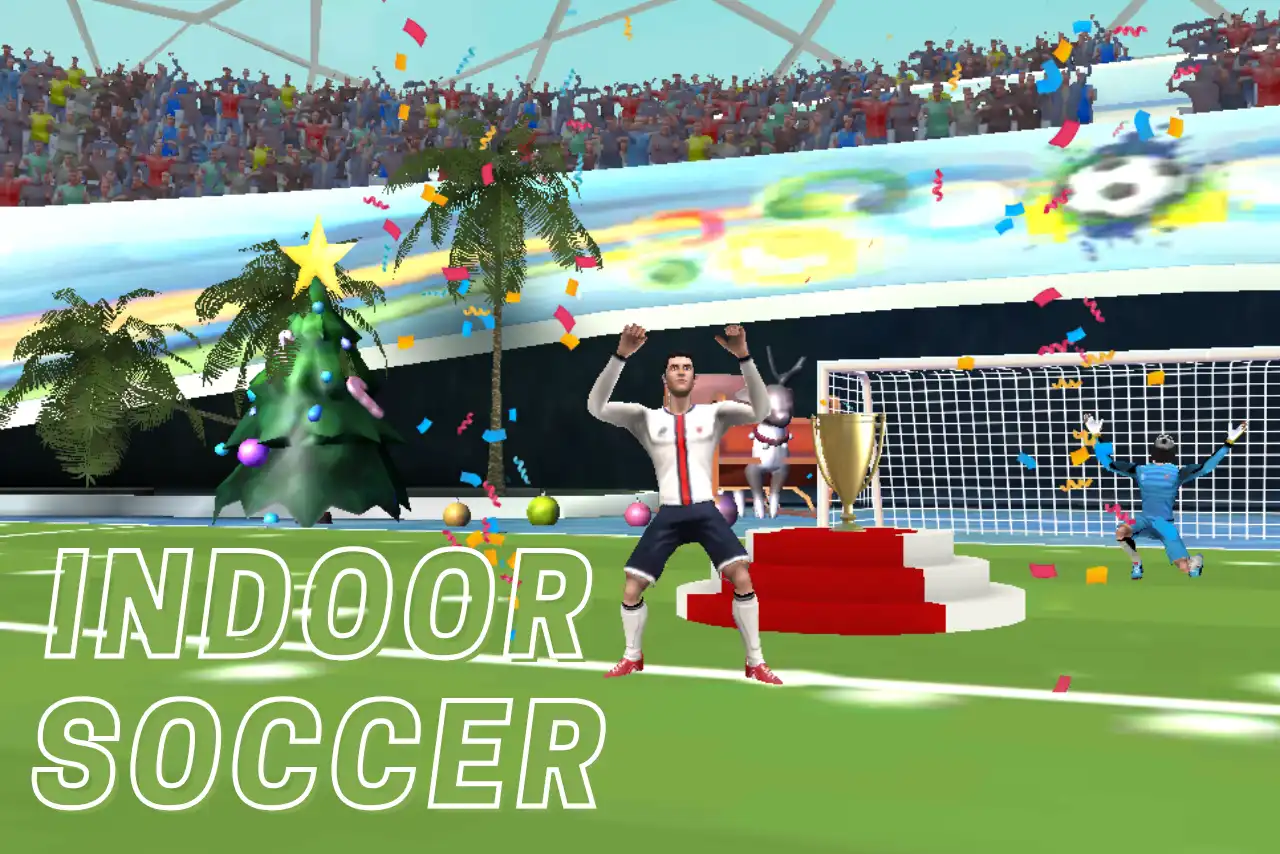
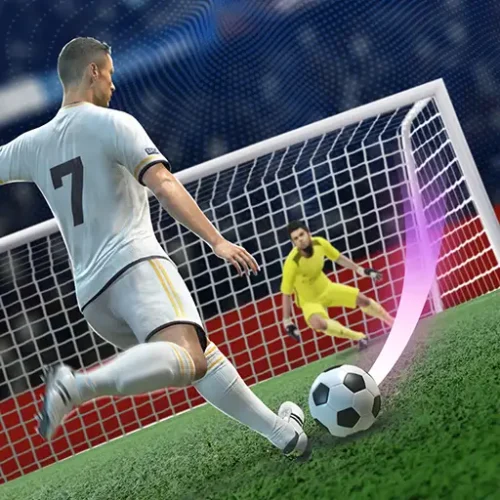
Indoor Soccer is a free browser sports game developed by Finz Games. It puts you on a compact five-a-side indoor football court where the pace is faster, the spaces are tighter, and the walls on the pitch boundaries are in play — which changes how you think about every shot and pass.
You do not manually run your players. Movement is handled automatically and your input controls passing, aiming, and shooting — which keeps the focus entirely on decision-making rather than player control. The result is a game where reading the situation, picking angles, and timing releases matter far more than button reflexes.
Compete solo against AI in quick matches, work through a full tournament bracket, or play head-to-head with a friend in 2 Player mode. Customize your squad and learn the slick moves that separate efficient goal-scorers from players who keep blasting the ball straight at the keeper.
No download, no account. Plays in any modern browser on desktop, tablet, and mobile. Also available on iOS and Android.
Finz GamesDeveloper
5v5Team Size
Quick / Tournament / 2PModes
FreeBrowser + App
Why Indoor Soccer Plays Differently
Most browser soccer games are built around the standard 11v11 open pitch format. Indoor Soccer strips that down to a smaller enclosed court with five players per side, and that single change reshapes almost everything about how the game works.
On an open pitch, space opens up gradually as you build attacks. On an indoor court, there is no such space. Defenders are always close. The goalkeeper’s range covers a higher proportion of the goal. Your angles to shoot are always contested and often narrow. This forces a style of play built around quick passing, wall rebounds, and patience — taking the shot when a gap genuinely appears rather than whenever you have the ball.
The other critical difference is the walls. Indoor soccer rules allow the ball to remain in play off any boundary wall — and Indoor Soccer the game uses this fully. A shot that reads as blocked by a defender from a direct angle can reach the goal via the side wall. A pass into the corner can bounce back to a teammate in space. Players who ignore the walls are leaving their best opportunities on the table.
The wall is your teammate
Defenders cannot cover a shot aimed at the wall and rebounding into the goal simultaneously. Learning to visualize bank shot angles — treating the wall the same way a pool player treats the cushion — unlocks approaches to scoring that direct play cannot replicate.
Controls
Input
Action
Mouse aim
Set the direction of your pass or shot
Click and drag
Set power — longer drag equals stronger kick
Release
Execute the kick
Touch and swipe (mobile)
Same mechanic — swipe direction sets aim, swipe length sets power
Player movement is automatic. You do not control where your players run — the game manages positioning. Your entire input is about what you do with the ball when you have it. This makes Indoor Soccer straightforward to start and rewards players who build their decision-making rather than their coordination.
Hitting specific areas of the goal rather than just the center earns score multipliers. A shot placed into the top corner or a specific target zone within the net scores more than a center-goal finish at the same power. Precision over power is consistently rewarded.
Game Modes
Quick Match
A single match against an AI opponent. Good for warming up, learning specific mechanics, or playing when you have a few minutes. No pressure, no stakes, and the AI scales reasonably so matches feel competitive rather than routine from the start.
Tournament
A bracket of matches that builds toward a final. Tournament mode is the main progression experience — winning rounds unlocks rewards and tests your ability to maintain performance across multiple consecutive matches rather than just winning one. Playing consistently through a full bracket is the primary way to earn customization upgrades.
2 Player Mode
Local head-to-head on the same device. Both players use the same screen and take turns when their team has the ball. This is the most competitive version of the game and produces the most memorable sessions — particularly because both players can see each other’s aims before the shot releases, creating a bluffing layer that the AI mode does not have.
The Rules Indoor Soccer Keeps
Indoor Soccer is not a simplified version of football with four walls added. The game carries over several rules from real indoor soccer that affect play in meaningful ways:
Walls are in play. The ball does not go out of bounds when it hits the boundary walls — it remains live and can be played off them intentionally or incidentally.
Fouls lead to direct free kicks. Foul play triggers a direct free kick opportunity, which on a small court is a significant scoring chance.
Penalty shots for fouls in the area. Fouls inside the penalty box result in a penalty kick — the highest quality scoring chance in the game.
Power plays are possible. Certain foul or tactical situations create a power play — a temporary numerical advantage that opens space on the compact court that would not otherwise exist.
Unlimited substitutions. Squad depth and player condition can be managed during the match, which adds a tactical layer to tournament play.
How to Score More
1
Pass first, shoot when the angle is genuinely there
The most common scoring failure in Indoor Soccer is shooting from the first opportunity regardless of the defender’s position. A quick pass to the other side of the court creates a better angle in far fewer touches than trying to shoot past a centered defender. Short passing wins more than solo rushing.
2
Use the wall angle before you use the direct route
When a defender blocks your direct path, look at the side wall first. A ball aimed at the wall at the right angle comes off toward the goal from a direction the keeper is not positioned for. Visualize the reflection angle before shooting — where the wall sends the ball is predictable and learnable.
3
Aim for target zones, not just the goal opening
Shots placed into the corners of the goal or specific target zones earn score multipliers beyond the base goal value. A well-placed shot is always worth more than a central one at the same power. Train yourself to aim for the corners rather than defaulting to center — it improves both your score and your conversion rate since keepers position centrally.
4
Match your power to the distance, not to the situation
Maximum power is not always the right choice. A shot from close range at full power loses accuracy and often goes wide or straight into the keeper. Medium power from close, full power from distance. Calibrating drag length to the shooting position rather than always dragging as far as possible converts more attempts.
Defending — What the Automatic Movement Means Tactically
Since player movement is automatic, you cannot manually pull defenders into better positions. What you can control is how well you read where the AI is defending and respond with the right release timing on your shot or pass.
Reading defense to attack
If a defender moves toward your ball carrier, the pass option just opened up. Automatic defensive movement is predictable once you learn the patterns — watching it before you decide rather than committing early converts more possession into chances.
In 2 Player mode
Your opponent can see your aim direction developing before you release. Faking one direction and releasing in another — dragging toward one side before quickly adjusting — introduces a bluffing dimension the AI mode does not have. 2 Player is a genuinely different game once both players understand this.
Indoor Soccer was developed by Finz Games, who also made Connect Puzzle and Karate Fighter.
Is Indoor Soccer free to play?
Yes, completely free. No download required for browser play and no in-app purchases needed. Also available as a free download on iOS and Android.
What are the controls?
Mouse to aim your pass or shot. Click and drag to set power — longer drag means stronger kick. Release to shoot or pass. On mobile, swipe in the direction you want to kick, with swipe length controlling power.
Do I control my players directly?
No. Player movement is handled automatically by the game. You only control passing and shooting — where the ball goes and with how much power. This keeps the focus on tactical decisions rather than coordination.
How many game modes are there?
Three: Quick Match (single game vs AI), Tournament (bracket of matches with rewards), and 2 Player Mode (local head-to-head on the same device).
Can I play with a friend?
Yes. The 2 Player mode supports local head-to-head on the same device. Both players take control when their team has possession. It does not require an online connection or separate devices.
What is the wall mechanic?
Indoor soccer rules allow the ball to remain in play after hitting the boundary walls. In Indoor Soccer the game, this means you can deliberately aim shots and passes off the side walls to create angles past defenders that direct play cannot achieve. The wall is a playable surface, not a dead-ball boundary.
How do score multipliers work?
Shots that land in specific target zones within the goal — particularly the corners — earn bonus points beyond the standard goal value. Aiming for corners rather than the center of the goal earns more per goal and also tends to convert at a higher rate since goalkeepers position centrally.
What makes indoor soccer different from regular football games?
The smaller pitch, five-player teams, and walls in play combine to produce a much faster game with fewer long-range chances and more emphasis on quick passing and angle play. There is no space to build slow attacks or exploit wide areas — everything happens quickly in a compact zone.
Can I play Indoor Soccer on my phone?
Yes. The game runs in mobile browsers and is also available as a dedicated app on both iOS and Android. Touch swipe controls work naturally for the aim-and-shoot mechanic.
✦ Final Verdict
Indoor Soccer earns its place in the browser sports space by committing to a format that genuinely plays differently from its full-pitch counterparts. The wall mechanics, the compact court, and the aim-and-release control system create a game about angles and patience rather than power and speed.