








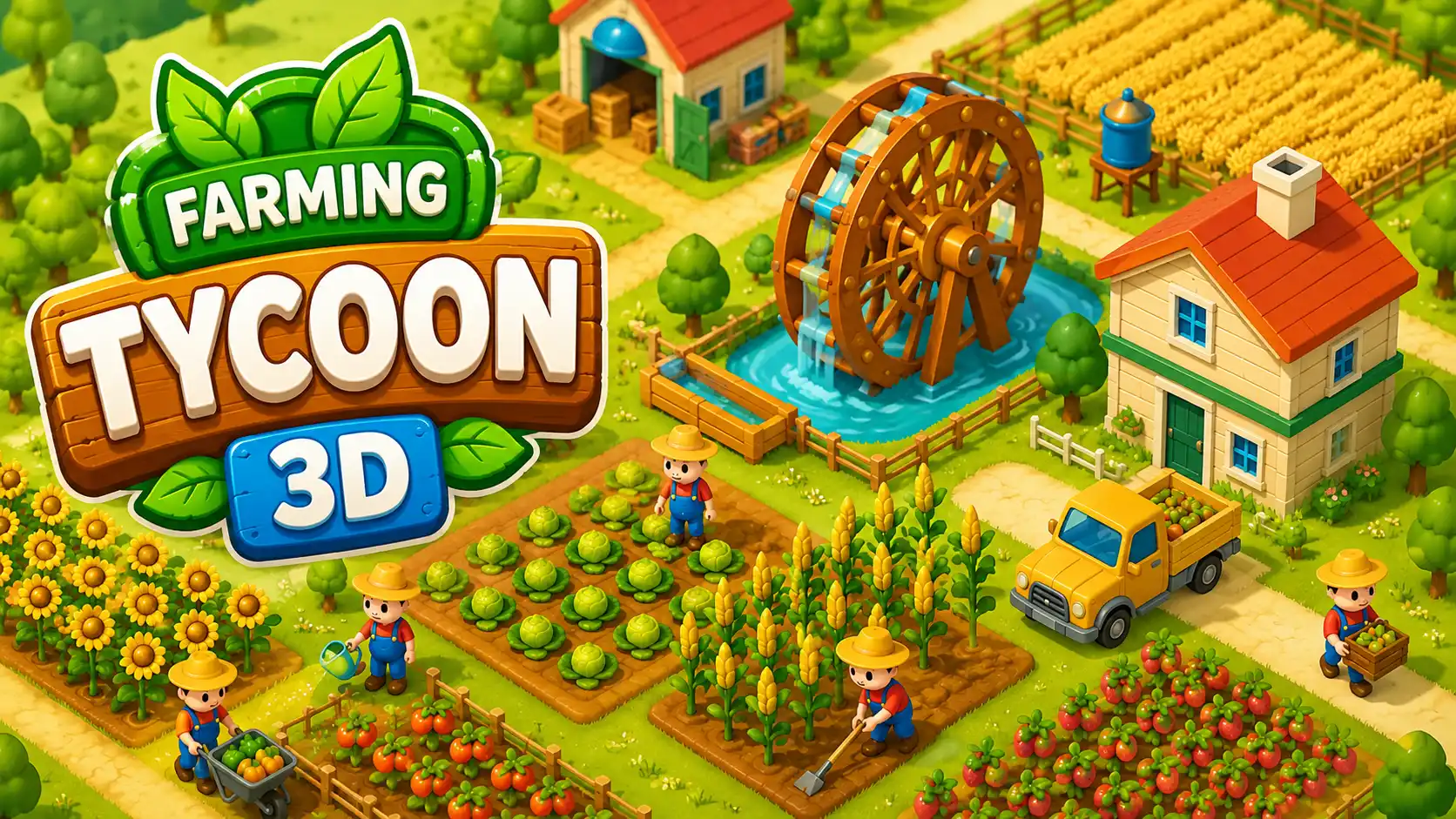
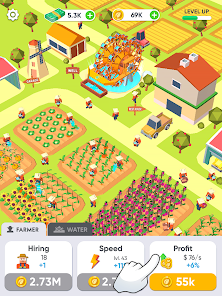








Farming Tycoon 3D is an idle farming management game where players start with a small piece of land and gradually transform it into a massive agricultural empire. Instead of focusing only on planting crops, the game combines farming, automation, worker management, business expansion, and long-term profit optimization.
What Is Farming Tycoon 3D?
Farming Tycoon 3D is a browser-based farming simulation and idle tycoon game where players build, expand, and automate a farming business.
The basic gameplay loop revolves around:
- Planting crops
- Watering fields
- Harvesting produce
- Selling products
- Reinvesting profits
- Expanding farmland
As the farm grows, players unlock workers, managers, upgrades, and additional areas that increase productivity and reduce manual work. The long-term goal is to create a highly efficient farming empire capable of generating massive income both online and offline.
How Farming Tycoon 3D Progression Works
The game begins with only a small plot of land and limited resources.
Early progress feels straightforward:
- Plant crops.
- Harvest them.
- Sell them.
- Repeat.
However, the economy becomes much more complex as the farm expands.
New areas require larger investments. Crop cycles become longer. Worker management becomes important. Upgrade choices start affecting profit efficiency.
The game slowly shifts from farming simulation into resource management and business optimization. This gradual progression is what keeps players engaged for long periods.
Why Automation Changes Everything
One of the biggest milestones in Farming Tycoon 3D is unlocking automation.
At first, players handle most tasks manually. Eventually, workers begin assisting with:
- Planting
- Watering
- Harvesting
- Transporting resources
Later, managers can automate entire sections of the farm.
This dramatically changes gameplay because players stop focusing on individual crops and start focusing on farm-wide efficiency.
The Hidden Strategy Behind Worker Management
Many players assume hiring workers immediately is always the best decision.
That is not always true.
Workers increase productivity, but they also represent an investment.
The key question is:
Will the worker generate enough profit to justify the cost?
Experienced players evaluate:
- Worker price
- Crop output
- Harvest frequency
- Upgrade opportunities
The strongest farms usually balance automation and expansion rather than spending everything on employees.
Understanding Crop Profitability
Not all crops provide equal value.
Some crops:
- Grow quickly
- Produce smaller profits
- Support rapid early-game progression
Other crops:
- Take longer to mature
- Generate larger rewards
- Become valuable later
One mistake beginners make is planting only the highest-value crop available.
Profit per harvest is important, but profit per minute is often more important.
Fast-growing crops can sometimes outperform expensive crops because they generate revenue more frequently.
How Expansion Really Works
Many players focus only on increasing crop production.
Expansion involves much more than adding fields.
A successful farm requires:
- Efficient worker coverage
- Good upgrade timing
- Balanced investment
- Resource flow management
Buying new land too early often creates inefficiencies because the player lacks enough workers or upgrades to support the expansion.
The most successful farms usually grow in controlled stages rather than expanding aggressively.
Things The Game Doesn’t Tell You
Bigger Farms Are Not Always Better
Large farms become inefficient if automation cannot keep up.
Idle Income Is Extremely Important
Offline earnings eventually become one of the largest income sources in the game.
Upgrades Often Outperform Expansion
Improving existing production frequently generates better returns than buying more land.
Worker Placement Matters
Poorly positioned workers waste time traveling between tasks.
Early Decisions Affect Long-Term Growth
Resource allocation becomes increasingly important as costs rise.
Common Mistakes Beginners Make
Expanding Too Quickly
Many players buy new fields before improving existing production.
Ignoring Automation
Manual farming eventually becomes far less efficient than automated systems.
Spending All Profits Immediately
Maintaining reserve funds allows faster adaptation later.
Hiring Workers Randomly
Every worker should serve a clear purpose.
Focusing Only On Harvest Value
Growth speed often matters just as much as crop price.
Advanced Farming Tycoon 3D Tips
One of the most effective high-level strategies is optimizing production chains rather than maximizing field count.
Strong players constantly ask:
- Which upgrade provides the best return?
- Which worker saves the most time?
- Which area generates the highest profit per minute?
Another important technique involves prioritizing bottlenecks.
Every farm eventually develops a weak point.
Common bottlenecks include:
- Slow harvesting
- Worker travel time
- Limited automation
- Underpowered equipment
Improving the largest bottleneck usually increases profits faster than upgrading random systems.
The Real Goal: Efficiency Scaling
Most farming games focus on growth.
Farming Tycoon 3D focuses on scaling.
Scaling means increasing production faster than costs increase.
This is why experienced players care about efficiency more than raw size.
A smaller farm with optimized automation can outperform a much larger farm with poor management.
Understanding scaling is one of the biggest differences between casual players and advanced tycoon players.
Why Offline Income Matters So Much
One feature that separates Farming Tycoon 3D from traditional farming simulators is idle progression.
After unlocking workers and managers, the farm continues generating income while the player is away.
Offline earnings allow players to:
- Return to major profits
- Purchase upgrades faster
- Expand more efficiently
- Reduce repetitive grinding
Eventually, idle income becomes one of the most important parts of long-term progression.
Farming Tycoon 3D Tips For Faster Progress
Players looking to expand quickly should focus on:
- Unlocking automation early
- Upgrading harvesting efficiency
- Avoiding unnecessary expansion
- Prioritizing worker productivity
- Reinvesting profits consistently
The strongest farms usually result from smart reinvestment rather than aggressive spending.
Similar Games You Might Enjoy
Frequently Asked Questions
What is Farming Tycoon 3D?
Farming Tycoon 3D is an idle farming simulation game where players build and automate a growing agricultural business.
Can you automate your farm?
Yes. Workers and managers can automate planting, harvesting, and production systems.
Does the game earn money offline?
Yes. Once automation systems are unlocked, the farm continues generating income while you are away.
What is the best beginner strategy?
Focus on upgrading efficiency, unlocking automation, and avoiding overly aggressive expansion.
Is there an ending?
No. Farming Tycoon 3D is designed around endless progression with continuous upgrades and expansion opportunities.
Final Thoughts
Farming Tycoon 3D succeeds because it combines the relaxing appeal of farming with the long-term progression systems of a business simulation. Planting and harvesting may drive the early game, but automation, scaling, efficiency, and resource management eventually become the real challenges.
CasualSimulation