







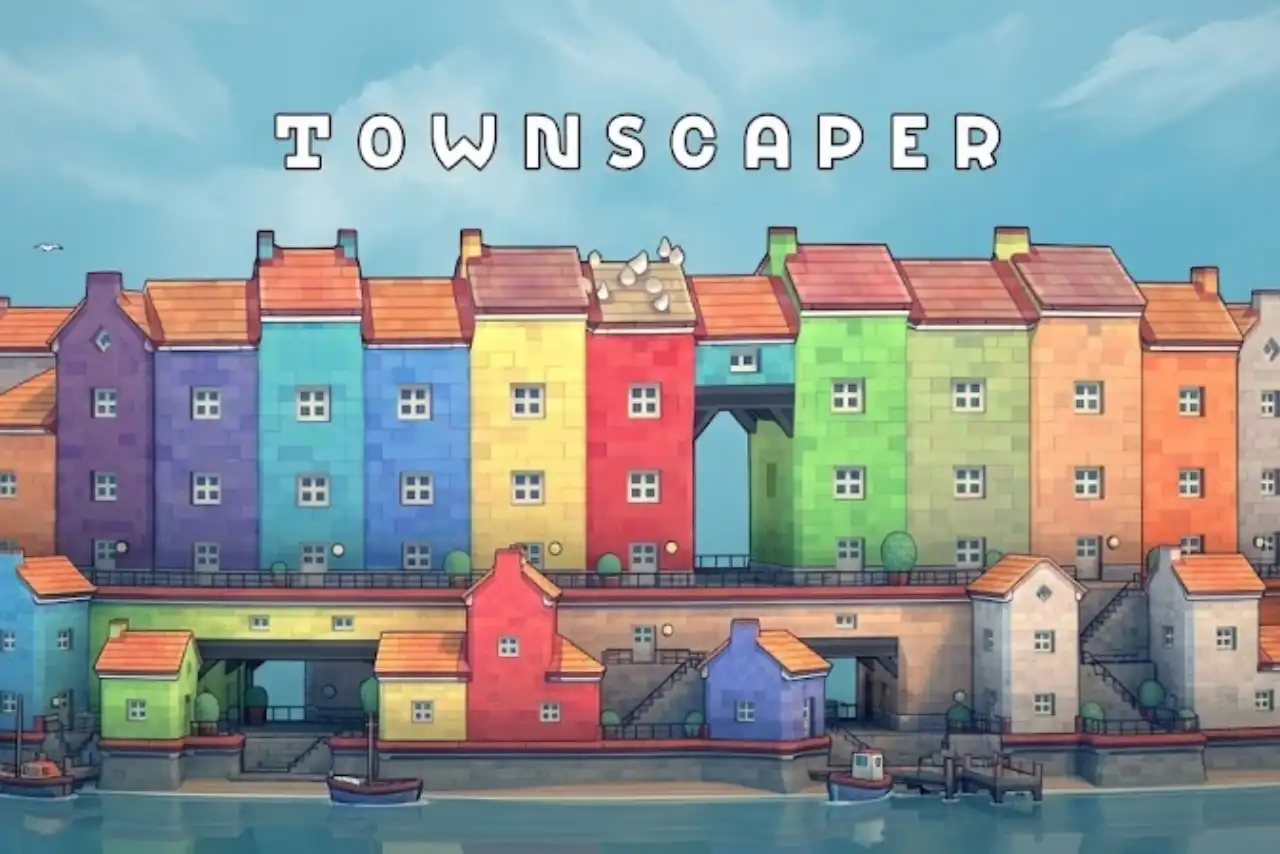
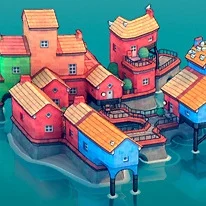







Townscaper is a relaxing city-building sandbox created by Swedish developer Oskar Stålberg that transforms simple clicks into colorful seaside towns, floating villages, towering cathedrals, winding canals, and intricate coastal cities. Released in 2021 after an early access period that began in 2020, Townscaper became one of the most recognizable “cozy games” ever made because it removes almost everything normally associated with city builders.
There are no resources, no budgets, no citizens to manage, no missions, and no failure conditions. Instead, the entire experience revolves around creativity, architecture, and experimentation. Players simply place blocks into an endless ocean and watch the game’s procedural generation system transform them into surprisingly detailed structures.
What Is Townscaper?
Most city-building games ask players to solve problems.
Townscaper asks players to create.
The game takes place on a large grid floating above an infinite sea. Every click places a colored building block onto the grid. Removing blocks is just as simple.
What makes Townscaper special is what happens afterward.
Players are not manually placing roofs, windows, stairs, balconies, bridges, gardens, archways, docks, or towers. The game automatically generates those architectural details based on how blocks connect to one another.
The result is a system where even simple structures can quickly evolve into beautiful settlements that look handcrafted despite being generated procedurally.
Why Townscaper Is Not Really A City Builder
One of the most important things new players misunderstand is that Townscaper is not trying to compete with games like Cities: Skylines.
There is:
- No economy.
- No population management.
- No traffic.
- No resource production.
- No zoning systems.
- No objectives.
Oskar Stålberg himself has frequently described Townscaper as more of a toy than a game. The purpose is not optimization.
The purpose is exploration.
That distinction completely changes how the experience should be approached.
How The Procedural Building System Works
The most fascinating part of Townscaper is the hidden system running beneath every building.
When players place blocks, the game analyzes surrounding structures and automatically determines what architectural pieces should appear.
Depending on placement patterns, blocks can transform into:
- Houses
- Towers
- Cathedrals
- Bridges
- Staircases
- Archways
- Harbors
- Gardens
- Courtyards
- Walkways
Players are technically only placing cubes.
The game handles everything else.
This system is why Townscaper often feels magical during the first few hours.
Unexpected structures constantly emerge from simple building decisions.
The Hidden Mechanic Most Competitors Ignore: Shape Logic
Most guides tell players to place blocks.
Very few explain shape logic.
Townscaper’s architecture is heavily influenced by the shape players create rather than the individual blocks themselves.
For example:
A straight line of buildings produces very different results than a circular formation.
Enclosed spaces frequently generate gardens.
Connected elevated structures may create bridges or support pillars.
Large vertical towers develop differently than wide horizontal districts.
The game rewards experimentation with geometry rather than traditional city-planning strategy.
Understanding this dramatically improves building quality.
Building Better Towns
Many beginners create random structures.
Experienced players often think in districts.
Instead of placing isolated buildings, they design:
- Harbor districts.
- Cathedral centers.
- Residential neighborhoods.
- Canal systems.
- Elevated sky cities.
- Island villages.
This creates towns that feel intentional rather than accidental.
The most impressive creations usually emerge when players focus on overall layout before worrying about individual details.
Colors Change More Than Appearance
The color palette appears cosmetic at first.
In practice, color placement strongly affects the atmosphere of a town.
Warm colors often create Mediterranean-inspired settlements.
Cool colors produce coastal Scandinavian aesthetics.
Alternating color blocks can create distinct neighborhoods within the same city.
Many advanced creators use color to guide visual storytelling rather than decoration alone.
How To Create Bridges, Gardens, And Archways In Townscaper
One of the most searched topics is how specific structures appear.
The answer is that players cannot place them directly.
Instead, they emerge through placement patterns.
Gardens
Gardens often appear when structures surround enclosed open spaces.
Bridges
Bridges frequently form when elevated sections connect across gaps.
Archways
Archways tend to appear beneath supported structures when enough vertical space exists.
Towers
Stacking structures vertically encourages taller architectural elements.
Because these systems are procedural, experimentation is usually more effective than following exact formulas.
Things The Game Doesn’t Tell You
Removing Blocks Is Just As Important As Adding Them
Many beautiful structures appear only after carefully removing sections of existing buildings.
Empty Space Creates Better Architecture
Crowding every available tile often reduces visual variety.
Open water and spacing help towns feel more natural.
Vertical Building Unlocks The Best Details
Some of Townscaper’s most impressive procedural structures appear only after significant vertical expansion.
Small Islands Often Look Better Than Giant Cities
Large cities can become visually overwhelming.
Many players eventually prefer creating several connected islands.
The Game Rewards Curiosity More Than Planning
Unexpected experiments frequently produce better results than rigid building plans.
Common Mistakes Beginners Make
Building In Straight Lines Only
This limits architectural variety.
Curved layouts generally create more interesting results.
Ignoring Vertical Construction
Many players never discover some of the game’s most impressive structures because they stay close to sea level.
Filling Every Space
Leaving gaps often improves the appearance of a settlement.
Using One Color Everywhere
Monochromatic cities can feel repetitive.
Treating Townscaper Like A Strategy Game
Trying to “win” usually misses the point entirely.
The game is about creativity, not efficiency.
Advanced Townscaper Tips
Players creating highly detailed towns often use a layered approach.
First, they establish island foundations.
Next, they define major districts.
Then they add height variation.
Finally, they adjust colors and remove blocks to create architectural complexity.
Interestingly, many advanced creations involve almost as much deletion as construction.
Carefully carving away sections often reveals some of the most attractive procedural details.
This is one of the least discussed techniques among beginner guides.
Why Townscaper Became So Popular
Townscaper arrived during a period when many players were actively seeking relaxing experiences.
Unlike competitive multiplayer games or complex management simulators, Townscaper offers immediate satisfaction.
There is no pressure.
No deadlines.
No punishment.
Every click produces something visually appealing.
This creates a calming feedback loop that many players describe as therapeutic.
Its popularity also helped inspire an entire wave of “cozy scene-building games” that focus more on creativity than objectives.
Frequently Asked Questions
Who made Townscaper?
Townscaper was created by Swedish developer Oskar Stålberg and published with support from Raw Fury.
Is Townscaper a real city-building game?
Not in the traditional sense. Townscaper focuses on creative building rather than management systems, resources, or objectives.
How do you make gardens in Townscaper?
Gardens usually appear automatically when buildings create enclosed spaces within a settlement.
Can you lose in Townscaper?
No. There are no failure conditions, timers, enemies, or objectives.
Why is Townscaper so relaxing?
The game removes pressure, objectives, and resource management while providing immediate visual rewards through procedural architecture generation.
Final Thoughts
Townscaper succeeds because it understands that creativity alone can be entertaining. By combining elegant procedural generation with simple building mechanics, Oskar Stålberg created something that feels closer to a digital toy box than a traditional game.
Whether you’re constructing tiny island villages, enormous floating cities, winding canal networks, or towering cathedrals, every project becomes an experiment in architecture and imagination. The lack of objectives is not a limitation—it is exactly what allows Townscaper to remain one of the most relaxing and visually satisfying building experiences available today.
CasualSimulation