





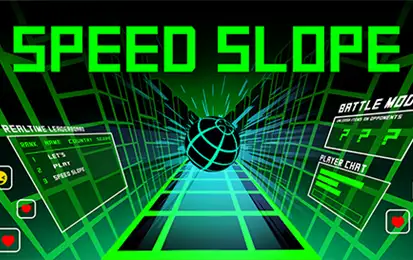
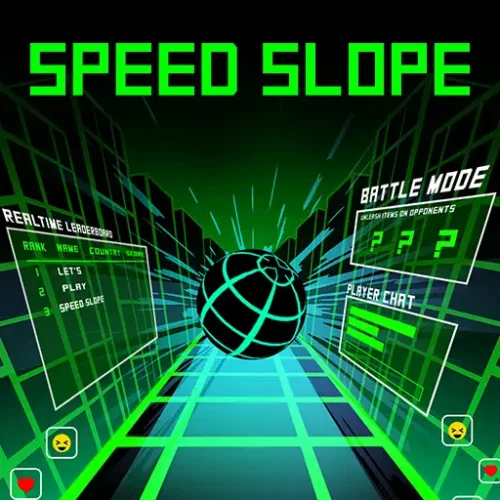







Speed Slope is a high-speed 3D endless runner that challenges players to control a rapidly accelerating ball across dangerous slopes filled with obstacles, sharp turns, gaps, and constantly changing pathways. At first, the game appears simple: stay on the track and avoid crashing.
However, as speed increases and obstacle patterns become more aggressive, Speed Slope transforms into a test of concentration, momentum control, visual anticipation, and decision-making under pressure. Every run feels different, every mistake feels costly, and every personal best creates the urge to immediately try again.
What Is Speed Slope?
Speed Slope is a browser-based endless rolling game where players guide a ball through an infinite downhill course suspended high above empty space.
The objective is simple: Survive as long as possible.
The ball moves automatically while gradually increasing in speed. Players must steer left and right to avoid hazards, remain on the track, and navigate increasingly difficult obstacle combinations.
Unlike traditional racing games, there are:
- No finish lines
- No checkpoints
- No story mode
- No brakes
Your score depends entirely on how far you can survive before eventually crashing.
Why Speed Slope Feels So Addictive
Many endless runners rely on unlocks and progression systems to keep players engaged.
Speed Slope uses a different approach.
The game creates a constant feeling that failure was avoidable.
Every crash feels like:
- A late reaction
- A positioning mistake
- An unnecessary movement
- A missed opportunity
Because players immediately recognize what went wrong, every failed run creates motivation for another attempt.
This cycle is one of the main reasons slope-style games remain among the most replayed browser games online.
How The Gameplay Works
Once the game begins, the ball starts rolling automatically down a continuously generated course.
Players must navigate through:
- Narrow pathways
- Moving hazards
- Red obstacle blocks
- Sudden drops
- Curved slopes
- Platform gaps
The farther you travel, the faster the game becomes.
Reaction windows shrink.
Mistakes become harder to recover from.
Obstacle combinations become increasingly complex.
Eventually, survival depends more on anticipation than reaction speed.
Controls
PC Controls
- Left Arrow = Move Left
- Right Arrow = Move Right
- A = Move Left
- D = Move Right
Mobile Controls
- Swipe Controls
- Touch Steering
The controls are intentionally simple.
The difficulty comes entirely from speed, momentum, and obstacle management rather than complicated inputs.
The Real Core Mechanic: Momentum Management
Most beginners think Speed Slope is a reflex game. Experienced players know it is actually a momentum game.
Every movement changes your future positioning. Large corrections create instability. Small adjustments preserve control. This is why advanced players often appear calm even at extreme speeds.
They are not reacting faster. They are making fewer unnecessary movements. Understanding momentum is one of the biggest skill jumps in the entire game.
Why Looking Ahead Matters More Than Reaction Speed
One of the most common mistakes new players make is staring directly at the ball. This creates a serious problem. By the time an obstacle appears, there is often not enough time left to react.
High-scoring players focus far ahead on the track itself.
This allows them to:
- Predict obstacle patterns
- Position earlier
- Reduce panic movements
- Maintain smoother runs
Many players dramatically improve their scores simply by changing where they look.
Understanding Obstacle Reading
Most competitors tell players to “avoid obstacles.” That advice is too basic. Strong players learn obstacle categories.
Single Block Obstacles
Simple hazards requiring minor corrections. These are often the safest sections of a run.
Narrow Gaps
Precision sections where positioning matters more than speed.
Curve Sequences
Obstacle chains combined with directional track movement. These punish oversteering.
Drop Sections
Large elevation changes that affect landing angles.
Speed Sections
Areas where acceleration increases dramatically and forces faster decision-making. Recognizing obstacle types helps players prepare before reaching them.
Things The Game Doesn’t Tell You
Most Crashes Happen After A Mistake
Not because of the mistake itself. Players usually panic and overcorrect.
The Center Is Usually The Safest Place
Staying near the middle creates more escape options.
Speed Creates Visual Illusions
At high velocity, distances appear shorter than they actually are.
Smooth Movement Beats Aggressive Movement
Large corrections create larger problems.
Good Runs Often Feel Slower
Experienced players frequently describe high-score attempts as feeling calmer because positioning reduces panic reactions.
Common Mistakes Beginners Make
Watching The Ball
This dramatically reduces reaction time.
Hugging The Edge
Edge positioning removes recovery options.
Oversteering
Many crashes happen because players move too much.
Panicking During Speed Spikes
Speed increases often trigger unnecessary mistakes.
Reacting Instead Of Predicting
Late reactions become impossible at higher scores.
Advanced Speed Slope Tips
One of the most important advanced skills is learning obstacle flow.
Instead of viewing obstacles individually, strong players view entire track sections as movement sequences.
For example:
Rather than avoiding three separate obstacles, experienced players identify the safest route through all three at once.
This reduces unnecessary movement and creates smoother navigation.
Another advanced strategy involves preparing for landings before leaving the ground.
Many players stop thinking while airborne.
Elite players use jump time to position for the next obstacle sequence.
The Psychology Of High Scores
One surprising aspect of Speed Slope is how mental state affects performance.
Many players achieve personal records immediately after failed runs.
The reason is simple:
They stop forcing results.
The highest scores usually happen when players focus entirely on movement rather than score tracking.
Constantly checking distance often creates tension that leads to mistakes.
Top players treat every obstacle as an isolated challenge rather than worrying about their overall score.
Why Speed Slope Gets Harder Than Most Endless Runners
Many endless runners increase difficulty by adding more obstacles.
Speed Slope increases difficulty in multiple ways simultaneously:
- Faster movement
- Smaller reaction windows
- Harder obstacle combinations
- Increased visual pressure
- Greater punishment for mistakes
Because these systems stack together, the challenge scales much more aggressively than many other browser runners.
Similar Games You Might Enjoy
Slope
The classic neon ball runner that inspired many modern slope games.
Slope 2
An expanded version featuring moving obstacles and dynamic track patterns.
Slope 3
A faster variation with updated visuals and more complex layouts.
Frequently Asked Questions
What is Speed Slope?
Speed Slope is a fast-paced endless runner where players guide a rolling ball through dangerous slopes while avoiding obstacles and surviving as long as possible.
Is Speed Slope endless?
Yes. The course continues indefinitely, and the objective is to achieve the highest distance possible.
Can you slow the ball down?
No. Speed increases automatically as the run progresses, forcing players to adapt.
What is the best beginner strategy?
Stay near the center, make small adjustments, and focus farther ahead on the track rather than the ball itself.
Why do players crash at high scores?
Most crashes happen because of overcorrection, panic reactions, or poor positioning before difficult obstacle sequences.
Final Thoughts
Speed Slope succeeds because it turns a simple concept into a relentless test of focus, anticipation, and momentum control. The increasing speed, endless track generation, and constant pressure create a challenge that remains engaging long after the first run. While beginners may focus on surviving a few extra seconds, experienced players discover a much deeper game built around positioning, obstacle recognition, and movement efficiency.
ArcadePopular games