












Slope Rider
What Is Slope Rider?
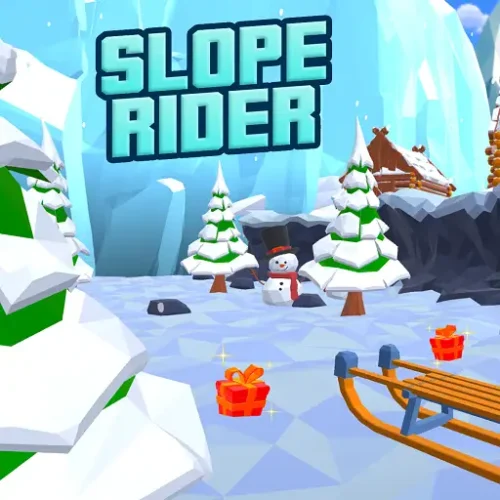
Slope Rider is a free endless sled arcade game developed by 1Games.IO, released on 21 August 2025 and updated over a dozen times since then. You steer a sled down procedurally generated winter slopes through three distinct terrain environments, dodging and jumping over a mix of static and moving obstacles — trees that collapse without warning, boulders that roll across your path, and logs that shift position mid-run.
What separates it from most winter runners is the dynamic obstacle system. Most games in this genre put static objects in your way. Slope Rider puts objects that move — falling from above, rolling from the sides, collapsing as you approach them. Reading a rolling boulder’s trajectory is a genuinely different skill from dodging a stationary tree, and that distinction is the core of what makes longer runs feel earned.
Rated 9.1 from over 23,000 players. No download, no account. Plays in any browser on desktop, tablet, and mobile.
Controls
| Input | Action |
|---|---|
| ← → Left / Right Arrow | Steer the sled left and right across the slope |
| ↑ Up Arrow | Jump over fallen trees, rolling boulders, and other hazards |
| Tap left / right (mobile) | Steer — same as arrow keys |
| Tap up (mobile) | Jump |
Three inputs. The jump — Up Arrow — is the mechanic that distinguishes Slope Rider from a purely lane-switching game. Some obstacles can be steered around. Others are wide enough that steering is not an option and a well-timed jump is the only way through. Knowing which to apply to which obstacle, at speed, is the skill the game is actually testing.
The Three Terrain Environments
Slope Rider’s world is not a single repeating snow slope. Three distinct environments are woven through each run, each with a different visual character and a different obstacle pattern to read.
How the Obstacles Actually Move
This is the thing most Slope Rider guides skip entirely. The game uses three categories of obstacle behavior and each requires a different response.
Sleds and What the Differences Actually Mean
Slope Rider includes multiple unlockable sleds, and the distinction between them is not purely cosmetic. Each sled has different trait weighting across three categories: speed, jump precision, and maneuverability.
A higher-speed sled covers more distance per run but compresses the time you have to read each obstacle. A better-maneuverability sled turns more sharply at the cost of raw pace. Better jump precision affects how forgiving the timing window is on the Up Arrow input — a sled with higher jump precision lets you clear rolling boulders slightly later in their approach than a sled with worse jump stats.
The implication: new players benefit from maneuverability-focused sleds while learning the obstacle patterns. Players who have the patterns memorized and want to push distance scores benefit more from speed sleds once they can reliably clear obstacles at pace.
Daily Missions and Achievements
Two systems give each session a purpose beyond raw distance. Daily missions reset every 24 hours and set specific objectives — reach a certain distance, jump a specific number of times, collect a set amount of coins. Completing them awards gift boxes that unlock new sleds and cosmetic items not accessible through regular coin spending alone.
The achievement system, added in February 2026, tracks milestones across your full play history — total distance covered, total jumps, number of runs completed, obstacles cleared by specific method. Achievements provide permanent unlocks and serve as a long-term progression record that makes individual short runs feel like they contribute to something larger.
Seasonal Events
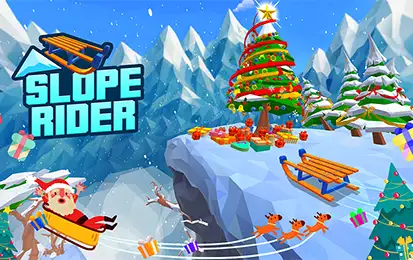
1Games.IO runs seasonal events that transform the visual and obstacle design of Slope Rider for limited periods. The Halloween 2025 event introduced creatures as obstacles alongside the standard hazards. The Christmas 2025 event added a themed visual layer with seasonal obstacles. New terrain and content are added during events and some of it — like new permanent terrain types — stays in the game after the event ends.
Events are announced through the 1Games platform and run for several weeks. Missing an active event means missing the limited-content unlocks available only during that window.
Tips for Longer Runs
- Stay centered unless you have a specific reason to move. A sled in the center of the slope has the option to steer left or right. A sled near one edge has lost one of those options. After every obstacle, return to center before the next one arrives.
- Watch the obstacle three positions ahead, not the one directly in front. At Slope Rider’s pace, reacting to the immediate obstacle is already slightly late. Focusing your eyes further down the slope gives your hands an extra beat of preparation time — which is the difference between a clean dodge and a forced, last-second input that often overcorrects.
- Jump is for wide obstacles, not emergency escapes. Using the jump reactively — when an obstacle is already too close to steer around — usually results in landing on top of it. Jump inputs need to be made slightly before the obstacle arrives, not when it is already at your sled. If you feel the urge to jump as an emergency, it is almost always too late for the jump to help.
- React to the boulder’s direction of roll, not its position. A boulder rolling left means steer right, toward the side the boulder has already cleared. Steering left — the intuitive response to something coming from the left — puts you directly in its path.
- Gift boxes near hazards are usually not worth the detour. A gift box sitting adjacent to a collapsing tree or a rolling boulder requires approaching that hazard zone to collect. The sled unlock it might contribute toward is worth less than the run distance you lose when the detour goes wrong. Collect gifts that are on your natural path.
Similar Games You Will Like
Frequently Asked Questions
Slope Rider earns its 9.1 rating by doing one thing most winter endless runners do not bother with: it makes the obstacles interesting. Boulders that roll, trees that collapse, logs that shift — each one requires a read, not just a reflex.