











Color Surfer
What Is Color Surfer?
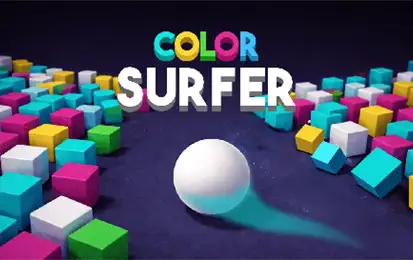
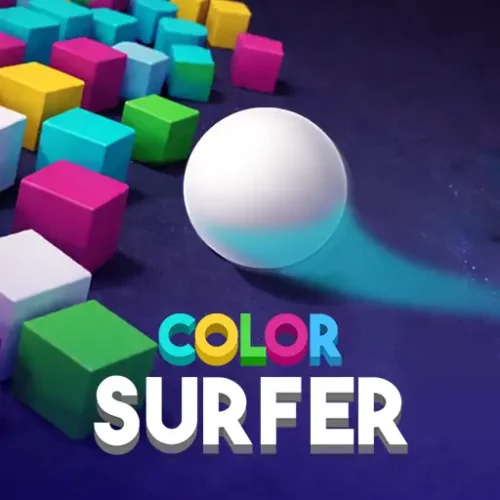
Color Surfer is a free 3D arcade obstacle game developed by AZGames and released in April 2026. You guide a rolling ball along a forward-moving track filled with obstacles. One rule runs every level: you can only collide with objects that match your ball’s current color. Touch anything else and the run ends instantly.
What makes it more than a simple avoid-everything game is that your ball’s color changes automatically over time and at section transitions. The path that was safe a moment ago becomes lethal the moment your color shifts. Surviving requires reading both the obstacle layout ahead and what color you will be when you reach it.
Over 200 levels with cleared stages staying marked across sessions. No download, no account. Plays in any browser on desktop, tablet, and mobile.
How It Works
The ball moves forward automatically. You steer left and right by dragging the mouse or swiping on mobile. The track is filled with obstacles of various colors. Some match your ball. Some do not. The ones that do not end the run on contact.
Your ball does not stay one color. It cycles through the palette automatically — on a timer and at level section transitions. This color-shifting creates the game’s core tension: you need to know not only where the safe path is right now, but where it will be by the time you get there.
Controls
| Input | Action |
|---|---|
| Hold + Drag Left/Right | Steer the ball across the track |
| Swipe left/right (mobile) | Same — touch-based steering |
One input, one direction of movement. The difficulty lives entirely in when and how far to steer, which depends on reading both the path and your upcoming color simultaneously.
The Color-Matching Rule — and the Shield Technique
The basic rule is simple: match your color, hit the object safely. Mismatch, and the run ends. Most new players apply this defensively — find a path between mismatched colors and stay on it.
The more advanced application flips this. Same-color objects can be pushed deliberately into the path ahead, using them as shields to clear mismatched obstacles before the ball reaches them. A block that shares your current color is not just safe to touch — it is a tool. Players who learn to push same-color objects ahead survive sections that pure avoidance cannot handle, particularly in later levels where safe open paths narrow significantly.
Color shifts happen on a timer and at section boundaries. Before committing to a route through a cluster of obstacles, check how far away the next color shift is. A clear path that works at your current color may become a wall of mismatches two seconds from now. Planning one color-step ahead is the skill that separates early-level players from late-level survivors.
The Five Obstacle Types
How Difficulty Scales
Across 200+ levels the game escalates in two ways. Speed increases, compressing the timing window for every decision. Obstacle density rises, narrowing the safe paths between hazards. A level layout that felt comfortable at standard pace feels completely different at the higher speed of level 100+.
Cleared levels stay permanently marked, so every session contributes to visible progression through the full course rather than resetting. This gives longer players a genuine long-term objective rather than just score chasing.
Tips for Getting Further
- Watch the color shift timer, not just the obstacles. The obstacles are visible far enough in advance to plan around. The color shift is invisible unless you are tracking when the last one happened. Develop a rough sense of the shift cycle so upcoming transitions do not catch you mid-path.
- Use same-color blocks as pushers, not just safe-to-touch objects. When you see a same-color block in the path ahead with mismatched objects beyond it, steer into it deliberately to push it forward and clear what is behind it. This is consistently more reliable than trying to thread through gaps in tight sections.
- Slow your steering at section transitions. Color-shifted zones are the moments of maximum vulnerability. Enter section boundaries with minimal committed steering input so you have room to adjust once the new color and obstacle layout are visible.
- Stay central between color shifts. A centered ball position when a color shift occurs gives you movement options in both directions. A ball near one edge when the color shifts may find itself immediately adjacent to a now-mismatched obstacle with nowhere to go.
Similar Games You Will Like
Frequently Asked Questions
Color Surfer takes a concept that sounds straightforward — match your color, avoid the rest — and builds genuine depth into it by making the ball’s color shift automatically rather than staying fixed. That one decision transforms the game from a pure reaction test into a prediction challenge where reading upcoming obstacles and upcoming color transitions simultaneously is the skill that determines how far you get.