










Sky Dart
What Is Sky Dart?
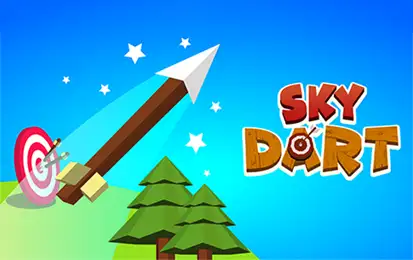
Sky Dart is a free skill-based archery distance game developed by AZGames and released in 2026. You aim and launch arrows across wide open skies — but unlike most archery games where the shot ends at release, Sky Dart gives you control of the arrow mid-flight. After launch you guide the arrow left and right to avoid obstacles, collect bonus targets, and push for maximum distance before it falls.
The distance your arrow travels is the score. Every successful run earns coins to spend on power upgrades. Better upgrades unlock further reach, which opens new terrain environments and longer distance milestones. The progression is satisfying, steady, and never requires long sessions to feel meaningful.
No download, no account. HTML5, plays in any browser on desktop, tablet, and mobile.
How It Works — Three Phases per Shot
Each shot runs through three distinct phases. Most archery games end at the second one. Sky Dart keeps the challenge going through all three.
Controls
| Input | Action |
|---|---|
| Hold + Drag | Set power and launch angle before firing |
| Release | Launch the arrow |
| Drag Left / Right | Steer the arrow while it is in the air |
| Touch controls (mobile) | Same — press and hold to aim, release to fire, drag to guide |
The Power Balance Problem
New players almost always overcharge their shots. Full power looks like it should produce maximum distance — a harder throw should go further. In practice, maximum charge launches the arrow steeply upward rather than forward, wasting the power on height that does not translate into range.
The optimal approach is medium power with a well-chosen angle. A medium-powered shot launched at the right trajectory spends more time travelling forward before gravity brings it down. A maximum-powered shot goes high, arcs steeply, and lands much shorter than its charge suggested it should.
Find the angle that keeps the arrow travelling at roughly 45 degrees after launch and apply around two-thirds of maximum power. That combination produces a consistent forward arc with enough momentum to sustain long flight. Once you have found an angle and power combination that feels right, small adjustments from there produce much better results than resetting entirely each attempt.
Bonus Targets and Score Multipliers
Bonus targets appear along the flight path during each run. Steering the arrow through them during the mid-air guidance phase doubles or quadruples the coins earned from that shot. The multipliers stack in some cases — hitting two bonus targets in one run produces a significantly larger coin reward than missing both even on a longer run.
Boost rings appear at certain distances and give the arrow a burst of additional speed and lift when passed through, extending the run beyond what the initial launch power would normally sustain. Both bonus targets and boost rings are accessible through active mid-air steering rather than hoping the arrow drifts into them naturally.
The Wind Factor
Wind conditions change between attempts. A tailwind (blowing in the same direction you are shooting) gives the arrow additional forward push and can significantly extend the natural range of a well-aimed shot. A headwind (blowing against your shot direction) reduces forward momentum and compresses effective range.
The wind indicator visible before each shot shows direction and strength. Adjusting your aiming angle slightly into the wind on a headwind attempt — rather than shooting directly forward — partially compensates for the compression effect. Players who ignore wind and shoot the same way regardless of conditions see inconsistent results; players who read and adjust see a more predictable performance across attempts.
Coins, Upgrades and Progression
Every run earns coins based on the distance the arrow travels plus bonuses from any targets hit mid-flight. Coins are spent on upgrades between runs — primarily power upgrades that increase the effective force of each launch and arrow upgrades that affect mid-air handling characteristics.
Upgrading power is the primary progression driver. Each tier of power upgrade opens distance milestones that were previously unreachable regardless of technique, which in turn unlocks new terrain environments with their own obstacle layouts and bonus target placements.
Tips for Longer Runs
- Never use full charge. Two-thirds power at the right angle travels further than maximum power every time. Overcharging is the single most common cause of shorter-than-expected runs, especially for players who have just upgraded their power tier and are testing the new ceiling.
- Check wind before aiming, not after. The wind indicator updates before each shot. Read it before you start the aim drag, not halfway through the shot. A wind compensation built into the initial angle is more precise than a mid-aim adjustment after you have already started charging.
- Steer toward bonus targets even if it costs a straight line. The coin multipliers from bonus targets are substantial enough that a slightly shorter run that hits two bonus targets earns more than a longer run that misses both. Prioritise multipliers over pure distance on runs where they are accessible.
- Adjust slightly between runs, not dramatically. The most common improvement trap in Sky Dart is making large aim changes after a short run. Small angle and power adjustments — fine-tuning what you already have — produce more consistent improvement than resetting to a completely different approach. Once a combination produces a solid result, make incremental changes from there.
- Upgrade power before arrow handling. Power upgrades unlock distance milestones and new terrain. Arrow handling improvements are useful but secondary in the early upgrade path. The most impactful investment is the one that literally lets you go further — that is always the next power tier.
Similar Games You Will Like
Frequently Asked Questions
Sky Dart earns its appeal by treating the arrow’s launch as a beginning rather than an ending. Mid-air guidance turns what would otherwise be a straightforward angle-and-power puzzle into an active two-phase skill challenge — aim well before release, then react well after it.