


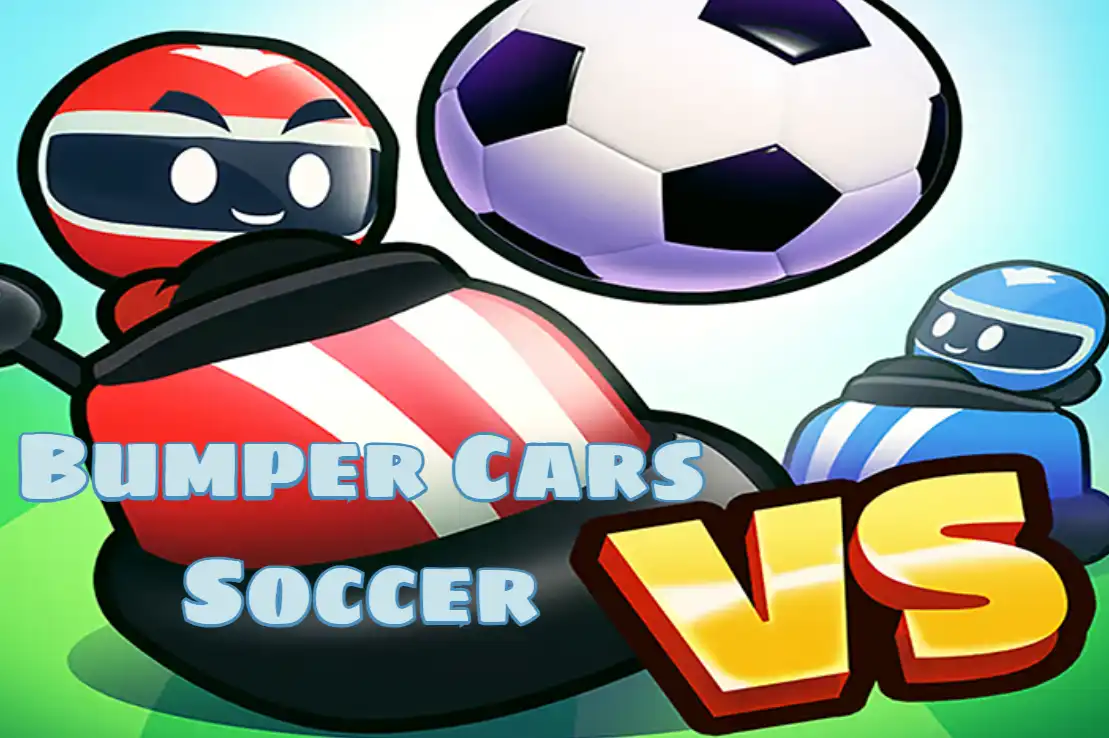
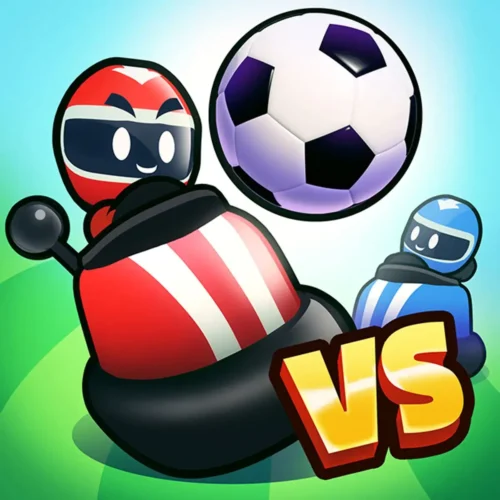




Bumper Cars Soccer is a physics-based car soccer game developed by Bdeuxagames, released in May 2024. It runs in the browser via HTML5 and WebGL on PC and mobile with no download required. Two players share one keyboard in local mode; solo play goes against AI. The goal is to score more goals than your opponent by ramming a giant soccer ball into the net using your bumper car.
Contents
Controls
| Action | Player 1 | Player 2 (2P mode) |
|---|---|---|
| Drive / Steer | WASD | Arrow Keys |
| Boost | Spacebar | Spacebar (shared or designated) |
| Hit ball (some builds) | Left click | — |
Two things most competitors don’t mention: Player 1 controls the car on the right side of the field, not the left — the opposite of what most players assume when they first load in, which causes early confusion. Second, tapping the movement keys produces more accurate control than holding them.
Bumper cars have momentum — holding a direction keeps adding speed until the car overshoots the ball entirely. Short, deliberate taps let you position precisely rather than chase the ball in circles. The boost is a burst of extra speed — save it for the final approach on a shot or a last-second defensive sprint, not as a constant speed increase.
Car Selection
At match start, players choose from a selection of colorful bumper cars. Achievements unlock additional cars beyond the default options, though specific achievement requirements aren’t publicly documented. The available cars differ visually — color, shape, and design vary — but no source confirms stat differences between them. From a gameplay standpoint, car choice is cosmetic; control and physics behave the same across all vehicles.
Game Modes
- Single-Player (vs AI) — One player competes against a CPU-controlled opponent. Best for learning the physics and angles before playing against a human. Player 1 takes the right-side car; the AI operates the left. The AI responds to the ball but doesn’t fake or set angles deliberately, so it’s predictable once you understand its reactive movement pattern.
- Two-Player (Local) — Both players share the same keyboard: Player 1 on WASD, Player 2 on Arrow Keys. Competitive, real-time 1v1 on the same screen. This is where the game’s physics are most unpredictable — human opponents create chaotic, reactive collisions that the AI doesn’t replicate. Desktop is strongly recommended for 2P mode; mobile touch controls make the split-key layout impractical on a shared screen.
Tips and Strategy
▸ Approach the ball at an angle, not head-on
Hitting the ball directly from behind sends it straight forward with no directional control. Coming in from a 30–45° angle redirects the ball across the field, toward the post, or into open space where the opponent isn’t positioned. Beginners always rush straight at the ball; that’s the predictable, easily blocked approach.
▸ Tap, don’t hold — especially near the ball
Bumper cars accelerate continuously while a key is held. At full speed, your car’s momentum carries it past the ball before contact is meaningful. Feather the movement keys when within a car’s length of the ball to maintain controlled, low-speed contact that sends it exactly where you intend. Mashing is the primary cause of own goals.
▸ Use quick reverses to fake out the opponent
Tapping the opposite direction key while moving creates a brief deceleration that mimics a change in intent. In 2P mode, this draws the opponent car toward your previous position, opening a gap on the ball’s other side. Following a fake reverse with an angled dash creates clean scoring chances that straight rushes never produce.
▸ Use the walls to redirect the ball toward goal
The arena’s side walls are live surfaces. A ball hit into the side wall at the right angle comes back across the face of goal — a cut-back trajectory that’s much harder for the opposing car to intercept than a direct shot from the same position. Hitting the ball along the wall rather than across the open field also keeps it close to your control path.
▸ Save boost for the last-second defensive sprint
Boost is a short-duration burst. Players who use it offensively often arrive at the ball too fast for a controlled contact. Its best use is covering distance quickly on a defensive retreat — getting between the ball and goal when the opponent is already in position. A well-timed defensive boost clears a near-certain score; a wasted offensive boost creates an own-goal risk.