




Stickman Hook
There is a moment in Stickman Hook when the physics clicks. You stop reacting and start flowing — hook, swing, release, fly, hook again — and the stickman moves through a level with a smoothness that feels genuinely earned. Getting to that moment is what the first hundred attempts are actually for.
Stickman Hook is a free physics-based swinging game developed by French studio Madbox, originally released on 3 October 2018. More than 50 million plays later, it remains the standard for browser swinging games — not because it invented the grappling hook mechanic, but because Madbox spent 47 iterations getting the swing physics to feel exactly right before releasing it. You feel the difference immediately.
The One Skill That Decides Everything
You can summarize all of Stickman Hook’s depth in a single sentence: release the rope at the peak of your forward swing. Everything else in the game builds on top of that one timing decision.
Hold too long past the apex and the stickman swings backward, burning the momentum you built. Release too early — before you have reached the peak — and you fly at the wrong angle with less force behind it. Release exactly at the top of the arc, when the stickman is pointing furthest forward and highest, and you rocket toward the next hook with maximum height and distance. That window is small at first. After enough levels, it becomes instinct.
This is why new players feel like the game is chaotic and unpredictable. It is not — the physics are completely consistent. The chaos is your own uncertainty about where the peak is. Once you can feel it, the game transforms from a stumbling mess into something closer to rhythm.
Hold and Release — The Controls
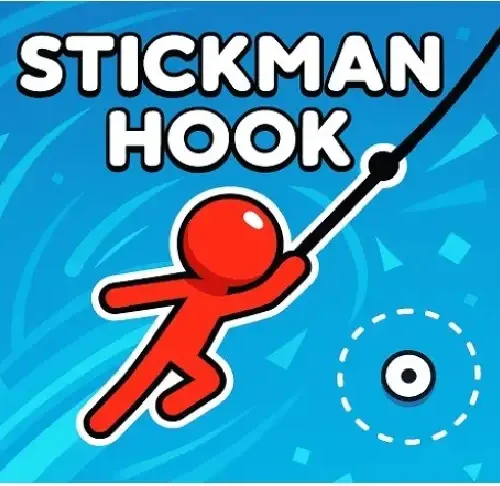
Hold the mouse button (or hold a tap on mobile) to throw your rope onto the nearest hook point and begin swinging. Release to let go and fly through the air. That is the entire control scheme.
The depth comes from what happens between hold and release. The angle your rope makes with the hook, the speed you were carrying when you attached, and the precise moment of release all feed into the physics simulation together and produce a different result every time one of them changes. No two swings are identical unless you make them identical.
Two States, One Character
Something Stickman Hook does that almost no guide mentions: your character exists in two genuinely different physical states throughout a level.
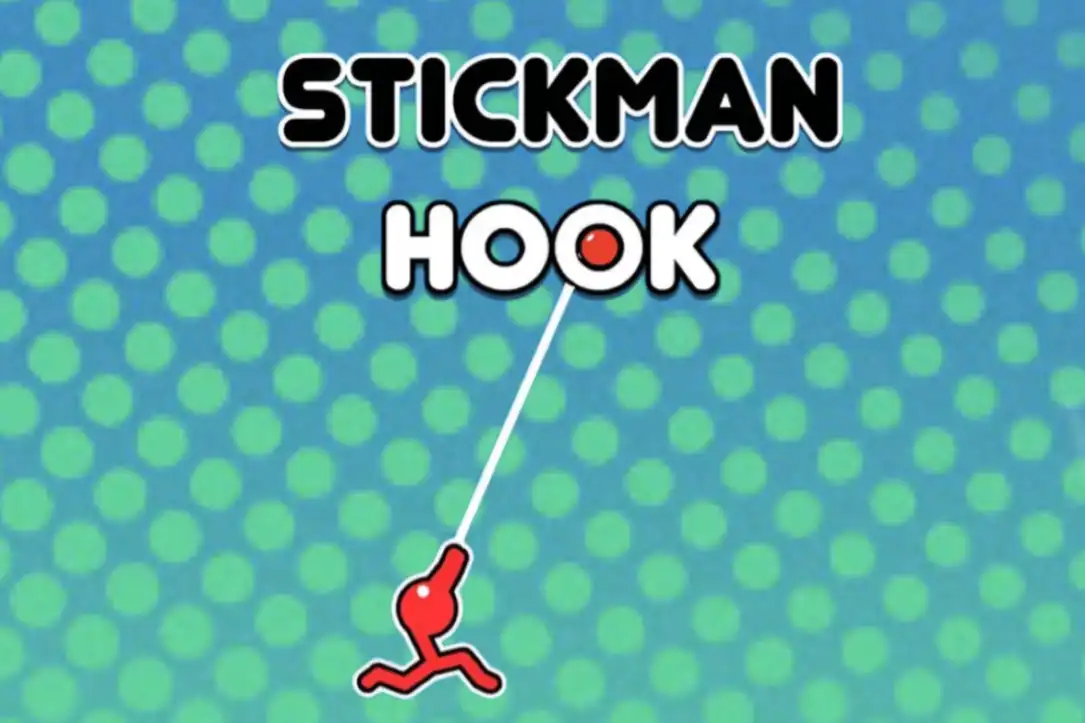
When you are not attached to a hook, the stickman compresses into a ball — light, fast, and subject to gravity alone. It flies, falls, bounces off things. When you grab a hook and the rope tightens, the ball extends into the full stickman form and swings in a pendulum arc around the anchor. The transition between states happens instantly and the physics change with it. Understanding when to be a flying ball and when to hook and become a pendulum is a strategic layer that goes beyond just “swing from point to point.”
What the Levels Actually Teach You
The first dozen levels exist to teach the hook-swing-release cycle in controlled conditions. Clean hooks, generous spacing, no hazards. They feel almost too easy and they should — you are building the muscle memory for timing before the game starts demanding it.
Bumpers arrive and change the equation. Landing on a bumper launches the stickman into a high arc that can skip two or three hooks entirely, which sounds helpful until you realise you have been launched past the hooks you needed. Learning to use bumper momentum rather than fight it is its own mini-skill.
Later levels compress the gaps, add moving platforms, spinning blades, and obstacles that end a run instantly on contact. The underlying mechanic never changes — still hold, swing, release — but the margin for error on each timing decision progressively shrinks toward zero. The best runs through late levels look effortless from the outside and feel nothing like effortless from the inside.
When to Skip a Hook
One of the most counterintuitive things experienced players do is deliberately miss hooks. When your ball is in flight at good speed and height, attaching to the next available hook can actually kill momentum by forcing a slow, low-arc swing where a free flight would have carried further. Reading whether to grab or skip is a judgment call that does not appear in any tutorial. It comes entirely from playing enough levels to sense when your current trajectory is already better than any swing could produce.
The instinct to hook onto every available point is exactly what makes early runs choppy. A clean flying arc with good speed carries more promise than a slow swing from a poorly-timed hook. The game rewards letting physics work for you rather than constantly interrupting it.
The Characters
Completing levels and reaching distance milestones unlocks a growing collection of stickman skins. These range from colourful costume designs to animals and themed characters — none of which change the physics or gameplay in any way. The unlock system gives long-term sessions a cosmetic goal separate from level completion, and the designs have enough variety that there is usually something in the collection worth chasing.
Stickman Hook 2 is available on the iOS App Store as the official sequel from Madbox, with new gameplay elements while keeping the core swing mechanics intact.
A Few Things That Actually Help
Trampolines launch further from the centre. Landing off-centre on a trampoline gives you a weaker bounce — hit the middle for the full height boost that can carry you over long gaps. On levels with ceiling constraints, shorter swings with quicker releases keep the arc flatter and prevent the stickman from clipping above the path. And on any level where a run is going badly after the first few hooks — restart immediately. The muscle memory you build from clean starts is more useful than grinding through a compromised run trying to recover.
Similar Games You Will Like
Questions Players Actually Search For
What makes Stickman Hook last where similar games fade is that the physics actually earns the trust you place in it. When a swing goes wrong you know exactly why — and that means you know exactly what to fix. 150 levels of that feedback loop, paired with a satisfaction curve that makes every improvement feel concrete, is the reason 50 million people have picked it up.