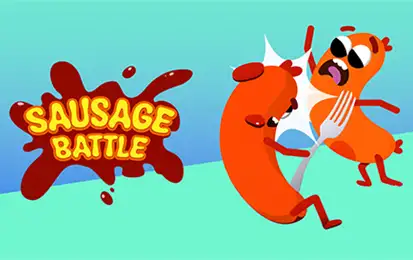
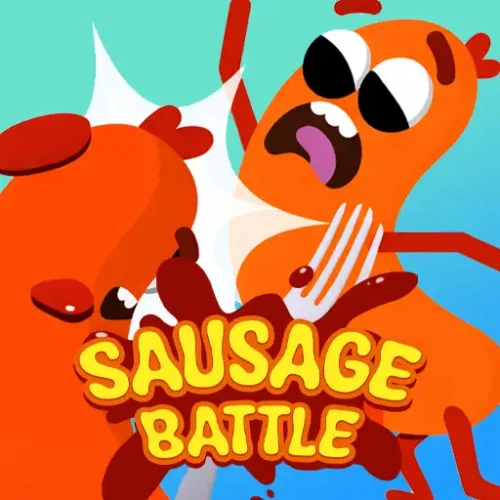
Sausage Battle is a free 3D physics-based arena survival game developed by AZGames and released in April 2026. You control a stretchy, floppy sausage fighter on a hazard-filled kitchen stage. The goal is to be the last sausage standing by knocking opponents into traps, off ledges, or into the environmental hazards scattered across every arena.
There is no direct damage system. You do not deal health points. You manage space — pushing opponents toward spinning blades, open pits, laser grids, and grills until they make contact with something lethal. The combat is absurd in premise and genuinely strategic in practice.
One input controls everything. Drag to move. Release to push. The entire game lives in that single mechanic and the positional decisions built around it. No download, no account. Plays in any browser on desktop, tablet, and mobile.
AZGamesDeveloper
April 2026Released
9 Campaign StagesUnique Hazard Logic
FreeBrowser + Mobile
Sausage Battle – Crazy Fun Food Battle Royale
How the Controls Work
Sausage Battle runs on a single input. Hold and drag to move your sausage around the arena. Release to perform a push or headbutt in the direction you are facing. Both movement and attack share the same trigger — the distinction is whether you are holding or releasing.
Input
Action
Hold + Drag
Move your sausage across the arena
Release
Push or headbutt in your current direction
Touch and drag (mobile)
Same as mouse — drag to move, release to push
The simplicity is deliberate. New players understand the mechanic in seconds. The depth comes from reading when and where to release — a push into open air is wasted, a push that sends an opponent into a spinning blade or off a ledge is an elimination. Timing and positioning replace the attack complexity that other fighting games build around multiple buttons.
The Growth Mechanic
Defeating an opponent causes your sausage to grow in size. A larger sausage hits harder on pushes and covers more space during movement. This creates a natural mid-game momentum shift — eliminating one opponent makes the next elimination slightly easier, which makes the third even easier. An early lead compounds as long as you can protect the size you have built.
The trade-off is that a larger sausage is also a larger target. A big sausage near a hazard is easier to redirect into it. Growth is power on offense and vulnerability on defense — the strategic balance between them is what the late game of every match is built around.
The 9 Campaign Stages
Campaign Mode runs through 9 distinct arenas, each built around a specific hazard logic that changes how combat works on that stage. The kitchen setting spans wildly different environments.
🔪
Kitchen — Spinning Blades and Grills
The introductory stage. Spinning blades sweep sections of the arena on a rotation and grills occupy fixed positions. Aggressive forward pushes work well when the blades are on the far side of the arena and poorly when they are sweeping the space between you and your opponent. Learning the blade rotation before charging is the foundational habit this stage teaches.
🌿
Garden — Wide Edges, Patience Rewarded
Open edges dominate this stage. The hazard is not a blade or grill but the wide perimeter drop. Patient redirection — maneuvering opponents toward the edges over several pushes rather than one dramatic move — is more consistent here than aggressive headbutts that often send both sausages toward the same edge.
🔬
Lab — Laser Grids
Laser lines divide the arena into corridors that shift between active and inactive. The safe path through the stage changes as the lasers cycle. Positioning an opponent in a corridor that is about to activate is the primary elimination route — and being caught in one yourself is the primary death cause. Movement rhythm and laser timing replace pure push timing as the core skill.
⚙️
Factory — Moving Machinery
Industrial machinery moves through the arena on tracks, shifting which zones are safe at any given moment. The stage layout changes dynamically mid-fight rather than following a fixed pattern. Sausages that try to establish and hold a single position get caught by machinery that moves their safe zone. Constant low-level repositioning to stay ahead of the machinery while maintaining pressure on opponents is the required playstyle.
🐄
The Farm — Unpredictable Terrain
Irregular terrain without the mechanical predictability of the earlier stages. Hazards and terrain features are less pattern-based, rewarding adaptability over memorized strategies. The Farm is the stage where players who have relied on fixed approaches from earlier stages often struggle — and where players with flexible positional instincts tend to perform best.
🔴
Laser Massacre — Total Laser Coverage
The entire stage is covered in laser hazard zones that cycle rapidly, leaving only brief windows of safe ground. Constant movement is not optional — standing still at any point gets caught by a laser cycle. This is the most movement-intensive stage in the campaign and the one where the one-button drag-and-release control scheme is most demanding.
🕳️
Trapdoor Hell — Random Floor Panels
Floor panels open randomly throughout the match, creating sudden gaps in apparently solid ground. Unlike the other stages where hazards are visible and predictable, trapdoor timing is random. No position on this stage is unconditionally safe, which shifts the optimal strategy toward constant movement and keeping opponents between you and the unpredictable floor rather than anchoring to a fixed position.
🔥
Burning Death — Fire Hazards
Fire zones spread across the arena in patterns. The visual distinctiveness of fire makes the hazard zones easier to identify than the laser-based stages, but the spread patterns create moving walls of damage that require specific routing to stay ahead of. This stage plays more like a movement puzzle layered over the push mechanic than a pure combat stage.
☠️
Final Stage — Combined Hazards
The campaign’s final stage combines hazard types from earlier stages. Multiple threat types active simultaneously remove the option of optimising for one hazard category. The final stage rewards the complete skill set developed across the eight preceding stages rather than any single strategy.
Strategy — Position Over Force
The most important principle in Sausage Battle is that you are not trying to push opponents into submission through sheer force. You are managing their position relative to the hazards that will eliminate them.
A push in the center of a stage accomplishes almost nothing even if it connects. The same push landing with an opponent a step from a spinning blade, an open pit, or a laser line is an elimination. The value of every push is entirely determined by where the opponent is when it lands.
Let opponents eliminate themselves first
Every arena has multiple opponents fighting each other simultaneously. In the early phase of any match, opponents who are not directly engaging you are still being threatened by the same hazards and by each other. Positioning yourself away from the main cluster, staying mobile, and letting the field thin through natural combat — then engaging when fewer opponents remain — is consistently more effective than rushing the center from the opening bell.
Tips for Surviving Longer
📍Always know where the nearest hazard is before pushing. A push with no hazard behind the opponent wastes the move. A push toward a blade, edge, or laser line is a potential elimination. Before executing any release, check what the opponent will hit if they travel in that direction.
🐌Smaller patient loops beat straight-line charges. Charging directly at an opponent is the most predictable move available and the easiest to dodge. Curved approaches from the side or from behind put the opponent in a position where they cannot simply move away — the push lands and they have less room to redirect.
📏Use your growth advantage near edges, not in open ground. A larger sausage is harder to push around but easier to redirect into edge hazards. When you are large, stay away from perimeter edges and work toward the center. When you are small, the edges of the arena are more dangerous for you than for a bigger opponent.
⏳In Campaign mode, observe the hazard cycle before committing. Each stage has a hazard pattern that repeats. The first few seconds of a new stage are most safely spent moving conservatively and reading the pattern rather than engaging immediately. A player who knows the Kitchen’s blade rotation by the third wave is significantly more dangerous than one who is still discovering it at the fifth.
Sausage Battle was developed by AZGames and released in April 2026.
What are the controls?
Hold and drag to move your sausage. Release to push or headbutt in your current direction. On mobile, touch and drag replaces the mouse. Both movement and attack share the same single input.
How do you eliminate opponents?
By pushing them into environmental hazards — spinning blades, grills, laser grids, fire zones, trapdoors, or open ledge drops. There is no direct health damage system. Every elimination requires redirecting an opponent into something the arena will finish for you.
What happens when you defeat an opponent?
Your sausage grows in size, which increases the force of your pushes and gives you a combat advantage. Larger sausages hit harder but are also easier to redirect into hazards by opponents, so size is both power and risk.
How many stages are in Campaign Mode?
Campaign Mode has 9 unique stages: Kitchen, Garden, Lab, Factory, The Farm, Laser Massacre, Trapdoor Hell, Burning Death, and a final combined-hazards stage. Each one is built around a specific hazard logic that changes how positioning and pushing work on that stage.
What is the best strategy for new players?
Stay mobile, avoid the main cluster of fighting sausages in the early phase of each match, and let opponents reduce each other’s numbers before engaging. When you do push, check where the opponent will land relative to a hazard before releasing — a push into open ground does nothing, a push toward a blade or edge is a potential elimination.
Can I play Sausage Battle on my phone?
Yes. The game runs on mobile browsers with touch-based drag controls. The drag-to-move and release-to-push mechanic translates directly to touchscreen play.
✦ Final Verdict
Sausage Battle earns its place in the physics arena genre by committing to a single-input design that carries genuine strategic depth. Drag to move, release to push — two states of one button — and everything else is positional thinking about where your opponent is relative to the hazards that will end their run.