






Papa’s Scooperia
The Vacation That Became an Ice Cream Empire
Your sightseeing trip to Oniontown goes sideways immediately. Your money is gone. Your belongings are gone. Papa Louie, who somehow always seems to be nearby when disaster strikes, offers his solution: stay and run his brand-new ice cream shop until you earn enough to leave. What starts as a temporary fix becomes a full seasonal operation with dozens of regulars, a sticker collection, daily mini-games, and more cookie varieties than you knew existed.
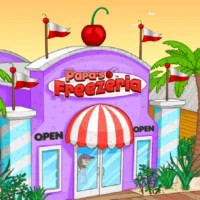
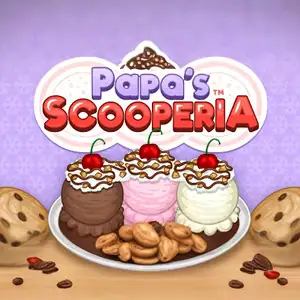
Papa’s Scooperia is a time management cooking game developed by Flipline Studios — the team behind the entire Papa Louie restaurant series — and released on July 24, 2018. It is the fourteenth game in the series and holds a specific piece of Flipline history: it was the last Papa’s game to launch as a Flash game, making it the final chapter of an era that stretched back to 2006. The HTML5 version you play today keeps the original experience intact.
What makes it stand apart from other games in the series is the two-stage production system. You are not just assembling ice cream — you are baking the cookies it sits on first, which creates a genuine production line challenge that most Papa’s games do not have.
How the Game Actually Works
Papa’s Scooperia runs on three stations and the challenge is managing all of them simultaneously. Customers arrive with an order — a specific cookie type, specific ice cream flavors in a specific order, specific toppings, and specific sauces. Your job is to execute that order perfectly without letting other customers wait too long while you do it.
The Real Challenge: Production Timing
Papa’s Scooperia is not a reaction game. You are rarely rushed by a single order. The challenge is running multiple orders at different stages of completion without any of them going wrong or making a customer wait too long.
While cookies for Order A are baking, you should be taking Order B and starting its cookies. While those are baking, you assemble Order A’s sundae at the Build Station. While Order A is being served, Order B’s cookies might be done. This production chain — where every quiet moment is an opportunity to advance the next order — is what separates long-time players from people who wait at the oven doing nothing.
Customer patience meters tick down the longer they wait. Serving someone quickly — even with a slightly imperfect order — can earn a better tip than a perfect order delivered slowly. Learning to read which customers have short patience and which are more relaxed is something you pick up naturally over the first few in-game days.
Controls
| Input | Action |
|---|---|
| Mouse click | Select stations, ingredients, tools, and customers |
| Click and drag | Scoop ice cream onto the build station, add toppings |
| Touch / tap (mobile) | Same as mouse — all interactions are click-based |
The controls are entirely mouse-driven and intentionally simple. Every instruction is shown on screen during the tutorial, and Papa Louie guides you through the first order step by step. The interface never becomes the difficulty — what becomes difficult is the management layer beneath it.
The Sticker System and What It Unlocks
Papa’s Scooperia includes a sticker collection of 90 stickers, earned by completing specific in-game tasks and achievements during play. Each customer in the game has three favorite stickers. Collect all three of any customer’s favorites and you unlock an exclusive new outfit for that character.
This system is one of the reasons longer-term players keep coming back. Unlocking customer outfits requires playing a variety of tasks — not just serving orders perfectly — which naturally pushes you to explore parts of the game you might otherwise skip. The stickers also function as a progress tracker that shows which challenges you have completed and which remain.
The Seven Daily Mini-Games
Each in-game day of the week has its own unique mini-game that you can play between serving shifts. Completing them wins prizes — decorations for the shop, accessories for your character, or items that add variety to your sessions. The mini-games are genuinely different in style from each other and from the main service gameplay, acting as a consistent change of pace that prevents any single session from feeling repetitive.
These are not optional padding — the rewards they provide are part of the game’s customization loop, and players who skip them miss a significant portion of what the game actually offers outside the service stations.
Ranks and Long-Term Progression
The game tracks your performance across 44 ranks, with each rank unlocked by accumulating enough points from tips, order accuracy, and customer satisfaction. New ranks unlock new customers, new ingredients, and new customization options for the shop. The final rank — “Better Than Papa!” — is the benchmark the game measures everything against, and reaching it means you have effectively mastered what the game set out to teach you.
The rank system ensures that even after many sessions the game continues introducing new elements. A player at Rank 5 and a player at Rank 30 are playing in noticeably different versions of the same shop — different customer roster, different available ingredients, different shop layout options.
Tips for Better Orders and Higher Tips
- Start baking cookies the moment you take an order. This is the single most impactful habit to build. Every second the oven sits empty while you do other things is time you will not get back later. Cookie baking is the longest step — starting it first makes everything else fit more naturally around it.
- Bake to the exact golden center of the meter. The baking indicator shows an ideal zone. Landing in the dead center earns maximum points. A slightly pale cookie or slightly dark cookie earns less. Hovering near the oven for the last few seconds and clicking at the perfect moment is worth practicing deliberately.
- Read the ice cream order from bottom to top. The ticket shows the scoop order from bottom layer upward. Placing scoops in the wrong sequence counts as an error even if all the flavors are present. Read the full order before scooping anything.
- Sauce placement matters. Some orders specify sauce drizzled under the toppings, others over. The ticket shows this. Drizzling sauce in the wrong position costs points even when every other element is correct.
- Serve impatient customers before perfect ones. When two orders are ready at similar times, serve the customer whose patience meter is lower rather than the one whose order took more effort. A slightly imperfect order served quickly often earns more than a perfect order served after the customer has given up waiting.
- Play the daily mini-games. Their rewards unlock shop customization options and character accessories that are not accessible any other way. Skipping them for multiple in-game days means permanently missing those unlocks in that save file.
Where Papa’s Scooperia Sits in the Series
The Papa Louie series — also called the “Gameria” series — has seventeen games spanning nearly two decades. It started with Papa’s Pizzeria in 2007 and each entry introduced a new food type and a new city setting. Scooperia is one of the more beloved entries in the fan community specifically because it added the cookie-baking layer on top of the ice cream assembly, making the production chain longer and more interesting than most earlier games in the series.
Its position as the last Flash game in the series also gives it a nostalgic quality for players who experienced the original release. The HTML5 version maintains the original gameplay and visual style without requiring Flash, which has not been supported in browsers since 2020.
Similar Games You Will Like
Frequently Asked Questions
Papa’s Scooperia takes the time management formula that made the Papa Louie series famous and adds a genuinely interesting production layer that most entries in the series do not have. Baking the cookies before building the sundae turns what could be a straightforward assembly game into a real scheduling puzzle — one where every quiet moment is an opportunity and every wasted second is a customer’s patience meter ticking down.