






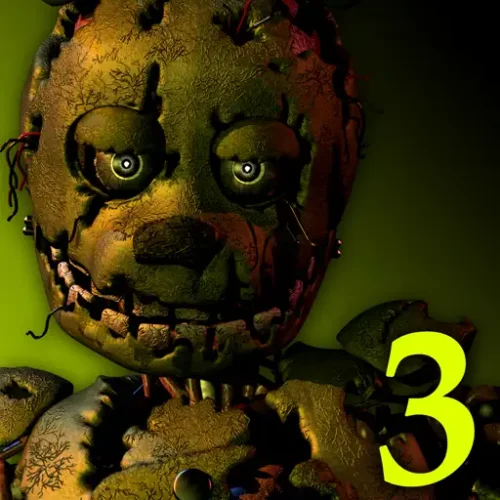







Five Nights at Freddy’s 3 takes a very different approach from the first two games. Instead of managing multiple active animatronics, almost every serious threat revolves around a single enemy: Springtrap. That sounds easier on paper, but in practice FNAF 3 becomes a game of system management, prediction, and damage control.
Set 30 years after the original Freddy Fazbear’s Pizza incidents, players work as a night guard inside Fazbear’s Fright, a horror attraction built around the mysteries of the old restaurants. During the attraction’s preparation phase, workers discover Springtrap, a damaged animatronic containing a dark secret. Once the night begins, surviving until 6 AM becomes your only objective.
What Makes FNAF 3 Different?
Most new players enter FNAF 3 expecting another camera-monitoring horror game. Instead, the biggest challenge is maintaining control of your systems while preventing Springtrap from reaching the office.
Unlike FNAF 1 and FNAF 2:
- Only Springtrap can directly end your run.
- Phantom animatronics cannot kill you.
- Ventilation management becomes critical.
- Audio lures play a major role in survival.
- System failures are often more dangerous than the enemy itself.
Because of this design, FNAF 3 rewards planning and multitasking far more than reaction speed.
Understanding Springtrap
Springtrap is the only animatronic capable of causing a game over, so most of your attention should be focused on tracking his movement.
One mistake many beginners make is constantly switching between cameras trying to locate him every few seconds. Experienced players usually monitor a small group of nearby cameras and focus on controlling his route rather than tracking every movement.
A good strategy is to keep Springtrap several rooms away using audio lures. If he disappears from your preferred camera zone, immediately begin searching neighboring rooms before he reaches nearby vents.
The longer Springtrap stays close to your office, the more difficult recovery becomes.
Why Vent Control Matters More Than Cameras
Many players focus entirely on the camera system and ignore vents until it is too late.
In reality, vents are often more dangerous than hallways.
If Springtrap enters a vent near your office, he can close distance extremely quickly. Whenever you locate him near a vent route, seal the most dangerous path immediately.
One important detail is that the vent directly connected to your office can never be permanently secured, which means delaying Springtrap is often more important than completely stopping him.
Using Audio Lures Effectively
The audio system is your strongest defensive tool.
Playing the Balloon Boy audio can attract Springtrap toward a selected location. However, many players misuse it by repeatedly activating sounds without a plan.
A better approach is:
- Locate Springtrap.
- Choose a camera far from your office.
- Play the audio lure.
- Confirm he responds.
- Continue monitoring nearby routes.
Think of the audio system as crowd control rather than a panic button.
When used correctly, it allows you to control where Springtrap wants to go.
Phantom Animatronics Explained
One of the most misunderstood mechanics in FNAF 3 involves the Phantom animatronics.
Phantom Freddy, Phantom Chica, Phantom Foxy, Phantom Balloon Boy, Phantom Mangle, and Phantom Puppet cannot directly kill the player.
Instead, they attack your systems.
After a Phantom jumpscares you, one or more systems may fail, creating opportunities for Springtrap to move closer while you’re distracted.
This means Phantoms are not dangerous because of damage—they are dangerous because they create chaos.
Experienced players avoid looking directly at Phantom appearances whenever possible.
The Real Enemy: System Failures
The biggest threat in FNAF 3 is often not Springtrap himself.
It’s losing control of:
- Cameras
- Audio Devices
- Ventilation
When ventilation fails, hallucinations begin appearing. These hallucinations make it harder to identify threats and can cause players to miss important movements.
If multiple systems fail at once, prioritize ventilation first.
A working camera system means little if hallucinations prevent you from reacting properly.
Recommended Reboot Priority
- Ventilation
- Audio
- Cameras
This order generally provides the best chance of recovery during difficult nights.
Night Survival Strategy
Early Night
During the opening hours, spend most of your time locating Springtrap and establishing control over his movement.
Avoid unnecessary camera switching and keep him contained within a manageable section of the map.
Mid Night
This is usually when system failures begin causing problems.
Pay close attention to vent routes and prepare to seal paths that lead toward your office.
Late Night
Most failed runs happen here.
Springtrap often becomes more difficult to control, and multiple system failures may occur in quick succession.
At this stage, focus on survival rather than perfect positioning.
Keeping Springtrap away from the office for even a short period can be enough to reach 6 AM.
Common Mistakes New Players Make
Chasing Springtrap Across Every Camera
Constantly searching the entire map wastes valuable time.
Instead, learn common routes and focus on nearby locations.
Ignoring Ventilation Warnings
Many players prioritize camera access over ventilation repairs.
This usually leads to hallucinations and poor decision-making.
Spamming Audio Lures
Using audio repeatedly without a plan often causes unnecessary malfunctions.
Panicking After a Phantom Attack
Phantom jumpscares are designed to disrupt concentration.
The best response is immediately checking which system failed and restoring it quickly.
Why FNAF 3 Is More Psychological Than Previous Games
Earlier games relied heavily on multiple enemies approaching from different directions.
FNAF 3 creates fear differently.
Much of the tension comes from uncertainty:
- Is Springtrap actually where you last saw him?
- Did he enter a vent?
- Is the audio lure still working?
- Will a Phantom attack cause a critical failure?
Because players spend most of the game trying to maintain control rather than reacting to visible threats, the atmosphere feels slower, more strategic, and often more stressful.
Frequently Asked Questions
Can Phantom animatronics kill you?
No. Phantom animatronics cannot directly cause a game over, but they can disable systems and create opportunities for Springtrap to attack.
What is the best way to stop Springtrap?
Use audio lures to keep him in distant rooms and seal important vents whenever possible.
Which system should I repair first?
Ventilation should generally be repaired before audio and cameras because hallucinations make threat management much harder.
Is Springtrap the only real enemy?
Yes. Springtrap is the only animatronic capable of directly ending your game.
Is FNAF 3 harder than FNAF 1 and FNAF 2?
The difficulty is different. Earlier games focus more on reaction speed and multitasking, while FNAF 3 emphasizes planning, system management, and controlling a single dangerous enemy.
Final Verdict
FNAF 3 stands out in the series because it transforms survival into a battle of information and resource management. Instead of defending against multiple attackers, players must constantly manipulate Springtrap’s movement while preventing system failures from spiraling out of control. The result is a slower, more strategic horror experience that rewards patience, map awareness, and smart decision-making more than quick reflexes. For players who enjoy psychological tension and long-term planning, FNAF 3 remains one of the most unique entries in the franchise.
HorrorSingle Player GamesStrategySurvivalUnblocked Games