







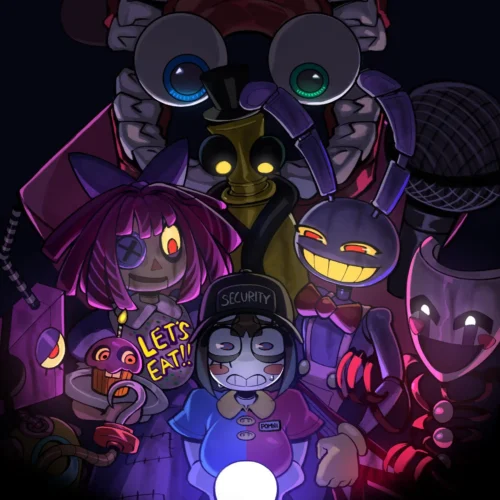








Five Nights in the Digital Circus drops you straight into a reflex test disguised as a horror game: a countdown ticks down from 2000, gift boxes and characters appear on screen, and your only job is clicking the right things before time runs out. Survive five nights, each one faster and busier than the last, with no checkpoints and no partial credit — miss the timer once and you’re restarting that night from scratch.
| Feature | Details |
|---|---|
| Developer | Alexander Denisov |
| Released | November 2024 |
| Genre | Horror clicker / reflex survival |
| Core mechanic | Click characters, objects, and gift boxes before a countdown hits zero |
| Nights | 5 total — difficulty increases each night |
| Fail condition | Miss the timer — restart the current night, no checkpoints |
| Counter | Starts at 2000, ticks down — click the red gift box to score and reset pressure |
| Platform | Browser — desktop and mobile, runs on low-spec devices |
This game is inspired by The Amazing Digital Circus animated series, but it’s worth knowing upfront that several different fan-made browser games share very similar names — “Five Nights in the Digital Circus,” “Five Nights at Pomni: Amazing Digital Circus,” and “Five Nights at Digital Circus” are separate projects by different creators with different mechanics (some are FNAF-style camera-and-door games, others are pure clickers). This guide covers the Alexander Denisov version, the clicker/reflex format described above, since it’s the most consistently documented across sources.
Contents
Controls
| Action | Input |
|---|---|
| Interact with characters/objects/gift boxes | Mouse Click (desktop) or Tap (mobile) |
One input, confirmed across Playgama listings for both the desktop and mobile versions. There’s no movement, no menus to manage mid-round, and no secondary actions — everything that happens on screen is something you either click in time or don’t. The simplicity is the point: this is designed as a short, high-pressure session rather than a game you sit with for a long stretch.
The Core Loop
The screen presents a countdown that starts at 2000 and ticks down continuously. While it counts down, characters appear and objects move around the tent. Gift boxes spawn on screen — clicking the red gift box scores points and is the primary scoring action. Characters and objects that appear also need to be clicked, and missing the click on a relevant target while the counter approaches zero is what triggers failure.
The loop never pauses: click the things that need clicking, rack up points from the red gift boxes, and keep the counter from hitting zero on an unhandled prompt. There’s no break between prompts and no way to “catch up” if you fall behind — each missed click compounds the pressure for the next one.
Night-by-Night Difficulty
Each of the five nights is confirmed to be harder than the last, with two specific changes as you progress: faster countdowns and more distractions on screen. A pace that’s comfortable on Night 1 won’t hold up by Night 3 or 4 — the same reaction speed that cleared early nights cleanly will start producing misses as the countdown accelerates and more elements compete for your attention simultaneously.
Beating all 5 nights wins the game. There’s no extended mode or post-completion content described beyond reaching that fifth night — the structure is a fixed five-stage escalation, not an endless survival format.
Tips
▸ Prioritize the red gift box over everything else when it appears
Since the red gift box is the primary scoring mechanism, and points presumably matter for how the game tracks your performance, treat a visible red gift box as your top-priority click in any given moment — even over characters or objects that have appeared, unless one of those is actively about to cause a fail.
▸ Don’t try to track everything at once — scan in a fixed pattern
With multiple elements appearing simultaneously, trying to watch the whole screen at once leads to slower reactions to all of it. Develop a consistent scan pattern — corners first, then center, or whatever order works for you — so your eyes aren’t randomly jumping based on whatever catches attention first.
▸ Expect each night to demand a faster baseline than the last
Since countdowns get faster and distractions increase every night, a reaction speed that felt comfortable on the previous night is the new minimum, not the new ceiling. Going into each new night expecting it to feel harder than the last one did at its end — not at its start — sets a more accurate expectation.
▸ Restart immediately after a fail rather than pausing
With no checkpoints, a failed night restarts from its beginning regardless of how far you got. There’s no benefit to a failed attempt beyond the practice itself — restarting quickly while the night’s pattern is fresh in memory is more useful than taking a long break and having to re-familiarize yourself with that night’s specific pacing.