


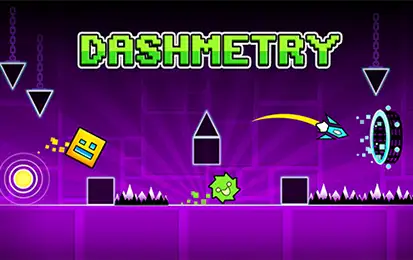
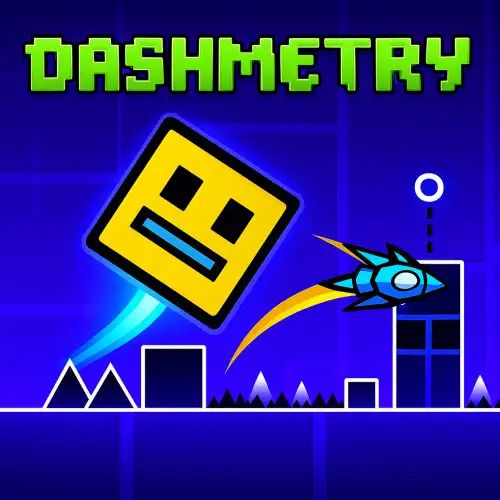




Dashmetry is a rhythm-based platformer that transforms simple jumping mechanics into a fast-paced test of timing, concentration, and muscle memory. Inspired by the formula that made rhythm platform games so addictive, Dashmetry challenges players to guide a constantly moving icon through dangerous levels packed with spikes, portals, gravity shifts, moving hazards, and rapid gameplay changes.
Every obstacle is synchronized with energetic music, turning each level into a combination of reaction challenge, memorization test, and rhythm experience where a single mistake immediately sends you back to the beginning. Unlike traditional platformers that allow slow progression and careful movement, Dashmetry demands precision from the very first second and rewards players who learn how to move with the music rather than fight against it.
Rhythm Is The Real Gameplay Mechanic
Many new players assume Dashmetry is simply about avoiding spikes and reaching the finish line. That description misses what actually makes the game difficult.
The music is not background decoration. Every level is designed around rhythm patterns that influence obstacle placement, jump timing, movement speed, and gameplay flow. Players who try reacting purely to visuals often struggle because obstacles arrive too quickly. Experienced players learn to sync movement with the soundtrack and use the beat itself as a guide.
This creates a unique experience where improving often feels less like learning a platform game and more like learning a song.
The Constant Forward Movement Creates Pressure
One of the biggest reasons Dashmetry feels intense is that the icon never stops moving.
From the moment a level begins:
- The cube moves automatically.
- Speed gradually increases.
- Obstacles become more complex.
- Reaction windows become smaller.
There is no way to slow down and think through a section.
Every decision must happen instantly.
That constant pressure is what creates the game’s addictive “one more try” feeling. Players often fail near the end of a difficult section and immediately restart because they know exactly where the mistake happened.
Understanding Dashmetry’s Core Controls
The control system is intentionally simple.
Controls
Spacebar
Jump
Left Mouse Click
Jump
Up Arrow Key
Jump
Depending on the current form and game mode, holding and releasing the button can also influence movement behavior, flight control, gravity shifts, and transformation mechanics.
The controls are easy to learn in seconds.
Mastering them can take hundreds of attempts.
Character Transformations Change Everything
One of Dashmetry’s most important mechanics is icon transformation.
Throughout levels, players pass through portals that instantly change how the character behaves.
The same obstacle may require completely different reactions depending on the current form.
Cube Form
The classic form focused on precision jumping and timing.
Ship Form
Players control vertical flight by holding and releasing input to navigate narrow spaces.
UFO Form
Movement becomes more unpredictable, requiring controlled taps rather than continuous jumps.
Wave Form
The icon moves in a zigzag pattern, creating some of the game’s most difficult sections.
Spider Form
Movement instantly teleports between surfaces, forcing players to react differently than in standard platforming sections.
Ball Form
Gravity shifts become the primary mechanic as players switch between surfaces while avoiding hazards.
The ability to quickly adapt between these forms separates advanced players from beginners.
Classic Mode: The Main Challenge
Classic Mode serves as Dashmetry’s primary progression system.
Players tackle handcrafted levels that gradually introduce:
- Faster speeds
- More difficult obstacle patterns
- New transformations
- Advanced rhythm sections
- Complex portal sequences
Several sources mention difficulty progression ranging from easier stages to much more demanding late-game challenges. Some versions feature multiple difficulty categories such as Easy, Normal, Hard, Harder, Insane, and Demon-inspired stages.
The further players progress, the more the game begins testing memorization alongside reflexes.
Endless Mode Pushes Consistency
Unlike Classic Mode, Endless Mode removes the finish line entirely.
The objective becomes survival.
Players attempt to travel as far as possible while:
- Maintaining rhythm
- Avoiding increasingly difficult obstacles
- Reacting to speed increases
- Preserving focus over longer periods
This mode often reveals weaknesses in consistency because players can no longer rely on memorized level layouts.
Race Mode Adds Competition
One of Dashmetry’s most interesting features is Race Mode.
Instead of focusing purely on level completion, players compete against others to reach the final portal first.
Race Mode rewards:
- Faster reactions
- Cleaner movement
- Fewer mistakes
- Stronger pattern recognition
Because everyone faces the same obstacles, even small errors can completely change the outcome.
Community Levels Create Endless Content
A major reason rhythm platformers survive long-term is community creativity.
Dashmetry includes a level editor that allows players to create and share their own stages. Community-created levels often introduce:
- Experimental obstacle patterns
- Custom visual themes
- Unique rhythm designs
- Extreme difficulty challenges
- New gameplay concepts
Popular levels frequently appear in Featured, Trending, and Community sections, ensuring players always have new content to explore.
Why Most New Players Struggle
The biggest misconception about Dashmetry is that it requires superhuman reflexes.
In reality, most failures come from different problems.
Playing With Your Eyes Only
Many beginners watch obstacles but ignore the music.
The soundtrack often provides better timing information than visuals alone.
Panicking After A Mistake
One small positioning error frequently causes players to lose focus and make several additional mistakes.
Trying To React Instead Of Memorize
Later levels often require pattern recognition rather than pure reaction speed.
Looking At The Character
Experienced players focus farther ahead on upcoming obstacles rather than staring directly at the icon.
Things The Game Doesn’t Tell You
Rhythm Is More Important Than Speed
Players who synchronize movement with the music often perform better than players with faster reactions.
Practice Mode Accelerates Improvement
Many difficult sections become much easier once players isolate and repeat them.
Muscle Memory Eventually Replaces Thinking
Advanced players often complete sections automatically because movement patterns become deeply memorized.
Every Death Has Useful Information
Failure is part of the learning process.
Each crash reveals timing mistakes, positioning errors, or pattern misunderstandings.
Some Levels Are Designed To Trick You
Visual effects occasionally distract players from the actual rhythm and obstacle timing.
Learning to separate decoration from danger becomes important at higher difficulties.
Why Dashmetry Is So Addictive
Dashmetry follows the same formula that defines many legendary rhythm platformers.
Failure feels frustrating for a moment but immediately motivates another attempt.
Players constantly feel close to success.
Every run teaches something new.
Every obstacle feels conquerable.
Every level becomes a puzzle that slowly transforms from impossible to manageable through repetition and practice.
That progression creates an extremely rewarding gameplay loop where improvement feels visible after every session.
Similar Games You Might Enjoy
Geometry Dash
The rhythm-platform masterpiece that inspired countless timing-based obstacle games. Geometry Dash
Slope
A fast-paced reflex game where players guide a rolling ball through increasingly dangerous tracks. Slope
Run 3
A gravity-defying endless runner that emphasizes movement mastery and spatial awareness. Run 3
Space Waves
A rhythm-inspired obstacle game focused on wave mechanics, timing, and precision navigation.
Frequently Asked Questions
What is Dashmetry?
Dashmetry is a rhythm-based platformer where players guide a constantly moving icon through obstacle-filled levels synchronized with music.
Is Dashmetry difficult?
Yes. While the controls are simple, the game requires strong timing, pattern recognition, concentration, and rhythm awareness.
Does Dashmetry have different game modes?
Yes. Various versions feature Classic Mode, Endless Mode, and Race Mode, each focusing on different gameplay challenges.
Can players create custom levels?
Yes. Dashmetry includes community tools that allow players to design and share their own stages.
What makes Dashmetry different from normal platform games?
Its gameplay is heavily synchronized with music, meaning rhythm and timing are just as important as movement and reactions.
Final Thoughts
Dashmetry transforms simple one-button controls into a demanding rhythm challenge where music, timing, and precision constantly work together. Between handcrafted levels, endless survival runs, competitive races, character transformations, and community-created content, the game offers far more depth than its simple appearance suggests.
Whether you’re trying to master difficult Demon-style stages, chase high scores in Endless Mode, or compete against other players in races, Dashmetry rewards persistence, focus, and the willingness to keep improving after every failed run.
ArcadePlatform





Good info. Lucky me I reach on your website by accident, I bookmarked it.