








Rooftop Run
What Is Rooftop Run?
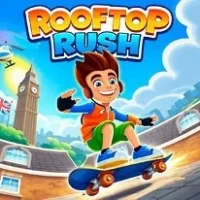
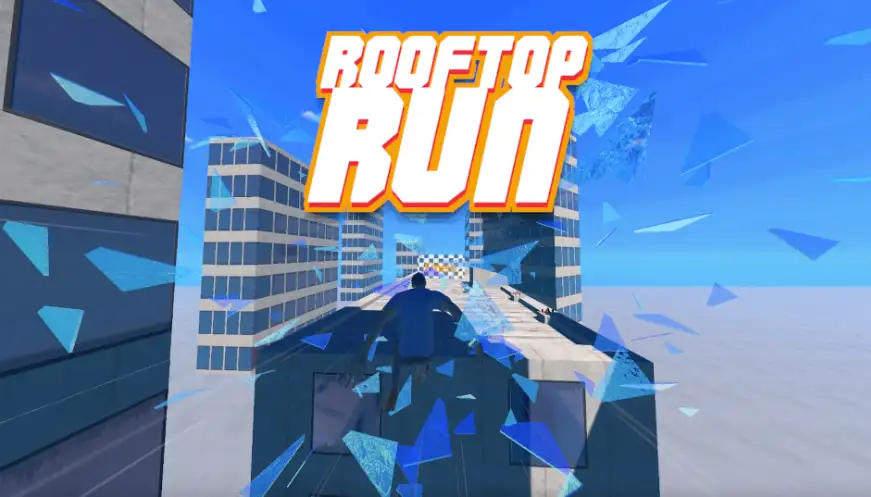
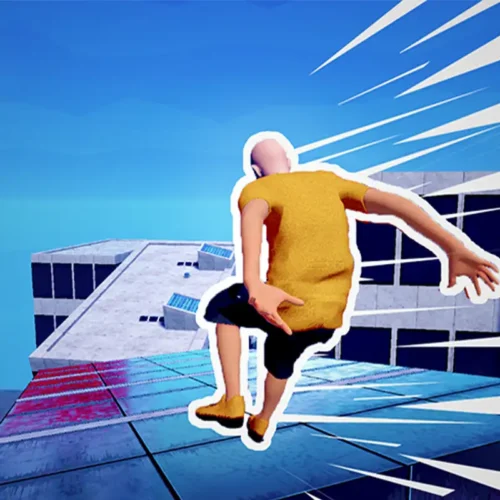
Rooftop Run is a free 3D parkour runner developed by Mad Hook. Originally launched for iOS in June 2020 and Android in September 2020, it arrived in browser via WebGL in April 2024. You sprint across the rooftops of skyscrapers in a vibrant urban environment, navigating platforms, leaping gaps, collecting coins and stars, and reaching the end of each level before falling or being caught.
The game’s central design choice is that your character runs forward automatically and jumps over obstacles on their own. Your input is entirely about direction — steering left and right to stay on the correct path, dodge oncoming hazards, and position yourself for the next platform. The speed is not yours to control. The path through it is.
No download required for browser play. Also available on iOS and Android. Over 50 levels with increasing difficulty.
The Auto-Run Design — Why It Works
Most parkour games ask you to manage movement speed, jump timing, and direction simultaneously. Rooftop Run removes speed management from the equation entirely. The character runs at a pace you cannot slow or accelerate — except by hitting speed booster platforms scattered along the route.
This design keeps the focus on the spatial challenge rather than the mechanics of running. You are reading the rooftop layout ahead, identifying which platforms connect, predicting where a gap is going to appear, and steering your character into the correct position before it arrives. The game becomes about path reading and anticipation rather than reflex reaction at the last second.
Auto-jumps extend this philosophy. When the character reaches a jumpable gap or obstacle, the jump happens automatically. You never press a jump button. You position the character and the run handles the rest — which means a mistimed jump is always a positioning error, not a button-press error. The game gives you a single input channel (direction) and builds the entire challenge around it.
Controls
| Input | Action |
|---|---|
| Hold Left Mouse + Drag | Steer character left or right — control direction and camera |
| Swipe (mobile) | Same — swipe left or right to steer |
One input. The game is deliberately playable with one hand on both desktop and mobile. The entire challenge lives in where you steer and when you begin steering — because at the game’s speed, starting a direction change too late is the same as not starting it at all.
The Progress Bar — Levels With a Defined Endpoint
Rooftop Run is not an endless runner. Each of its 50+ levels has a defined endpoint tracked by a progress bar that fills from 0% to 100% as you advance through the level. Reaching 100% completes the stage. Falling off or being caught by an opponent resets the attempt.
This structure gives each level a clear goal and a measurable sense of progress. Reaching 70% of a level before a fall means the next attempt starts with the knowledge of what the first 70% looks like. Unlike endless runners where distance is the only measure, Rooftop Run’s levels can be genuinely completed — and then revisited to improve time or star count.
What You Encounter Along the Route
Difficulty Progression Across 50+ Levels
Early levels are wide, forgiving, and designed to teach the steering mechanic. Platforms are broad, gaps are readable well in advance, and enemy presence is minimal. The game communicates its systems through layout design rather than tutorial text.
Later levels introduce the specific combinations that produce the game’s hardest moments: narrow platforms after a speed booster, enemy patrols at gap transitions, and sequences where the required steering arc conflicts with a coin placement that tempts you off the optimal path. Each layer appears in isolation first, then in combination. The difficulty curve is genuine rather than arbitrary.
The most common mistake in Rooftop Run is watching the character’s feet rather than the platform layout two or three steps ahead. At the game’s speed, a hazard that appears in your direct sightline is already too close to respond to comfortably. Scanning further ahead gives you the spatial information you need while there is still time to use it — a direction change started early from good information produces a clean pass every time a last-second scramble does not.
Speed Booster Strategy
Speed boosters are optional — you can steer around them if the upcoming level section is particularly demanding. The decision is a genuine trade-off every time one appears.
Taking a booster through an open, wide-platform section costs almost nothing in terms of increased difficulty and produces a meaningful time improvement. Taking a booster into a narrow section with enemies ahead multiplies the challenge significantly. Reading what comes after the booster before deciding whether to take it is the advanced habit that separates players who use boosters strategically from players who reflexively take every one and pay for it on the next platform.
Tips for Completing Levels
- Scan two or three platforms ahead, not one. By the time a platform is directly in front of your character, the steering needed to reach it cleanly should already be in progress. Reading ahead keeps you positioned rather than reacting.
- Begin steering early — overshooting is rare, late steering is fatal. A direction change started slightly too early can be corrected mid-approach. A direction change started too late cannot. Default to early, gentle adjustments rather than sharp last-second steers.
- Skip boosters before known difficult sections. If you know a narrow section or enemy patrol follows, steer around the booster rather than through it. The booster is worth more on open sections than on tight ones.
- Treat collectibles as secondary on first attempts. On your first run through a new level, complete it first. Learn the platform layout. On repeat runs, add the coin and star routing to the clean path you already know. Chasing collectibles during a first-attempt navigation of an unknown level produces falls at the exact moments where a coin placement was designed to tempt you.
- Map enemy patrol patterns on the approach, not on arrival. Enemies that appear in later levels have visible patrol routes. Spotting the patrol direction from a distance — before your character reaches the same section — gives time to choose the wider avoidance arc. Encountering an enemy already at close range leaves no room to adjust.
Similar Games You Will Like
Frequently Asked Questions
Rooftop Run earns its place in the parkour game category by making a genuinely smart design decision: removing speed management from player control and building the entire challenge around spatial reading and path anticipation instead. The auto-run and auto-jump design sounds limiting but produces a game that is easier to pick up and harder to master than most equivalent games with full control schemes.