












Last Chess Standing – Play Chess Game
Last Chess Standing

Last Chess Standing

4.8 (3,579)
Chess · Puzzle · Casual · Beginner-Friendly

Last Chess Standing

🎮 Controls: Click to Select and move
⚡ Style: Chess Puzzle
🌐 Platform: Browser · itch.io

What Is Last Chess Standing?

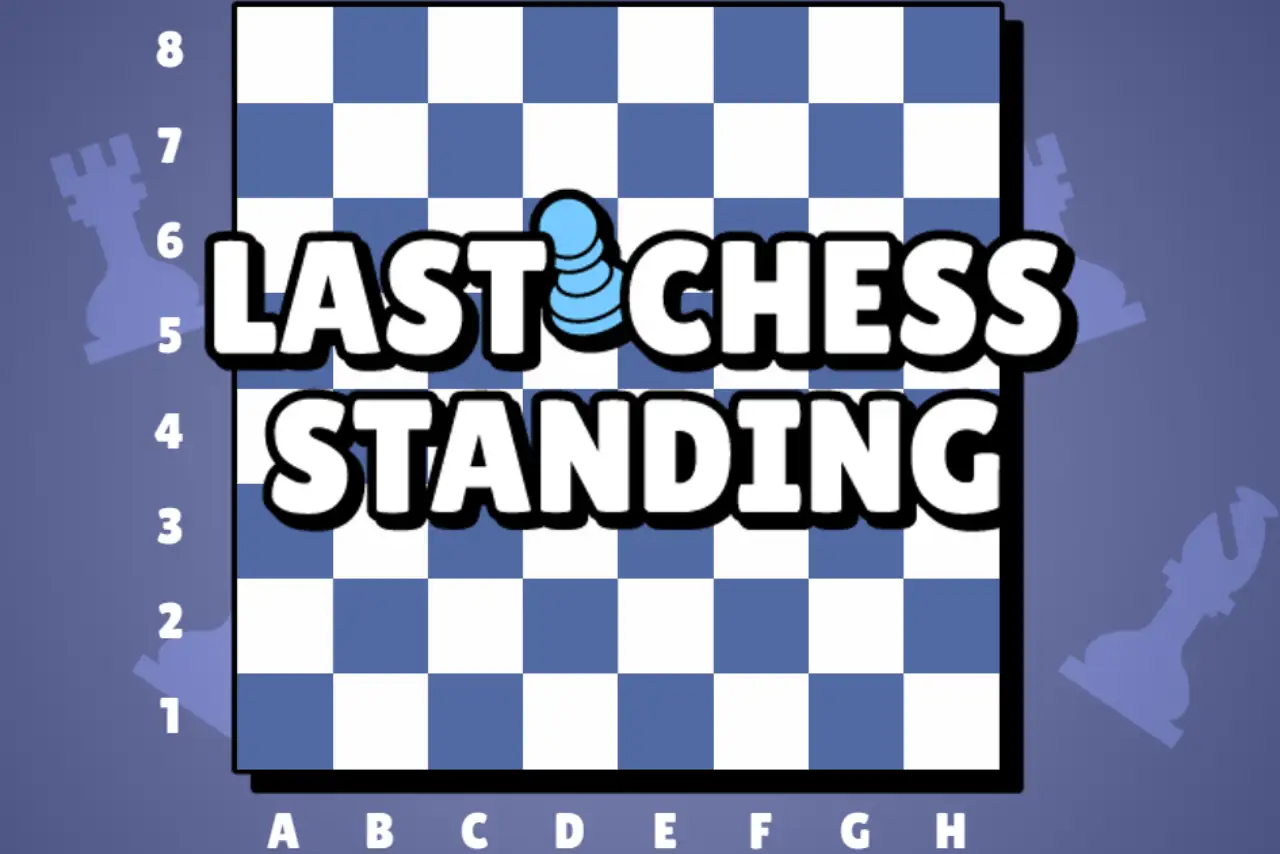
Last Chess Standing is a free casual chess puzzle game developed by FeatureKreep. There is no opponent, no checkmate, and no clock. Each level presents a board with a set of chess pieces — yours and others — and one objective: be the last piece standing. Capture every other piece on the board until only one remains.

The pieces move according to standard chess rules — pawns advance and capture diagonally, rooks travel in straight lines, bishops in diagonals, knights in their characteristic L-shape. What changes the game from simple pattern-matching is the addition of special pieces: bombs that eliminate everything around them when captured, pieces that self-destruct under specific conditions, and other variants that add explosive logic to the chess framework.

Created as a gentle introduction to chess piece movement, it has collected over 400 community ratings and sits at 4.7 out of 5 stars on FeatureKreep’s itch.io page, where the developer publishes all their projects. No download, no account. Plays instantly in any browser.

FeatureKreepDeveloper
Last Piece WinsCore Objective
Special PiecesBombs · Self-Destruct
FreeBrowser + itch.io
Last Chess Standing: Brain-Tickling Chess Challenges

Why It Works as a Chess Introduction

Traditional chess asks new players to learn piece movements, opening theory, tactical patterns, and long-term positional strategy simultaneously. Last Chess Standing removes everything except the first item on that list.

Movement rules — how each piece travels and captures — are exactly what the puzzle demands. A rook that needs to capture a bishop needs to reach it in a straight line. A knight capturing a pawn needs to find the right L-shaped approach. The puzzle format makes these movement rules concrete and immediately testable rather than abstract memorisation. A wrong move is immediately visible because the capture does not work.

Players who complete Last Chess Standing do not emerge as chess players. But they do emerge with an intuitive understanding of how each piece moves and captures — the foundation that everything else in chess is built on.

Controls

InputAction
Left Click a pieceSelect the piece — valid moves highlight on the board
Left Click a destinationMove the selected piece to that square
Click outside the boardDeselect current piece — note: clicking the piece again does not deselect
Reset buttonRestart the current level from the beginning

One important control note: clicking a selected piece again does not deselect it. To deselect and choose a different piece, click outside the board boundary first, then select the new piece. There is no undo button — if a move creates an unsolvable state, use Reset to restart the level.

Standard Piece Movement — What You Need to Know

Last Chess Standing uses the same movement rules as standard chess. If you already know how chess pieces move, you know the rules. If you are new, here is the complete movement reference for every piece in the game:

♟️
Pawn
Moves one square forward. Captures diagonally one square. Cannot capture directly in front — only forward-diagonal. A pawn blocked by any piece directly ahead cannot move at all unless there is a diagonal capture available.
Rook
Moves any number of squares horizontally or vertically. Cannot jump over pieces — must have a clear path to the destination. The most powerful straight-line piece and the one that forms the backbone of most multi-capture sequences in later levels.
Bishop
Moves any number of squares diagonally. Stays on the same colour square for the entire game. Like the rook, cannot jump over pieces. A bishop on a board with pieces only on the opposite colour is effectively unable to capture anything — a critical constraint that shapes several puzzle solutions.
Knight
Moves in an L-shape — two squares in one direction, one square perpendicular. The only piece that can jump over other pieces. Knights ignore blocking pieces entirely, which makes them uniquely useful in crowded board states where rooks and bishops cannot find a clear path.
Queen
Moves any number of squares in any direction — horizontal, vertical, or diagonal. The most powerful piece on the board. The queen combines the rook’s straight lines with the bishop’s diagonals into a single piece. Cannot jump over pieces.
King
Moves one square in any direction. Slow but able to approach from any angle. In Last Chess Standing the king is not protected by checkmate rules — it can be captured like any other piece. Its survival is not automatically the goal; becoming the last piece means every piece including the king can be a valid final survivor or an early capture depending on the puzzle solution.

The Special Pieces — Where the Puzzles Get Interesting

Standard chess pieces produce logic puzzles through their movement constraints. The special pieces in Last Chess Standing add explosive outcomes that standard chess has no equivalent for.

Bombs
A bomb piece eliminates every piece adjacent to it when captured — including your own piece that performed the capture. Capturing a bomb is not always lethal and not always avoidable. The puzzle around a bomb is timing: identifying which pieces around the bomb are acceptable losses, and whether capturing the bomb creates a path to a final surviving piece or destroys everything including your last option. Bombs require planning the capture sequence two or three moves ahead rather than one at a time.
Self-Destructing Pieces
Pieces that eliminate themselves under specific conditions — sometimes when captured, sometimes after a set number of moves, sometimes based on position. Self-destruct mechanics create puzzle states where the “correct” move is counterintuitive: allowing a piece to self-destruct may clear the board more efficiently than manually capturing it. Recognising when to use a self-destruct trigger rather than force a direct capture is one of the key skills later levels develop.

How Difficulty Scales Across the Levels

Early levels use small boards with few pieces and straightforward capture sequences. The movement rules alone solve them — identify which piece can reach which target and execute the captures in the right order.

Later levels introduce the special pieces and create board states where the “obvious” capture sequence leaves an isolated piece that cannot reach anything else. The solution requires either a different piece order or a counter-intuitive move that looks like it makes the situation worse before it resolves.

When stuck — look for the piece you are avoiding

Most stuck states in Last Chess Standing come from leaving one piece for last when that piece cannot reach anything. Work backward from the board state: which piece would be hardest to capture last given its movement constraints? That piece should usually be captured early rather than avoided. A bishop that can only reach half the board colours needs a target placed correctly or needs to be eliminated while other pieces are still available to do it.

The No-Undo Design and Why Reset Is Your Friend

Last Chess Standing has a reset button but no undo. This is a deliberate design choice — and a useful one for learning. A full reset forces you to reconsider the entire level rather than backing up one step at a time, which tends to produce better solutions than incremental undo-and-retry cycles.

When a level feels stuck, reset and try a completely different first capture rather than trying the same opening sequence with a different continuation. The first capture in a level often determines whether the rest of the sequence is possible — an opening that leaves a specific piece isolated early frequently cannot be recovered.

Similar Games You Will Like

Frequently Asked Questions

Who made Last Chess Standing?
Last Chess Standing was developed by FeatureKreep, an indie puzzle game developer whose work is published on itch.io. The game has collected over 400 community ratings and holds a 4.7 out of 5 star average.
What is the objective?
Capture all pieces on the board except one. The last piece left standing — whichever piece it is — completes the level. There is no checkmate and no opponent. It is a single-player puzzle.
Do I need to know how to play chess?
You need to know how chess pieces move — or be willing to learn as you play. The game teaches piece movement through the puzzle format itself: if a capture does not work, the move path is invalid. No chess strategy knowledge is required. The game is specifically designed as a beginner-friendly introduction to chess piece movement patterns.
What are the special pieces?
Special pieces include bombs (capturing one eliminates all adjacent pieces including your own) and self-destructing pieces (eliminate themselves under specific conditions). These create puzzle scenarios where standard capture sequences fail and counter-intuitive approaches are required.
Is there an undo button?
No. The game has a Reset button that restarts the current level from the beginning but no step-back undo. If a move creates an unsolvable board state, press Reset and rethink the capture sequence from the first move.
How do I deselect a piece?
Click outside the board boundary to deselect. Clicking the same piece again does not deselect it — this is a known UI quirk of the game. Click the empty area around the board, then select the piece you want.
Can this game actually help me learn chess?
It teaches chess piece movement specifically — how each piece travels and captures. That is the most fundamental skill in chess and the game builds genuine intuition for it through puzzle solving rather than drills. It does not teach openings, tactics, or strategy. Think of it as learning what the tools do before learning how to use them in a real game.
✦ Final Verdict

Last Chess Standing earns its 4.7 star community rating by finding a genuinely clever angle on chess as a puzzle format. The shift from “checkmate your opponent” to “be the last piece standing” removes the game’s traditional social anxiety — there is no opponent to outthink, just a board to solve — while keeping every movement rule intact.


CasualPuzzleStrategy

Discuss Last Chess Standing

Leave a Comment

Link copied!