



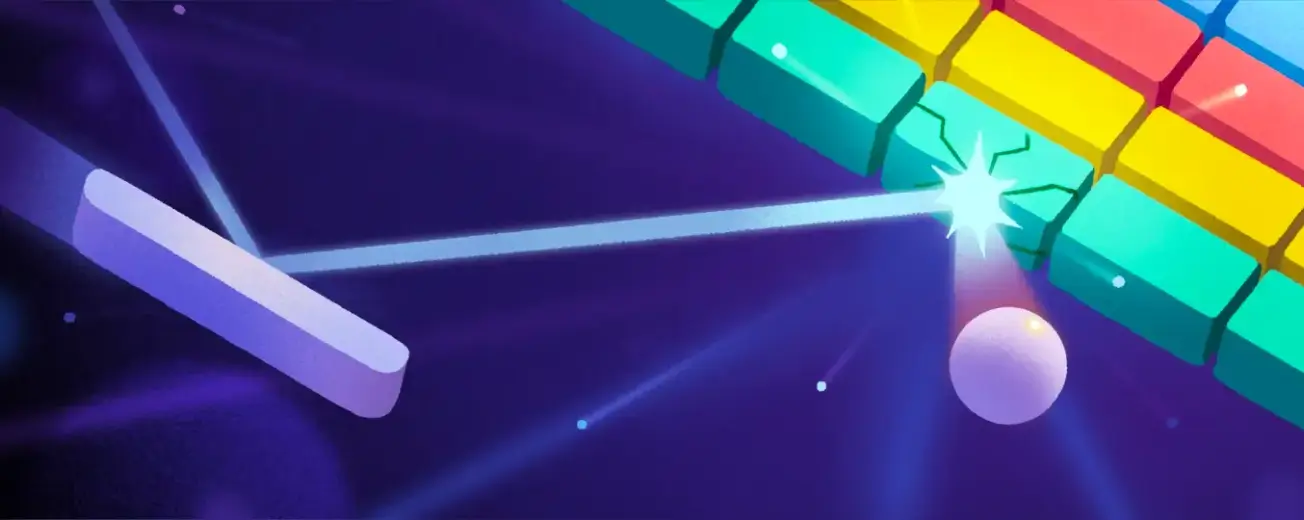
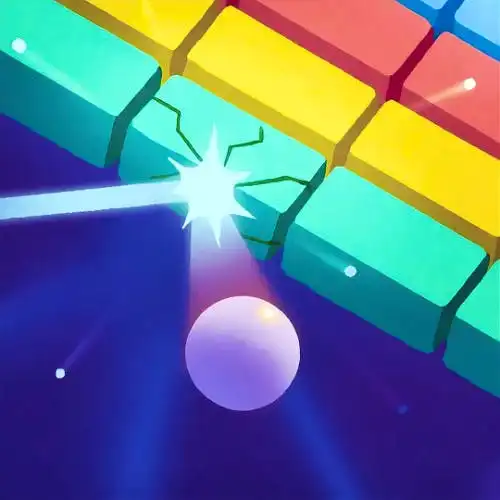



Move a paddle along the bottom of the screen to bounce a ball into rows of bricks above. Clear every brick to advance, and don’t let the ball get past your paddle. It’s a Breakout-style arcade game — simple to pick up, harder to keep going once the ball speeds up.
| Feature | Details |
|---|---|
| Genre | Breakout-style brick breaker |
| Origin | Based on Atari’s Breakout (1976) |
| Core mechanic | Move a paddle to bounce a ball and clear bricks |
| Goal | Clear every brick on screen to advance to the next level |
| Difficulty curve | Ball speed increases and brick layouts get denser each level |
| End condition | Ball passes below the paddle with no way to recover it |
| Platform | Browser — desktop and mobile |
Contents
- Controls
- How the Ball and Paddle Interact
- Scoring and Levels
- Where This Style of Game Comes From
- Tips for a Longer Run
- Similar Games
- FAQ
Controls
| Action | Desktop | Mobile |
|---|---|---|
| Move paddle | Left / Right Arrow Keys, or mouse movement | Swipe or drag left/right |
| Launch the ball | Click, or Spacebar | Tap |
On desktop, arrow keys give the most precise paddle control — mouse movement also works but can feel slightly less exact for last-second saves near the edges. On mobile, dragging a finger across the bottom of the screen mirrors the paddle’s position. Launch the ball with a click or tap, and from that point your only job is keeping the paddle under the ball.
How the Ball and Paddle Interact
The part that’s easy to miss on a first try: where the ball hits your paddle changes the angle it bounces off at. Hit it dead center and it tends to go straight back up. Catch it nearer the edge of the paddle and it deflects at a sharper angle toward that side. This isn’t just a visual detail — it’s the main tool you have for reaching bricks that are off to the side or tucked into corners, since you can’t aim the ball directly.
As you clear bricks and move into later levels, the ball speeds up and the brick layouts get denser or more awkwardly shaped. The fundamentals don’t change — paddle, ball, bricks — but the margin for error shrinks the longer a run goes.
Scoring and Levels
Every brick the ball touches and breaks adds to your score. The goal is to clear every brick on the screen to progress — once a layout is cleared, the next level loads with a new arrangement and a faster ball. The run ends when the ball gets past your paddle and falls below it, with no way to recover that ball once it’s gone.
There’s no save system between sessions — each run starts fresh, and your score resets if you reload the page. The challenge is purely about how far you can get in one continuous run.
Where This Style of Game Comes From
This style of game traces back to Atari’s Breakout, released in arcades in 1976. The development contract was given to Steve Jobs, who brought in Steve Wozniak to do the actual hardware engineering — and the work Wozniak did on Breakout’s circuit design fed directly into what became the Apple II’s color graphics system. Breakout itself grew out of an earlier idea from Atari’s Pong: instead of two paddles hitting a ball back and forth, one paddle hits the ball into a wall of targets.
The genre has stuck around for decades for a simple reason — paddle, ball, bricks is a complete, satisfying loop with almost nothing to learn before you’re playing well. Block Breaker is a modern version of that same loop, with the same core mechanics that made the original work.
Tips for a Longer Run
▸ Use the paddle’s edges on purpose, not by accident
Once you know that hitting the ball off-center changes its angle, you can use that deliberately. If a brick is sitting in a corner the ball isn’t reaching, let the ball connect with the edge of your paddle on the side facing that corner rather than always centering it. Center hits are safe but predictable — edge hits are how you clear the awkward spots.
▸ Don’t chase the ball — let it come to you
The paddle moves faster than most people initially assume, which tempts players into constant small corrections. Reading the ball’s trajectory early and moving to the landing spot once, rather than tracking it pixel-by-pixel, leads to steadier paddle position when the ball speeds up in later levels.
▸ Clear the bottom rows of bricks first when you can
Lower bricks are easier to reach with a controlled, central paddle hit. Higher or corner bricks usually require the angled hits described above. Working through reachable bricks first reduces the clutter on screen and makes it easier to read the ball’s path as the level thins out.
▸ Play on a larger screen if you have the option
The paddle and ball are both small relative to the play area on a phone screen. A larger browser window or a desktop screen gives more visual space to track the ball’s position and react, which matters more as speed increases in later levels.