







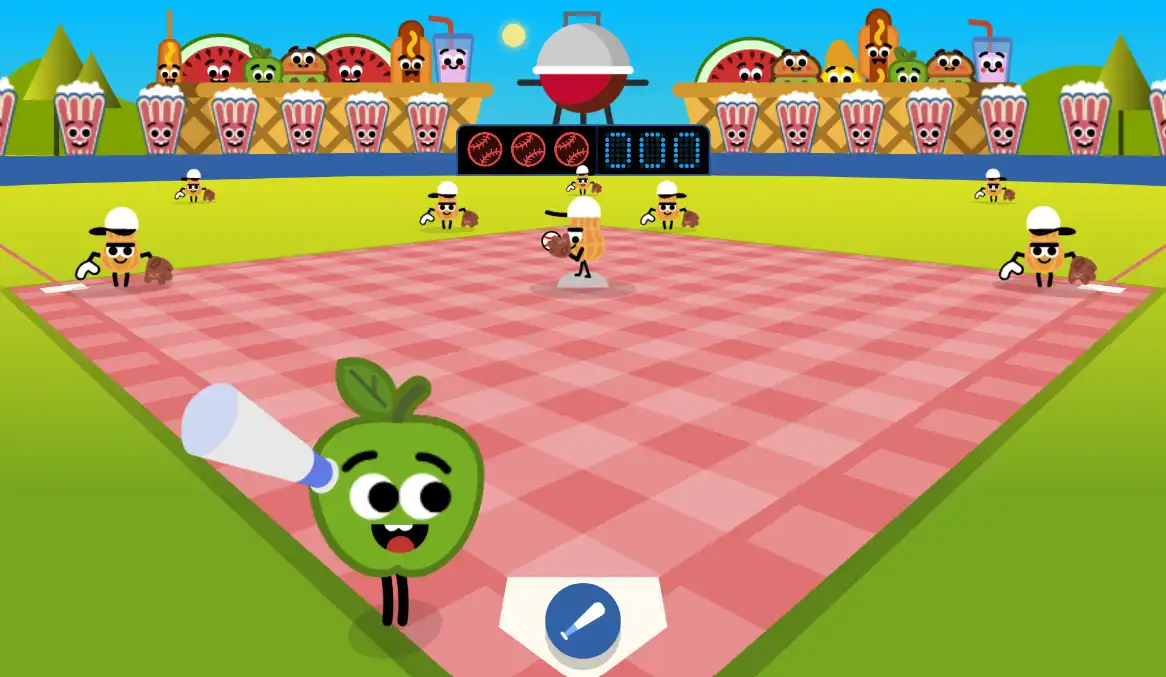
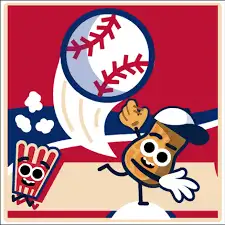





You’re at the field as a food-themed batter — hot dogs, popcorn, watermelon, lemonade — facing off against a team of peanut fielders. Click, tap, or hit the spacebar to swing. Time it right and your character runs the bases, scoring a point for every full lap around the diamond. Miss three pitches and the game ends.
Doodle Baseball is an interactive Google Doodle released on July 3, 2019, to celebrate American Independence Day (July 4th). Unlike most Google Doodles, which are static illustrations, this one is fully playable. It’s free, requires no download, and runs directly in browser on desktop and mobile.
| Feature | Details |
|---|---|
| Released | July 3, 2019 (4th of July tribute) |
| Theme | Food-themed characters — hot dogs, popcorn, lemonade, watermelon vs. peanut fielders |
| Core mechanic | Click/tap/spacebar to swing — timing-based |
| Scoring | 1 point per completed run around all four bases |
| End condition | 3 strikes (missed swings) = game over |
| Bonus | Home run = fireworks animation (red, white, and blue) |
| Platform | Browser (desktop and mobile) — free, no download |
Contents
Controls
| Action | Input |
|---|---|
| Swing the bat | Click, Tap, or Spacebar |
This is the entire control scheme — one input, no aiming, no fielding control. There is no button to control the direction of your hit — confirmed directly across multiple sources. The only variable you control is when you swing. Direction and distance are determined automatically based on how well-timed your swing was relative to the pitch.
How Scoring Works
When you make contact, your batter runs the bases — confirmed by SlashGear: “The farther the ball goes, the more bases they can get to.” A weak hit might only advance the runner one base; a well-timed hit can send them further. You score a point only when a runner completes the full loop back to home plate — every completed run equals one point on the board.
A perfectly timed swing that sends the ball out of the park triggers a home run — confirmed with a celebratory animation of red, white, and blue fireworks, fitting the game’s July 4th theme. Missing a pitch entirely counts as a strike. Three strikes ends the game — there’s no inning structure or opposing team turn, just a continuous batting session until you’ve struck out three times.
Pitches and Timing
The pitcher throws a mix of pitch types and speeds — confirmed across multiple sources as varying delivery patterns rather than a single repeating pitch. As the game progresses, pitch speed and variation increase, making the timing window progressively tighter. Swinging too early sends your bat through empty air before the ball arrives; swinging too late means the ball has already passed. There’s a narrow window in between where contact actually happens, and that window is the entire skill of the game.
Because there’s no fielding or pitching role to switch to — unlike some earlier baseball-themed doodles which had two-player or role-switching elements — this version keeps you exclusively as the batter for the entire session. The focus stays narrow and the loop stays fast: pitch, swing decision, result, repeat.
Tips
▸ Watch the pitcher’s motion, not the ball itself
By the time the ball is close enough to react to on sight alone, the swing window is often already closing. Reading the pitcher’s wind-up gives an earlier cue for when the pitch is coming, which is more useful than waiting to visually track the ball’s full flight before deciding to swing.
▸ Stay patient — rushing causes more strikeouts than late swings
The instinct under pressure is to swing earlier to avoid missing entirely. But an early swing is just as much a miss as a late one — there’s no partial credit for “close.” A calm, consistent rhythm produces more contact than anxious early swinging, especially as pitch variety increases later in a session.
▸ Play in full screen for a better read on pitch distance
A larger view of the field gives more visual runway to judge the pitch’s approach before the swing decision has to be made. Full-screen mode is a small adjustment that meaningfully extends your effective reaction window compared to a small embedded window.
▸ Don’t overthink it — the game rewards rhythm over analysis
Doodle Baseball has no stats, no aiming, and no strategy layer beyond timing. Treating each pitch as a fresh, simple timing decision — rather than trying to “read” a pattern across pitches — matches how the game is actually designed. The variation in pitch types means there isn’t a fixed pattern to memorize.