

















Escape Road
Where the Series Started
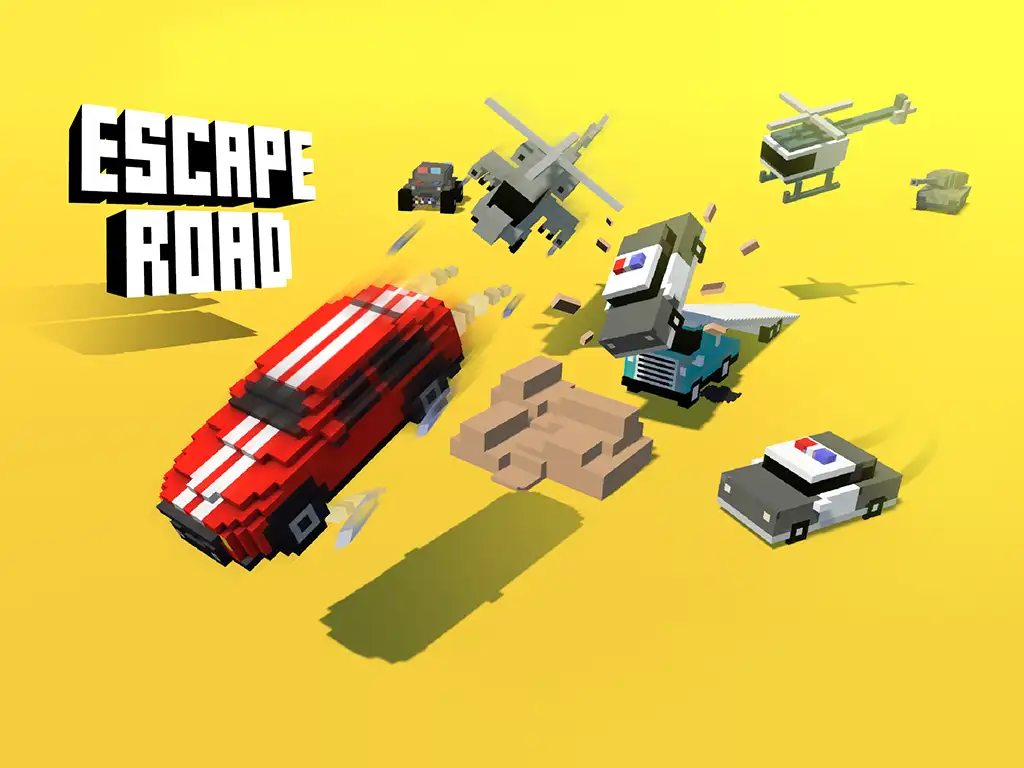
Escape Road is the game that started a franchise. Developed by 1Games.IO, it puts you in the role of a bank robber trying to escape through a pixel art city while police cars close in from every direction. Your car moves forward automatically at a constant speed. You steer left and right. You reverse when necessary. The run ends the moment you collide with a police car.
That stripped-down design — automatic movement, two steering directions, one losing condition — is what made the game spread. There is almost no learning curve. Within thirty seconds of starting a run, you understand the game completely. Within five minutes, you realize the depth underneath the simplicity: the police AI responds to your movement, swerving confuses it, crowded intersections are traps, and survival comes down to reading the city map faster than the pursuit can close in.
Escape Road is also the origin of a six-game franchise — Escape Road 2, City, Halloween, Winter, City 2, and Escape Road 3 all build on what this version established. Playing the original is understanding where all of those mechanics came from and why the series works.
The Auto-Forward Mechanic — Why It Matters
Most driving games give you three things to manage: speed, steering, and the decision of when to brake. Escape Road removes speed entirely. Your car moves forward at a constant pace on its own. You only decide which direction to steer.
This sounds like a simplification. In practice it changes the nature of every decision. Without speed control, you cannot slow down to buy time before a tight corner. You cannot accelerate out of a dangerous situation. The pace is constant, the police are always closing in, and your only tool is steering — which direction to turn, when to reverse, and how to use the city’s layout to your advantage.
The result is a game where survival is entirely about reading the environment ahead of you and steering into positions that give options rather than positions that cut them off. Every dead end you drive into is a positioning error. Every police collision is a steering decision that happened a beat too late.
Controls
| Input | Action |
|---|---|
| ← or A | Steer left |
| → or D | Steer right |
| ↓ or S | Reverse direction — escape dead ends and police blockades |
| Touch controls (mobile) | On-screen directional buttons replace keyboard |
Three inputs. No acceleration, no braking, no special moves. The entire game is these three keys used at the right moments in the right sequence. The down arrow reverse is more important than it looks — knowing when to stop and flip direction rather than committing to a road that leads into a police blockade is the skill that separates short runs from long ones.
The City — Understanding the Map
Escape Road’s city is rendered in a pixel art style viewed from above — a dense urban grid of roads, intersections, buildings, and police units that move through the streets. The city is not randomly generated in the way an endless runner generates terrain. It has a consistent layout that rewards players who learn it.
Knowing which intersections open up into wider road networks and which funnel into dead ends is genuine knowledge that improves survival time. Driving through crowded city sections — dense with civilian vehicles and intersections — means more obstacles to navigate around, but it also means more direction options. Open stretches that look safe often have fewer exits when police start closing from multiple angles.
Money scattered across the road during each run represents the city’s collectible layer. Driving through cash pickups adds to your garage fund. The temptation is to collect every piece of money visible. The discipline is collecting the money that falls on your route and skipping the money that would pull you toward a police car or a dead end.
The Police — How They Pursue
Police cars in Escape Road do not simply chase you in a straight line. They read your current direction and pursue along the road network toward where you are heading. This has a specific exploitable consequence: the police AI responds to where it thinks you are going, not a perfect prediction of every turn you might make.
A sudden change of direction — an unexpected left turn where the police AI predicted you were continuing forward, or a reversal that sends you back through the gap a pursuing car just passed — creates separation. The police need a moment to recalculate the new pursuit angle. That moment is time.
The game itself recommends turning suddenly to distract the police — and it means this literally. A turn you make without obvious predictive reason is harder for the pursuit to anticipate than a turn forced by the road geometry. A player who turns left at an intersection because the road continues right is predictable. A player who turns left at an intersection where continuing right was also perfectly viable has broken the pursuit’s angle. Building unpredictability into your routing produces longer survival times than following the most obvious clear path.
The Garage — Collecting Money, Buying Vehicles
Money collected during runs accumulates toward the vehicle garage. Spending that money unlocks new cars, each with different performance characteristics. The garage is straightforward: more expensive vehicles offer different speed and handling trade-offs compared to the starting car.
The original Escape Road keeps the garage deliberately simple — it is a vehicle unlock system, not the deep upgrade tree that later entries in the series added. You collect money, you unlock a new car, and you discover how its slightly different handling changes your approach to the same city. Different vehicles suit different playstyles within the same basic escape formula.
The important thing to understand about money collection in this game: it is a secondary priority. A run that ends after thirty seconds because you diverted toward cash pickups earns less than a run that ignores several cash pickups and survives for two minutes. Longer survival time produces more money per session than aggressive pickup chasing that ends runs early.
What the Sequels Add — And Why the Original Still Matters
The Escape Road franchise grew significantly from this starting point. Escape Road 2 added on-foot running, swimming, parachutes, vehicle hijacking, armed police, military helicopters, and 90 vehicles across four rarity tiers. Escape Road Winter added ice physics, a drift mechanic, and deliberate crash mechanics. Escape Road Halloween added a dark carnival city, Halloween obstacle types, and atmospheric audio. Each sequel added meaningful new mechanics that changed how survival works.
The original Escape Road has none of that. What it has is the purest version of the core formula — automatic forward movement, steer-only input, one losing condition — in its most concentrated and immediately playable form. No learning curve beyond the first ten seconds. No additional mechanics to understand before you can play effectively. Just a car, a city, and the police that never stop coming.
Many players return to the original specifically because of its simplicity. The later games are more complex and in many ways more rewarding to master. The original is the one you can hand to anyone and have them playing competitively within a minute of opening it.
Tips for Surviving Longer
- Favour road junctions with multiple exits over open straight roads. A long straight road with no side turns looks safe. It is a corridor. Police approaching from ahead have nowhere to miss you. Junctions give you options to turn away from multiple directions of pursuit simultaneously.
- Reverse before committing to a dead end, not after entering it. The moment you see a road narrowing toward a wall or a no-exit building block ahead, reverse. The down arrow is your escape from road geometry mistakes. Using it a half-second before a dead end is confirmed still leaves room to navigate. Using it after you are already facing the wall does not.
- Turn unpredictably at open intersections, not only when forced. Every intersection where multiple exits are viable is an opportunity to break the police AI’s pursuit angle. A turn made when you could have gone straight sends the pursuit in the wrong direction for a moment. Stack those moments and gaps open up.
- Collect money on your natural route, skip money that requires detours. Money that falls across the road you are already on is worth collecting. Money that requires a turn into a denser area of police pursuit is not. Long survival time generates more money per session than risky pickup chasing.
- Learn the dead ends in the city layout. The city is consistent. Dead ends appear in the same places every run. Knowing which roads lead to no-exit building blocks before you commit to them is genuine knowledge that improves run length — not reflexes, not reaction time, just map familiarity.
The Full Escape Road Series
The original Escape Road launched the franchise that 1Games.IO expanded across six distinct entries. Each one built on the original’s auto-drive, steer-only formula while adding new mechanics and settings:
- Escape Road 2 — Added on-foot running, swimming, parachuting, vehicle hijacking, armed police, military helicopters, and a 90-car roster across Common/Rare/Epic/Legendary tiers. The Police Interceptor and Speedster are the top Legendary vehicles.
- Escape Road City — Dense urban environment focused on intense city-block navigation with tighter road networks and more complex police pursuit patterns.
- Escape Road Halloween — Night-time carnival city with haunted pumpkins, flying bats, and floating ghosts as new obstacle types. Direct upgrade shop for speed, handling, and durability improvements.
- Escape Road Winter — Snow-covered city with ice physics, a drift mechanic, and deliberate crash capability. Lottery system for festive vehicle unlocks. Pine tree cart as the starting vehicle.
- Escape Road City 2 — Playable characters, power-ups, and hidden maps added to the city format.
- Escape Road 3 — The most recent main series entry with further escalated mechanics and the largest content roster in the franchise.
Similar Games You Will Like
Frequently Asked Questions
The original Escape Road is a perfect example of a game that knows exactly what it is and delivers it without apology. Automatic forward movement, steer left, steer right, steer back, do not hit the police — five words of instruction, a career’s worth of depth in the city layout and police AI response. It is the most immediately playable entry in a franchise that grew into one of the most-played browser game series around, and it remains the best entry point for anyone encountering Escape Road for the first time.