















Dinosaur Game
What Is the Dinosaur Game?
The Dinosaur Game — also known as the Chrome Dino or T-Rex Runner — is a free endless runner built directly into Google Chrome, developed by Google’s Chrome UX team. It was created by Sebastien Gabriel, Alan Bettes, and Edward Jung and released in September 2014. It is played over 270 million times every month, making it one of the most played games in the world.
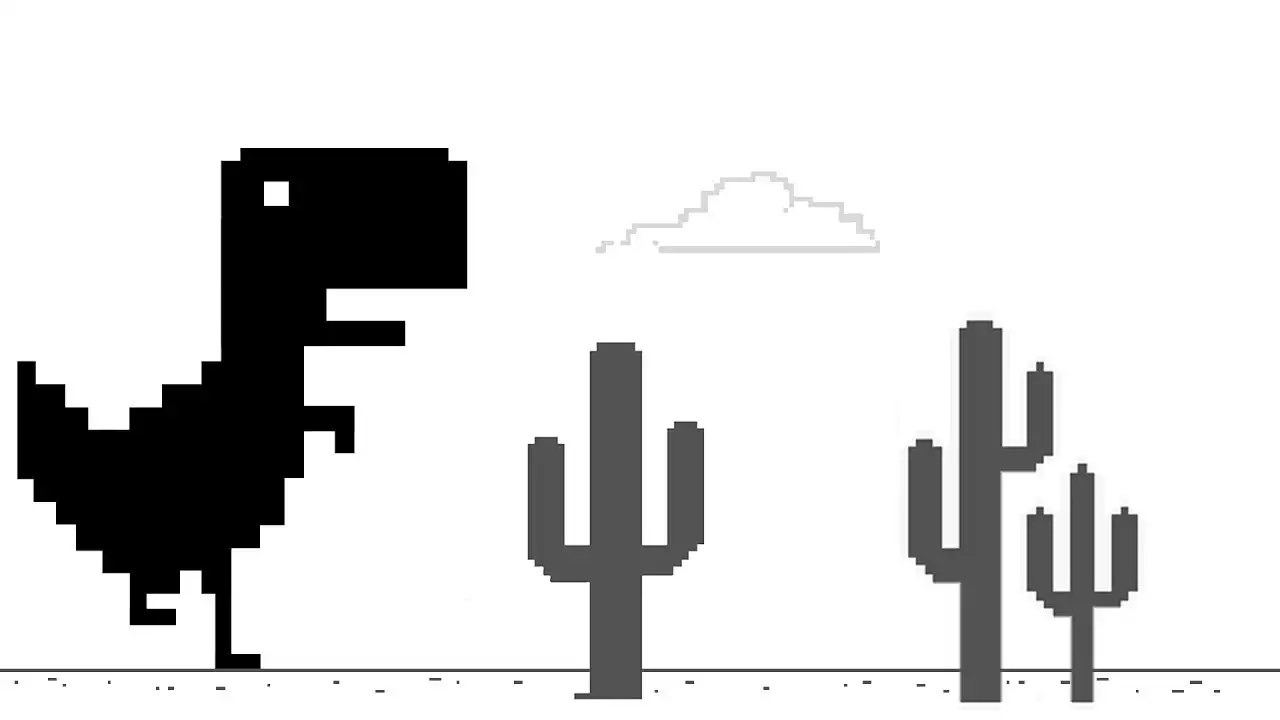
The concept is two inputs and a single character. A pixelated T-Rex named the Lonely T-Rex runs through a desert automatically. Press spacebar to jump over cacti. Press the down arrow to duck under pterodactyls. The game speeds up continuously. There is no finish line. The theoretical maximum duration of a session is 17 million years — deliberately matching the time the T-Rex existed on Earth.
Originally designed as an Easter egg for Chrome’s “no internet” error page. Now playable in any browser, including when you are online.
The Story Behind the Game
In early 2014, Google’s Chrome UX team wanted to do something with the error page that appeared when users lost their internet connection. The blank, lifeless “you are offline” page was frustrating. The team’s solution was an Easter egg — a hidden game that only appeared in that frustrating moment.
Sebastien Gabriel, a Senior Staff Designer, designed the character. He named the T-Rex the “Lonely T-Rex.” The choice of dinosaur was deliberate: as Gabriel explained, the theme was a joke about going back to the “prehistoric age” — a time before the internet existed. Losing your connection drops you back there.
Edward Jung, the Chrome UX engineer who wrote the game’s code, later admitted it was the first game he had ever written. The project was given the internal codename “Project Bolan” — a reference to Marc Bolan, the lead singer of the 1970s glam rock band T. Rex. The name is both a tribute and a pun.
The initial September 2014 release ran poorly on older Android devices. Jung rewrote the entire codebase, and the corrected version launched in December 2014 across all platforms. The game was technically hidden — it appeared only when Chrome users went offline — until typing chrome://dino in the address bar became a known shortcut to launch it even with a live connection.
Controls
| Input | Action |
|---|---|
| Spacebar or ↑ | Jump over cacti and ground-level obstacles |
| ↓ | Duck under low-flying pterodactyls |
| Tap (mobile) | Tap the dino or the screen to jump |
Obstacles — The Original and the Addition
The original September 2014 release had only one obstacle type: cacti. Cacti appear in different sizes — single plants, small clusters, and tall dense clusters — each requiring a jump. A single small cactus is comfortable at early speeds. A tall dense cluster at high speed requires an earlier and longer jump.
Pterodactyls were not part of the original game. They were added as a second obstacle type in a browser update in 2015. Pterodactyls fly at different heights: low-flying ones require a duck, mid-height ones can be jumped over or ducked under, and high-flying ones can be run beneath without any input. Reading the height of each pterodactyl before reacting is a skill that separates inconsistent runners from consistent ones.
The Night Mode
After reaching a certain score milestone, the game inverts its colours — the white background turns black and the black pixels turn white. This is night mode. The gameplay does not change but the visual contrast reversal requires a brief adjustment. Players who have been reading obstacle silhouettes against a white background now need to read light silhouettes against a black one.
The game cycles between day and night periodically throughout long runs. Each transition is a moment of increased risk — reaction habits calibrated to one visual state are briefly disrupted by the switch to the other.
How the Speed Escalation Works
The game starts at a manageable pace where each cactus gives adequate reaction time. Speed increases continuously as the score grows. There is no plateau — the game keeps accelerating for as long as the run lasts.
The practical consequence: a jump timing that felt comfortable at 200 points starts catching the edges of obstacles at 500 points. Players who do not consciously shift their jump timing earlier as speed increases will find that the same reflex that worked earlier now consistently lands them on the obstacle rather than over it. Jumping earlier than feels necessary — anticipating the cactus before it arrives rather than reacting to it — is the adjustment that extends runs past the mid-game speed threshold.
The visual cue that triggers most players to jump arrives at roughly the same distance regardless of game speed. At higher speeds, that distance represents less reaction time. The cactus that looked safe at the moment you noticed it at 200 points is already dangerously close at 600 points. Shift your jump trigger to fire when the obstacle is further away than feels necessary — your instinct will lag the game’s speed by a beat or two unless you actively compensate for it.
The 17 Million Year Design Limit
Edward Jung stated that the game was designed to theoretically max out at approximately 17 million years of continuous play — matching the duration that T. Rex existed as a species on Earth. In practical terms, the score counter maxes out at 99,999 points, at which point the game resets itself to zero. No human player has ever reached that score through normal play — the speed makes it mechanically impossible before that point.
The 17 million year figure is a design philosophy more than a technical specification: the game was built to feel endless, and the number was chosen as a deliberate connection between the character and the game’s horizon.
The Birthday Easter Egg
In September 2018, on the game’s fourth birthday, an Easter egg was added. When the T-Rex passes a birthday cake in the desert, it “eats” it and receives a party hat on its head. Balloons appear in the background. The Easter egg resets on each new session and celebrates the game’s anniversary in the most low-key way possible — a tiny hat on a pixelated dinosaur.
Tips for Higher Scores
- Read pterodactyl height before committing to a response. Not every pterodactyl requires the same action. A high one can be run under, a low one needs a duck, and a mid-height one gives you a choice. Defaulting to jump for every pterodactyl will eventually put you into a high one that required nothing and costs your rhythm going into the next cactus cluster.
- Shift your jump timing earlier as the game speeds up. The moment you notice yourself clipping the tops of cacti that felt safe a moment ago is the signal that your jump timing needs to move earlier. Pre-empt rather than react — see the cactus and jump while it still looks distant.
- When night mode activates, give it one full obstacle to recalibrate. The first obstacle after a day-to-night transition tends to catch players who have not adjusted to the inverted contrast. Let your eyes settle on the new visual state before trusting your silhouette-reading instincts again.
- Watch for cactus clusters, not just single cacti. A single cactus requires one jump. A dense cluster requires that the jump clears the full width — which means a longer hold and a slightly earlier start than a single cactus needs. The silhouette of a cluster is wider and denser than a single plant — recognising the difference early gives time to adjust the jump.
How to Play When You Have Internet
The Dinosaur Game appears automatically on Chrome’s offline error page when there is no internet connection. But you do not need to disconnect to play it. Typing chrome://dino in Chrome’s address bar launches a full-window version of the game at any time, regardless of whether you are online or offline. The game on 1games.io and similar browser gaming platforms hosts an HTML5 version that works in any browser without Chrome-specific access.
Similar Games You Will Like
Frequently Asked Questions
The Dinosaur Game is 270 million sessions a month played on the back of two inputs and a handful of pixels. Edward Jung said there is nothing fun about getting kicked offline — unless you have a friendly T-Rex. He was right. The game earns its status as one of the most-played in history by doing less than almost every other game on this site and being more immediately replayable than most of them.