





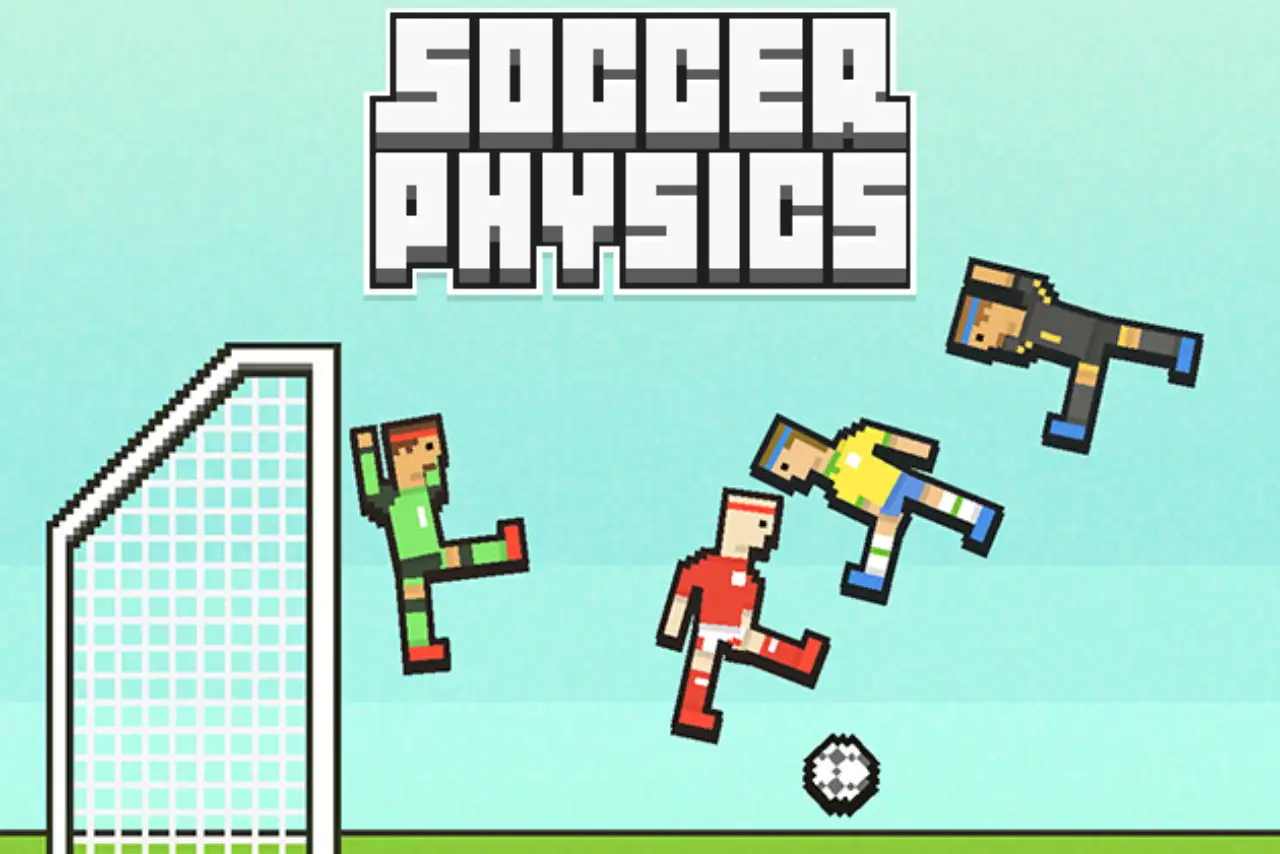




Soccer Physics is a one-button 2v2 arcade soccer game developed by Finnish indie developer Otto-Ville Ojala, originally released in 2014. It won the IMGA Best Multiplayer Game award and was played by PewDiePie, who described the controls as having “a very, very complex control scheme” — sarcastically, because there is one button. The game is built in Unity and runs free in browser on itch.io alongside downloads for Windows, Linux, and Android. The iOS version was permanently removed from the App Store in May 2017 when the developer left iOS development — it is no longer available there.
Contents
Controls
| One-Button Mode | Two-Button Mode (4P) | |
|---|---|---|
| Blue team | Up Arrow | Left Arrow + Right Arrow (one key per player) |
| Red team | W | A + D (one key per player) |
In one-button mode, a single key controls both players on your team simultaneously — one press makes both characters jump and kick at the same time. You never control them individually. This is not a limitation; it’s the entire design. Positioning matters more than timing — where your two players are standing before you press determines what happens, not the press itself. On mobile, one large tap button sits on each side of the screen, one per team. Two-button mode splits the team: each of the four players gets their own key, turning this into a four-player game on one device.
Random Variations
What most competitor guides miss: the variation changes after every single goal, not between matches. Each time someone scores, the game randomly applies a new condition for the next point. Confirmed variations include:
| Variation | What changes |
|---|---|
| Slippery floor | Players slide on contact with the ground — sharp direction changes don’t work |
| Acrobatic movement | Players flip and rotate more aggressively on each press |
| Small goals | Goal mouths shrink — the same shot that scored previously may now miss |
| Beach ball | The soccer ball is replaced by a larger, bouncier ball with different physics |
| Random outfits and hair | Visual only — no gameplay effect, but part of the chaos aesthetic |
Because the variation is random and changes every goal, no strategy carries cleanly from one point to the next. Muscle memory developed on a normal ball is immediately irrelevant once the beach ball appears. The game is explicitly designed so that adapting to what’s in front of you is the skill, not mastering a fixed system.
Modes
| Mode | Details |
|---|---|
| 1 Player | You vs CPU. Same one-button scheme. CPU plays the same physics — it’s not scripted. |
| 2 Player (local) | Two people on the same device. One-button mode. First to 5 goals wins. |
| 4 Player (two-button mode) | Four people on one device. Each player gets one key. Requires enabling two-button mode first. |
| Endless mode | No win condition — play continues indefinitely. Available as a separate mode option. |
First to 5 goals wins in all standard modes. The match is short by design — the developer describes it as “a few minutes” average session. In the iOS version, replays could be recorded and shared; this feature is not available in the browser or desktop versions.
Tips
▸ Let the ball drift to your players before pressing
Pressing when the ball is on the other side of the field makes your players jump in empty space. The most effective presses happen when the ball is already near your players’ side — patience with the button produces better contact than constant tapping. This is the closest thing to a skill gap in a game designed to remove skill gaps.
▸ Short taps and held presses produce different jumps
A brief tap creates a small hop. Holding the button slightly longer produces a larger forward leap. Against a ball rolling fast toward your goal, a short tap deflects it upward; a held press sends your player diving forward. Neither is always correct — it depends on the ball’s current speed and angle, which is why awareness of the ball matters.
▸ Don’t press while a variation change is loading
After a goal, the variation resets and players briefly reposition. Pressing during this transition produces an unintended jump that may move your players away from their starting defensive position. Wait until the new variation is visible and players are set before engaging.
▸ In four-player mode, one player defends
With two people per team, the instinct is to rush the ball together. This leaves the goal open. Designate one player to stay near the goal and press only to deflect incoming shots, while the other applies pressure. It’s the only coordination-based tactic the two-button mode enables.
▸ On slippery floor, press less frequently
The slippery variation makes players slide after every press. Over-pressing sends both characters into the walls repeatedly. One well-timed press near the ball on slippery floor is more effective than three rapid presses that send your team sliding away from it.