





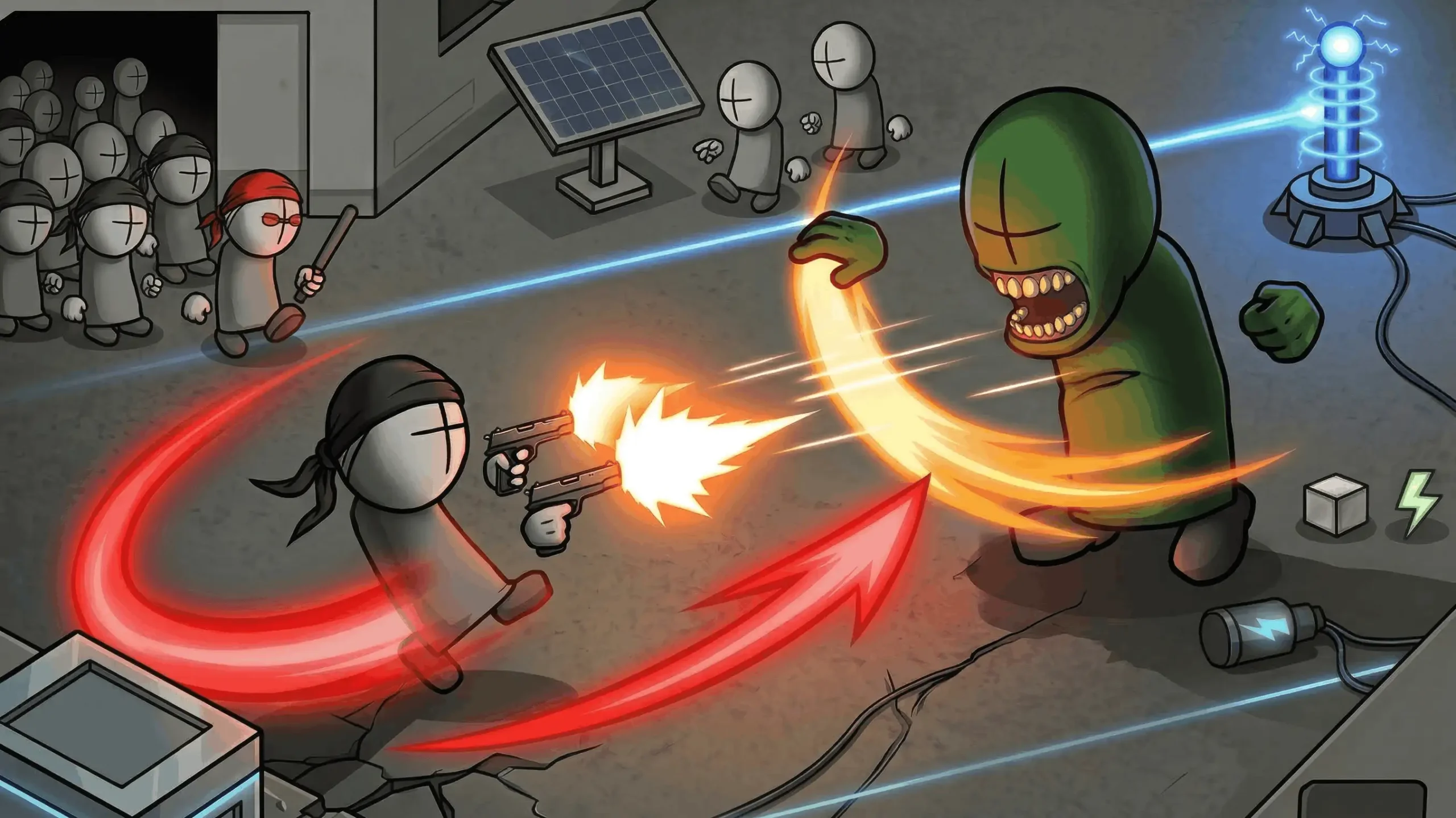
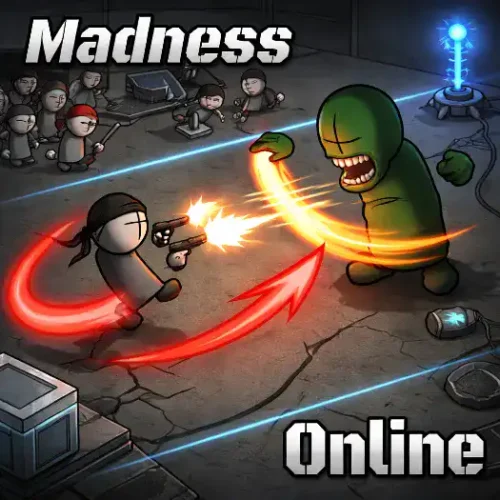






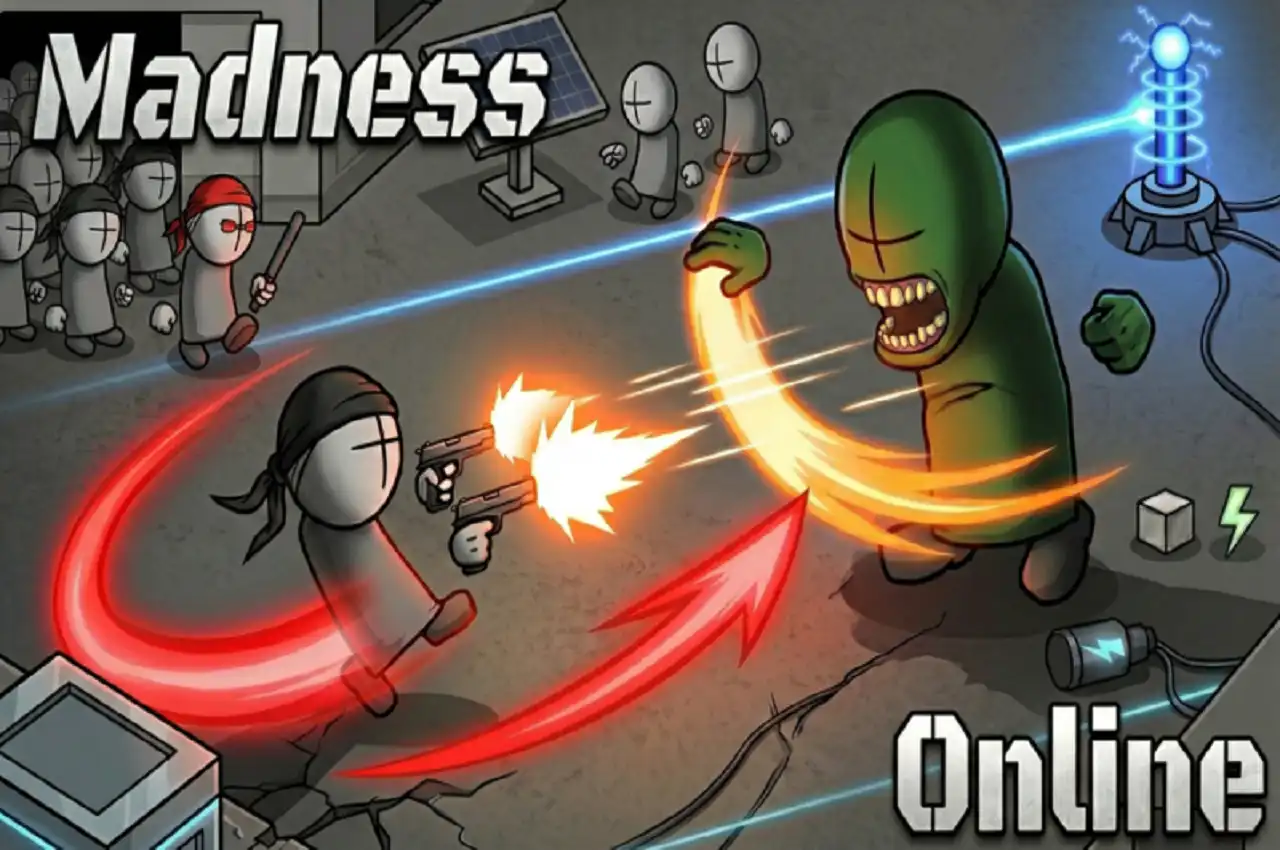
You spawn into a procedurally generated wasteland with nothing. Gather resources, craft weapons and gear, build a fortified base, and survive against zombie hordes and hostile players — alone or with friends.
Madness Online is a 2D top-down multiplayer survival shooter developed by Madguy777 (also credited as Madguyqq on itch.io), inspired visually and tonally by the Madness Combat animation series. Released in March 2026, built in HTML5. Free to play in browser, desktop only — no download required, requires an active internet connection.
| Feature | Details |
|---|---|
| Developer | Madguy777 / Madguyqq |
| Released | March 2026 |
| Technology | HTML5 |
| World | Procedurally generated, infinite — no two runs are the same |
| Core systems | Gunplay, dodge mechanics, crafting, base-building, inventory/backpack |
| Enemies | Zombies and hostile human survivors — AI grows more aggressive and numerous over time |
| Multiplayer | Solo or co-op — players can split roles (defending base vs. scavenging) |
| Platform | Browser, desktop only — free, no download |
Contents
- Controls
- The Survival Loop
- Noise — Guns vs Melee
- Base Placement and Building
- Playing With Friends
- Tips
- FAQ
Controls
| Action | Input |
|---|---|
| Move | WASD |
| Aim / Shoot | Mouse |
| Dodge | Spacebar |
| Reload | R |
| Switch Weapon | Q |
| Interact | E |
| Inventory | B |
| Pause | M |
| Chat | Enter |
| Dance | G |
The dodge mechanic (Spacebar) is core to survival rather than a flourish — confirmed by ikarigames.com as one of the “dynamic dodging mechanics to avoid enemy attacks.” Combined with constant aiming via mouse, the controls support the same fast-twitch combat the Madness Combat series is known for, adapted into a top-down survival format with reload and inventory management layered on top.
The Survival Loop
Every run starts the same way: you’re dropped into a procedurally generated world with nothing. The early phase is exploration — collecting materials from the environment, securing basic gear, and identifying nearby threats before they identify you. From there, the loop branches into three interconnected systems:
- Crafting — gathered materials become weapons and equipment. Confirmed weapon range includes “rapid-fire SMGs to devastating heavy artillery.”
- Base-building — fortify a location to defend against the escalating AI. The base is both a safe zone and a strategic anchor for the run.
- Backpack management — confirmed as a “tactical backpack system” where deciding what to carry and what to leave behind matters. A full backpack slows you down and makes you a bigger loss if you die.
The enemy AI becomes more aggressive and numerous over time — confirmed directly by Miniplay. This means the loop isn’t static: a base and loadout that worked fine in the first ten minutes of a run will be tested harder as the session continues. Early preparation directly determines how long you can sustain the later pressure.
Noise — Guns vs Melee
One mechanic confirmed directly by Miniplay’s official tips section, and largely absent from other guides: gunfire attracts more enemies than melee combat does. The exact quote: “The noise of gunfire will attract more enemies than you can sometimes handle.” Miniplay’s tip explicitly recommends crafting a powerful melee weapon or a silent option when possible.
This creates a genuine tradeoff. Guns are confirmed to range from SMGs to heavy artillery and are clearly more effective per-hit than melee. But every gunshot is also a beacon. In open exploration or when scavenging near your base, a melee weapon or silenced option keeps your position hidden — guns are better reserved for moments when the fight is already happening and stealth no longer matters.
Base Placement and Building
Miniplay’s confirmed tip on base location: build close to sources of basic materials. The reasoning is direct — walking long distances back to base with a full backpack makes you an easy target. A base placed far from resource clusters means every supply run is a vulnerable round trip; a base placed adjacent to materials minimizes that exposure window.
“Before building a mansion” — Miniplay’s phrasing implies that overbuilding early, before securing a resource-adjacent location, is a common mistake. Location comes before scale. A small, well-placed base near materials is more defensible in practice than a large base that requires long, exposed supply routes.
Playing With Friends
Madness Online supports co-op play where players divide tasks — confirmed by Miniplay: “Play with friends to divide tasks, while some defend the base, others search for supplies.” This division of labor directly addresses the core risk of solo play: a solo player has to choose between defending their base and gathering resources, and can’t do both simultaneously. A coordinated group can run both operations in parallel, which is a significant structural advantage as the AI escalates.
Tips
▸ Pick your base location before you build anything substantial
The official tip is explicit: proximity to basic materials matters more than the base’s defensive features in the early game. Spend the first few minutes of a run scouting for a resource-dense area before committing to a build location. A strong base in the wrong place is still a liability if every resupply trip crosses open, dangerous terrain.
▸ Default to melee or silenced weapons when not actively in a fight
Gunfire is a confirmed enemy magnet. If you’re scavenging, traveling, or doing anything other than actively defending against a wave, avoid firing guns unless necessary. Save loud weapons for moments when stealth has already failed and the priority shifts entirely to survival in that fight.
▸ Manage your backpack — don’t carry everything you find
The confirmed “tactical backpack system” means inventory space and weight matter. Carrying excess materials you don’t immediately need increases your loss if you die and may slow you down in a chase. Drop or store items at base regularly rather than hoarding everything in your active inventory.
▸ Use the dodge (Spacebar) proactively, not as a panic button
Dodge mechanics in fast top-down shooters are most effective when used to read incoming attacks rather than react after taking damage. Watching enemy wind-up and dodging before the hit connects preserves health that becomes increasingly important as AI aggression scales up later in a run.
▸ If playing solo, prioritize a defensible loop over a large base
Without a co-op partner to split duties, a solo player needs a base that’s quick to return to and quick to defend — not necessarily large. A small, well-placed, well-defended position that you can reach quickly from nearby resources beats a sprawling base you can’t adequately patrol or retreat to under pressure.