














Retro Rush
What Is Retro Rush?
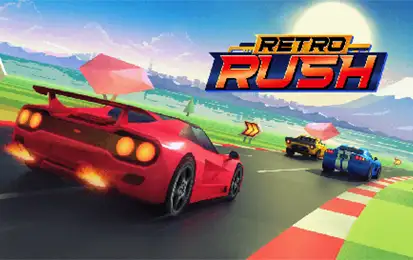
Retro Rush is a free arcade highway racing game that puts you into fast, clean, traffic-heavy races across a world tour of global tracks. You start at the back of a 20-car pack and work your way to the front, weaving through traffic, collecting fuel pickups to stay in the race, and finishing high enough to unlock new cars and faster challenges.
The game draws directly from the spirit of classic 1980s and 1990s arcade highway racers — the same genre that inspired modern throwbacks like Horizon Chase Turbo. No simulation, no damage physics, no pit stops. Pure forward momentum, clear visuals, and the specific satisfaction of threading through a wall of traffic at speed and coming out the other side in first place.
No download, no account. Plays in any browser on desktop, tablet, and mobile.
The Arcade Racing Formula — Why It Still Works
Classic arcade racers stripped everything down to the essentials: steer, accelerate, avoid traffic, go faster. No qualifying laps, no tyre compounds, no weight transfer physics. The game communicates visually and asks for clean, quick reactions.
Retro Rush operates on exactly this principle. Every race begins with a pack of 20 cars and a clear objective — get to the front. The traffic ahead is both the obstacle and the puzzle. A clear lane opens for one second. A fast car cuts in from the side. Fuel pickups are scattered through the field and collecting them is not optional — missing them ends the race regardless of position.
The result is a game that demands a specific kind of attention: wide-field vision that reads three or four cars ahead, not just the one directly in front.
Controls
| Input | Action |
|---|---|
| ← → Arrow Keys | Steer left and right through traffic |
| Nitro | Trigger a speed burst on straight sections |
| Touch / swipe (mobile) | Swipe or tap to steer and activate nitro |
The Fuel Mechanic — The Race Within the Race
Running out of fuel ends your race immediately — not with a slowdown, not with a warning lap, but instantly. Fuel pickups appear on the road throughout each race and must be collected actively by steering your car over them.
This creates a secondary challenge running parallel to the position chase. The fuel pickup may be in the far left lane when traffic is clustered center-right, meaning collecting it requires a lane change that costs position. Skipping it risks running dry two corners later. Committing to it at the wrong moment puts you behind cars you had just passed.
Managing both objectives simultaneously — maintaining position while routing to fuel pickups — is what separates consistent race finishers from players who either run dry or finish last while keeping their tank full.
The most efficient fuel collection happens when you are already moving laterally to pass a slower car. A lane change to overtake that also collects a fuel pickup on the same trajectory costs nothing extra. A dedicated lane change purely for fuel while sitting in a clean position costs the time and gap you just built. Plan overtakes that pass through fuel pickup positions rather than treating fuel as a separate task.
The World Tour — 30 Tracks Across Global Landscapes
The World Tour mode is the game’s progression spine. Tracks are organised by location and unlock sequentially as you finish events in the current region. Finishing events in top positions earns the points that open the next set of tracks.
The environments change meaningfully as the tour progresses. Desert highways have long straight sections that favour nitro usage. Volcanic ash fields introduce reduced visibility sections. Rainy city circuits narrow the effective lane width and punish aggressive weaving. Each environment is not just a visual backdrop — it changes the pace and approach the track rewards.
Cars and Upgrades
Seven cars are available, unlocking as you progress through the World Tour. Later cars have higher top speeds and better nitro characteristics, but the starting car is competitive on early tracks — the unlock progression is paced so that you are not punished for playing the opening races with the default vehicle.
Two upgrade types improve your current car between events:
- Exhaust upgrade — increases base top speed. The most consistently useful upgrade because it affects every race on every track regardless of traffic conditions or nitro management.
- Nitro capacity upgrade — extends the duration of each nitro burst. More valuable on tracks with long straight sections where nitro can be sustained for several seconds. Less impactful on tighter city circuits where straight sections are short.
Tips for Finishing in Top Positions
- Start near the center and read the field before committing to a lane. The opening of each race is the most chaotic moment — 20 cars in a compressed space all trying to find position simultaneously. The center lane provides escape options in both directions during this initial compression rather than boxing you into one side.
- Read three cars ahead, not one. Reacting to the car directly in front leaves no time to adjust before contact. Watching the cluster three to four positions ahead gives enough lead time to see a lane opening developing before it arrives and position for it before it closes.
- Treat fuel pickup routing as part of every overtake plan. When planning a pass on the car ahead, check if the overtake path passes through a fuel pickup. If it does, the overtake is higher priority than it would otherwise be. If a fuel pickup is in an inconvenient position, plan two moves ahead so it falls on a natural trajectory rather than requiring a dedicated detour.
- On the final lap, nitro saves are worth deploying. Nitro saved for the final stretch of the last lap — rather than used earlier in the race — often produces the cleanest position gains because the field is more spread out and the straight ahead to the finish has less lateral interference than mid-race traffic.
Similar Games You Will Like
Frequently Asked Questions
Retro Rush delivers the arcade highway racing experience cleanly and without fuss. The fuel management mechanic elevates it above pure traffic-dodging by introducing a second objective that interacts with every positioning decision in the race. The World Tour structure gives it long-term progression direction.