
Pokémon Type Chart: The Complete Guide to Type Effectiveness
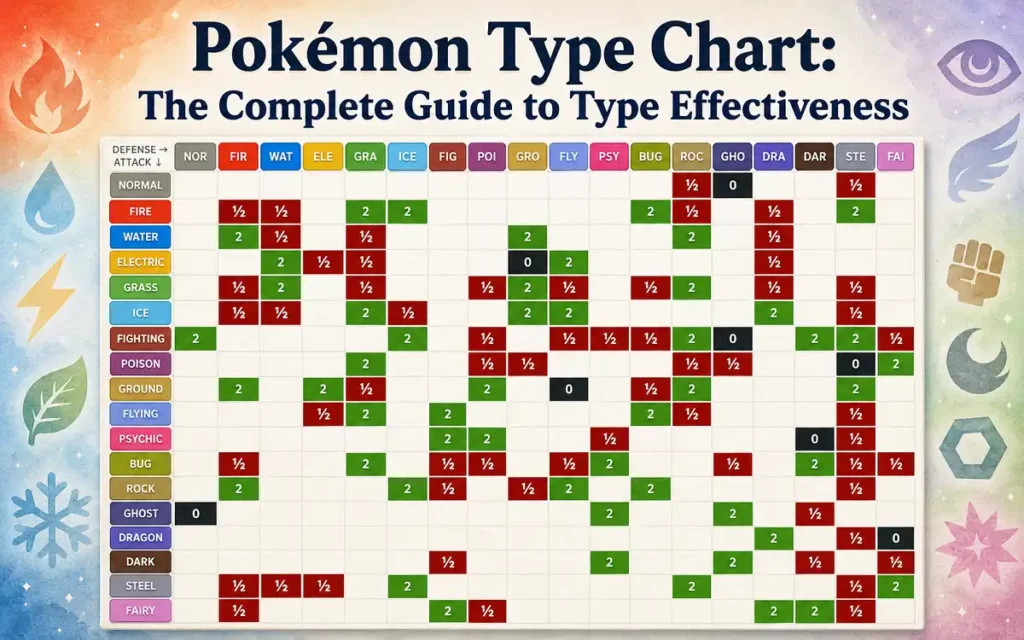
The complete Pokémon type chart for all 18 types. Every weakness, resistance, and immunity explained, with dual-type math and STAB mechanics. Every Pokémon battle, from your very first Gym fight to the highest levels of competitive play, comes down to one core system: type effectiveness. Knowing that Water beats Fire is easy. Knowing that a Fire/Flying Pokémon takes quadruple damage from a single Rock-type move is what separates a casual player from someone who wins consistently. This guide covers the complete, current 18-type chart, exactly how to read it, the math behind dual-typing, and a breakdown of every individual type — everything you need in one place.
The Complete Pokémon Type Chart
This chart has been stable since Generation 6 (2013) and applies to every current mainline game, including Scarlet & Violet, Legends: Z-A, and Pokémon GO (with one small exception for GO’s damage multipliers, covered further down). Find the attacking type down the left-hand column, then read across to see its effectiveness against each defending type.
| Attacker ↓ / Defender → | Nor | Fir | Wat | Ele | Gra | Ice | Fig | Poi | Gro | Fly | Psy | Bug | Roc | Gho | Dra | Dar | Ste | Fai |
|---|---|---|---|---|---|---|---|---|---|---|---|---|---|---|---|---|---|---|
| Normal | — | — | — | — | — | — | — | — | — | — | — | — | ½ | 0 | — | — | ½ | — |
| Fire | — | ½ | ½ | — | 2 | 2 | — | — | — | — | — | 2 | ½ | — | ½ | — | 2 | — |
| Water | — | 2 | ½ | — | ½ | — | — | — | 2 | — | — | — | 2 | — | ½ | — | — | — |
| Electric | — | — | 2 | ½ | ½ | — | — | — | 0 | 2 | — | — | — | — | ½ | — | — | — |
| Grass | — | ½ | 2 | — | ½ | — | — | ½ | 2 | ½ | — | ½ | 2 | — | ½ | — | ½ | — |
| Ice | — | ½ | ½ | — | 2 | ½ | — | — | 2 | 2 | — | — | — | — | 2 | — | ½ | — |
| Fighting | 2 | — | — | — | — | 2 | — | ½ | — | ½ | ½ | ½ | 2 | 0 | — | 2 | 2 | ½ |
| Poison | — | — | — | — | 2 | — | — | ½ | ½ | — | — | — | ½ | ½ | — | — | 0 | 2 |
| Ground | — | 2 | — | 2 | ½ | — | — | 2 | — | 0 | — | ½ | 2 | — | — | — | 2 | — |
| Flying | — | — | — | ½ | 2 | — | 2 | — | — | — | — | 2 | ½ | — | — | — | ½ | — |
| Psychic | — | — | — | — | — | — | 2 | 2 | — | — | ½ | — | — | — | — | 0 | ½ | — |
| Bug | — | ½ | — | — | 2 | — | ½ | ½ | — | ½ | 2 | — | — | ½ | — | 2 | ½ | ½ |
| Rock | — | 2 | — | — | — | 2 | ½ | — | ½ | 2 | — | 2 | — | — | — | — | ½ | — |
| Ghost | 0 | — | — | — | — | — | — | — | — | — | 2 | — | — | 2 | — | ½ | — | — |
| Dragon | — | — | — | — | — | — | — | — | — | — | — | — | — | — | 2 | — | ½ | 0 |
| Dark | — | — | — | — | — | — | ½ | — | — | — | 2 | — | — | 2 | — | ½ | — | ½ |
| Steel | — | ½ | ½ | ½ | — | 2 | — | — | — | — | — | — | 2 | — | — | — | ½ | 2 |
| Fairy | — | ½ | — | — | — | — | 2 | ½ | — | — | — | — | — | — | 2 | 2 | ½ | — |
Legend: 2 = Super effective (2× damage) ½ = Not very effective (0.5× damage) 0 = No effect (immune) — = Normal damage (1×)
How to Read the Chart and Calculate Damage
The chart works from the attacker’s perspective. Find your attacking move’s type in the left-hand column, then move across to the column matching your target’s type. The number in that cell tells you the damage multiplier:
- 2× (Super effective) — the game shows “It’s super effective!” and the move deals double damage.
- 0.5× (Not very effective) — the game shows “It’s not very effective…” and the move deals half damage.
- 0× (No effect) — the move deals no damage at all, regardless of power. There are exactly 8 of these immunities on the current chart.
- 1× (Normal) — no bonus or penalty; this is the outcome for the vast majority (204 out of 324) of type matchups.
Dual-Type Math: Multiplying Effectiveness
Most Pokémon have two types, and this is where the chart gets genuinely interesting. When a Pokémon has two types, you multiply the effectiveness values together rather than just picking one:
- Two weaknesses stack to 4× damage. A Fire/Flying Pokémon like Charizard takes 4× damage from Rock-type moves, because Rock is super effective against both Fire (2×) and Flying (2×), and 2 × 2 = 4.
- A weakness and a resistance cancel out to 1× (normal) damage. If a type is weak to one of a Pokémon’s types but resisted by the other, the two multipliers (2× and 0.5×) cancel to a completely neutral 1×.
- Two resistances stack to 0.25× damage. This is what makes certain dual-type Pokémon exceptionally tanky against specific move types.
- An immunity always wins. If either of a Pokémon’s types is immune to the attacking move, the Pokémon takes zero damage, no matter what its other type would suggest.
STAB: Same-Type Attack Bonus
On top of type effectiveness, there’s a second multiplier worth knowing: Same-Type Attack Bonus, or STAB. When a Pokémon uses a move that matches one of its own types, that move gets an extra 1.5× damage multiplier. This stacks with type effectiveness rather than replacing it. A Water-type Pokémon using a Water-type move against a Ground/Rock-type target — which is weak to Water twice over — would deal 2 × 2 × 1.5 = 6× damage, making STAB one of the most powerful tools in team building and move selection.
Quick Reference: Every Type’s Strengths and Weaknesses
| Type | Strong Against | Weak To | Immune To |
|---|---|---|---|
| Normal | — | Fighting | Ghost |
| Fire | Grass, Ice, Bug, Steel | Water, Ground, Rock | — |
| Water | Fire, Ground, Rock | Electric, Grass | — |
| Electric | Water, Flying | Ground | — |
| Grass | Water, Ground, Rock | Fire, Ice, Poison, Flying, Bug | — |
| Ice | Grass, Ground, Flying, Dragon | Fire, Fighting, Rock, Steel | — |
| Fighting | Normal, Ice, Rock, Dark, Steel | Flying, Psychic, Fairy | — |
| Poison | Grass, Fairy | Ground, Psychic | — |
| Ground | Fire, Electric, Poison, Rock, Steel | Water, Grass, Ice | Electric |
| Flying | Grass, Fighting, Bug | Electric, Ice, Rock | Ground |
| Psychic | Fighting, Poison | Bug, Ghost, Dark | — |
| Bug | Grass, Psychic, Dark | Fire, Flying, Rock | — |
| Rock | Fire, Ice, Flying, Bug | Water, Grass, Fighting, Ground, Steel | — |
| Ghost | Psychic, Ghost | Ghost, Dark | Normal, Fighting |
| Dragon | Dragon | Ice, Dragon, Fairy | — |
| Dark | Psychic, Ghost | Fighting, Bug, Fairy | Psychic |
| Steel | Ice, Rock, Fairy | Fire, Fighting, Ground | Poison |
| Fairy | Fighting, Dragon, Dark | Poison, Steel | Dragon |
Type-by-Type Breakdown
Normal is the most defensively unremarkable type — no offensive advantages against anything, only two resistances, and a single immunity to Ghost. What it lacks in type synergy it makes up for with some of the highest base HP stats in the game, seen in Pokémon like Snorlax, Blissey, and Chansey.
Fire is a strong offensive type, hitting four different types super effectively, but it’s also weak to three of the most common types players run into: Water, Ground, and Rock.
Water pairs well offensively and defensively, resisting both Fire and its own type while hitting Fire, Ground, and Rock hard — a big part of why Water-types are a reliable pick across nearly every generation.
Electric has a narrower offensive spread than most starter-adjacent types, but its immunity to Ground-type status effects (like Paralysis, in certain contexts) and clean matchup against Water and Flying make it a valuable team piece.
Grass has excellent offensive range against Water, Ground, and Rock, but suffers from the most weaknesses of nearly any type — five in total — making Grass-types a bit fragile despite their utility.
Ice hits four types super effectively, including the always-relevant Dragon type, but is itself resisted by only one type while being weak to four, making it a common glass-cannon pick.
Fighting ties with Ground for the widest offensive coverage in the game, hitting five types super effectively, including the powerful Steel and Dark types.
Poison was the primary check to Grass and Fairy types across the series, though its narrow offensive coverage (only two types) makes it more of a support pick than a primary attacker in modern games.
Ground shares the widest offensive coverage in the game with Fighting, hitting five types super effectively, and its total immunity to Electric-type moves makes it one of the most valuable defensive answers to an entire type.
Flying is naturally immune to Ground — one of the most common attacking types in the game — while hitting Grass, Fighting, and Bug hard, making it a near-universal team addition.
Psychic was historically one of the most dominant types in the franchise (a big reason Dark and Steel were introduced in Generation 2 specifically to check it), and it remains strong against Fighting and Poison.
Bug has the most resisted offensive profile in the game, with seven types resisting its attacks, though it’s still valuable for hitting Psychic and Dark super effectively.
Rock punishes Flying types especially hard, since Flying can’t resist or dodge it defensively, and also hits Fire and Ice — two types with few natural counters — very effectively.
Ghost has one of the most unique defensive profiles in the game: it’s immune to both Normal and Fighting, historically two of the most common attacking types, making Ghost-types excellent defensive pivots.
Dragon is famous for being resisted only by itself and hitting only itself for super effective damage — a rare case of total mirror-matching — though its complete immunity to Fairy (added specifically to check Dragon’s dominance in Generation 6) reshaped competitive play significantly.
Dark was introduced specifically to counter Psychic’s dominance in Generation 2 and remains one of the most valuable defensive types thanks to its immunity to Psychic-type moves.
Steel is widely considered the single best defensive type in the game, resisting a huge number of types (historically even more before Generation 6 removed its Ghost and Dark resistances) and carrying a full immunity to Poison.
Fairy is the newest type, introduced in Generation 6 specifically to balance out Dragon’s dominance. It’s immune to Dragon entirely and super effective against Fighting, Dragon, and Dark, making it one of the strongest additions to the franchise’s type balance.
How the Type Chart Has Changed Over Time
The type chart hasn’t always looked like this. It’s changed twice in the franchise’s history:
- Generation 1 (Red, Blue, Yellow) had only 15 types — no Dark or Steel, and no Fairy. Notably, Ghost-type moves had no effect on Psychic-type Pokémon due to a well-documented programming quirk, even though the games’ own guides claimed otherwise.
- Generation 2 (Gold, Silver, Crystal) introduced Dark and Steel specifically to reduce the dominance of Psychic-type Pokémon, which had been overwhelming in the original games. Ghost and Dark-type moves also became not-very-effective against Steel at this point (rather than neutral, as they are now).
- Generation 6 (X and Y, 2013) introduced Fairy — the 18th and, so far, final type — specifically to check Dragon’s dominance in competitive play. At the same time, Steel lost its resistances to Ghost and Dark, bringing the chart to its current, stable form.
The chart has remained completely unchanged since 2013, applying identically across Sun & Moon, Sword & Shield, Scarlet & Violet, Legends: Z-A, and Pokémon GO’s core damage relationships.
Memorization Tips
- Learn the immunities first. There are only 8 of them across the entire chart, and they’re disproportionately useful to know since they let you completely wall specific attackers: Ghost is immune to Normal and Fighting, Flying is immune to Ground, Fairy is immune to Dragon, Dark is immune to Psychic, Steel is immune to Poison, Ground is immune to Electric, and Normal is immune to Ghost.
- Remember the “classic trio” as a foundation. Fire beats Grass, Grass beats Water, Water beats Fire — this three-way relationship (mirroring the starter Pokémon types in most games) is the easiest entry point before tackling the rest of the chart.
- Group types by real-world logic where it applies. Water puts out Fire, Electricity doesn’t work well through the Ground, Rock and Ice both shatter easily against Fighting-type force — these intuitive connections cover a surprising number of matchups.
- Focus on Fighting and Ground first for offense. Since these two types have the widest super-effective coverage in the game (5 types each), learning their matchups gives you the most practical battle value for the least memorization effort.
- Treat Steel as the defensive benchmark. It’s the type with the most resistances in the game, so understanding exactly what still works against Steel (Fire, Fighting, and Ground) is valuable knowledge on its own.
Frequently Asked Questions
How many Pokémon types are there?
There are 18 types: Normal, Fire, Water, Electric, Grass, Ice, Fighting, Poison, Ground, Flying, Psychic, Bug, Rock, Ghost, Dragon, Dark, Steel, and Fairy.
What is the newest Pokémon type?
Fairy, introduced in Generation 6 (Pokémon X and Y) in 2013. It’s the most recent addition to the type chart, and no new types have been added since.
What type has the most weaknesses?
Grass has five weaknesses (Fire, Ice, Poison, Flying, and Bug), the most of any single type.
What type has the fewest weaknesses?
Several types have just one weakness, but Steel is widely regarded as the strongest overall defensive type thanks to its combination of resistances and a full immunity to Poison.
Does Pokémon GO use the same type chart?
Yes, the underlying type relationships are identical, but Pokémon GO uses different multipliers — roughly 1.6× instead of 2× for a super effective hit — and immunities are treated as double-resistances rather than true zero-damage interactions.
What is STAB?
Same-Type Attack Bonus. When a Pokémon uses a move matching one of its own types, that move gets an extra 1.5× damage multiplier, stacking with type effectiveness.
Can a Pokémon take 4× damage from a single move?
Yes. If both of a dual-type Pokémon’s types are weak to the same attacking type, the two 2× multipliers combine into 4× damage.
Has the type chart changed recently?
No. It has remained completely unchanged since Generation 6 in 2013, and applies identically across all current games including Scarlet & Violet and Legends: Z-A.
BlogPokémon Type Chart
Saqib Javaid
Saqib Javaid is a developer and the founder of Basketball Games Hub, built out of frustration with laggy, ad-choked, login-required browser games. He personally tests every game on the site before it's added, and writes the guides himself so players actually know how to play what they click on.